Intel defends its data center territory vs. ARM with C2000 Atom

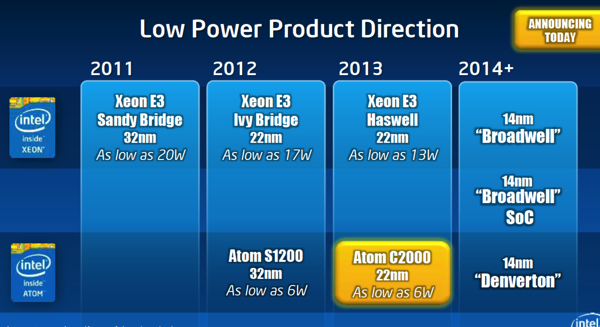
Intel announced last week the Intel ARM C2000 at 6W
NewImage

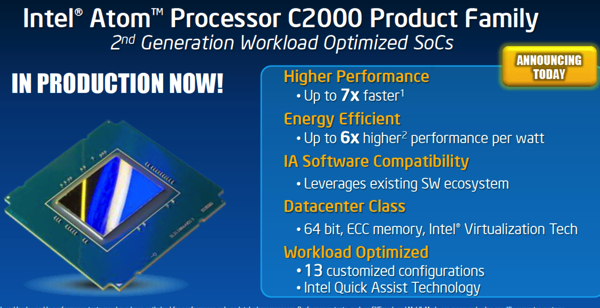
The ARM processor was claimed to be more efficient.  And now the C2000 is 6x performance per watt
NewImage

Barrons blog has a post on the business impact of the Intel Atom.  Here are the two analyst views.

Doug Freedman of RBC Capital Markets reiterated an Outperform rating and a $29 price target on the shares, writing, “INTC’s new Atom low-power C2000, successor to S1200, is a very compelling offering in that it not only offers up to 6x performance/ watt (vs. S1200), but will enable newer markets leveraging prior SoC efforts in mobile (smartphone/tablet).

Thus INTC stands to pick-up ground in new markets with attractive ROI on more customized solutions [...] Performance vs. select S1200 parts are expected to be up to 7x faster, offering up to 6x higher performance per watt. The product is expected to be a best-in-class solution vs. competitive ARM solutions in the marketplace [...] We were encouraged to hear that the gross margin impact is expected to be “a wash”. To us, this implies that the margins are at least comparable to performance-based parts, and potentially better due to 22nm and cost efficiencies realized as a result of leveraging mobile resources.”

From the bear camp, Hans Mosesmann of Raymond James, reiterating an Underperform rating, wrote that “Intel introduced today an impressive number of Atom-based processor, switch, memory, and optical connectivity products/technologies for the datacenter in a move that highlights, in our view, Intel’s sense of urgency to defend its server processor supremacy.”

It is hard to fathom Intel making this big of a splash had ARM not released its 64-bit v8 architecture (for licensing) nearly two years ago with the subsequent strong design interest. Intel was at pains to explain that microservers, as a category, are small but the opportunity for adjacent markets is big. Translation: we are worried about the ARM threat and are willing to cannibalize existing low-end, highly profitable XEONs to make sure this does not happen.”

Steve Jobs never wrote code, who cares? his code would have probably sucked

Some things that get written up are random things that aren't an issue.  For example?  Steve Jobs didn't write code covered in Business Insider.

Steve Jobs Never Wrote Computer Code For Apple

Publicly answering an email over at his site, Apple co-founder Steve Wozniak goes into a few details on Steve Jobs's technical background.

"Steve didn't ever code," writes Wozniak. "He wasn't an engineer and he didn't do any original design, but he was technical enough to alter and change and add to other designs."

Why does the visionary CEO need to write code? To inspire the coders to write better code?  

Introvert-Friendly Career - Computer Programmer

Spending time alone with a computer could be a dream come true for any introverted techie. For them, life as a computer programmer might sound like a dream that could also pay the rent.

"From my understanding, computer programmers work by themselves, in the world of ideas," Anthony says. "That's more on the introverted side because introverts are more comfortable alone and like working on their own."


Apple products work because there is a huge amount of effort to hide the technical issues and just make things work.  Who cares if the code is beautiful if it doesn't solve an end user problem.

BTW the article got the introverted and extroverted pictures switched.  Here is the extrovert post.

Extrovert-Friendly Career - Computer Support Specialist

If you're a computer geek - sorry, computer aficionado - who isn't afraid of terms like face time and small talk, you might be hard-wired for a computer support specialist career.

"I think as a computer support specialist you have to feel comfortable interacting with people, unlike a computer programmer where you'll be working alone for long periods," Anthony says. "You'll want to make sure people are at ease so you can get information about their computer problems and then be effective in solving them."

What DCIM could have done if it was designed as a platform, Network Optimization

DCIM has not taken off the way the analyst and VCs would like.  What is wrong?  The niche of data centers and money saved is not big enough.  If DCIM was designed well it should be able to optimize other mission critical operations.  Like what?  How about mobile network optimization.

Here is a GigaOm post on Mobile network optimization.

The mobile network optimization business is not a bad one to be if you’re a tech startup looking for a big exit. Telecom billing systems maker Amdocs justannounced its intention to buy Actix for $120 million in cash. But it’s certainly not the first nine-figure selling price for a software company analyzing and tweaking traffic in mobile networks.

Actix tracks the how individual cells perform as devices connect to them throughout the day, letting carriers know where they need to add coverage and capacity as well as which apps and devices are performing well and which are not. That may not sound sexy to you, but that technology is really turning on the big telecom infrastructure vendors, who have been scooping up optimization companies left and right in the last year.

It is a dream of the DCIM world to be in the situation like the networking optimization companies.

So are there any network optimization startups left still ripe for the picking? There are plenty of companies who optimize some aspect of the mobile network — from the core to the base station — but it’s at the cell where most of the mobile industry’s interest seems to lie. One of the reasons why Intucell went for a high price is because its technology could react to changing networking conditions – when service in a particular part of the network starts sucking, its self-optimizing networking software can expand and contract cells to rectify the problem.

It is hard to get in one company to get the networking guys to work with the data center team, and it's probably even harder to get this done in a start-up which is probably why there is little overlap between the networking optimization software companies and DCIM.  Yet, at a low level they are doing many of the same things monitoring operations, optimizing, and reporting status in a dashboard.

Disclosure:  I work part-time for GigaOm Research.

One Theory on what would explain the unexpected retirement of Microsoft CEO Steve Ballmer

It is mystery why Steve Ballmer decided to retire earlier than expected.  Talking to a friend he had an interesting theory that seems plausible to explain the event.

First let's take a time sequence of facts.

1. Steve Ballmer announces the One Microsoft Strategy on July 11, 2013.

2. On Aug, 23, 2013 Microsoft announces Steve Ballmer will retire within 12 months.

3. On Sept 2, 2013 Microsoft announces its acquisition of Nokia Devices and Services.

4. After the Nokia acquisition announcement the story is out that Microsoft has been negotiating with Nokia since Jan 2013.

I just posted about John Sculley discussing the role the Apple Board had in firing Steve Jobs.  When you read about the Microsoft acquisition of Nokia devices, there is no mention of the Microsoft Board approving the deal.  It would seem like the Microsoft Board would approve the deal.

What happened between July 11 (Microsoft announces reorg) and Aug 23 (Steve Ballmer Retires)?  The Nokia negotiations had been going on for 8 months could they have had an affect on Steve Ballmer's retirement?

This graphic has been used to describe how Tech companies are organized.  Could there have been someone who held a gun to the Microsoft Board to get them to push for Steve Ballmer's retirement?

NewImage

Here is an interesting idea that one friend threw out.  What if Steve Elop who left Microsoft in 2010, put on the table with the Microsoft Board he wouldn't bring his Nokia team to Microsoft unless Ballmer was not the CEO.  The Board faced with the situation of investing in Mobile with a Nokia acquisition or keeping Steve Ballmer as CEO for 4 more years realized they needed Nokia's mobile expertise more than Ballmer.  At the same time this was going on, Ballmer was selling the Nokia acquisition as a strategic move Microsoft could not miss and he had a good deal on the table.  

There is no data I know of to support this idea. The above is a "thought experiment" on what could explain the surprise Steve Ballmer retirement announcement. I first heard this idea yesterday and it seemed worth throwing out there.

We'll see if the story comes out what happened at the Microsoft Board level for why Steve Ballmer was retired (or fired).  It took 26 years for John Sculley to tell the story of the Apple Board's role in removing Steve Jobs.  So, it may a long, long time before the story is told on why Steve Ballmer retired early.

John Sculley tells the rest of the story, How Steve Jobs was fired

I was at Apple from 1985 - 1992, and didn't have a meeting with Steve Jobs or John Sculley during that time.  I did meet with John Sculley in 1996 when I had my job at Microsoft and we discussed publishing technologies.  I still can't remember why or how I got a meeting with John Sculley.  Must have been at time when working for Microsoft meant a lot or maybe my job was a bigger deal than I thought.  Too long ago.  Can't remember. :-)

Forbes just posted a presentation where John Sculley provided a retrospective of what led to Steve Jobs leaving Apple.

John Sculley Just Gave His Most Detailed Account Ever Of How Steve Jobs Got Fired From Apple

After years of silence, former AppleAAPL +1.61% CEO John Sculley has recently been moving more into retrospective mode.  On Thursday, Sculley gave perhaps his fullest public account ever of the circumstances surrounding Apple’s firing of Steve Jobs, spending eight extemporaneous and uninterrupted minutes on the most infamous human resource decision in business history.


The video is here.


The video can be seen here:

This article provides the rest of the story of what happened in the Apple Board room.

What happened in the Microsoft Board room when Steve Ballmer was asked to retire?  There is no way a Microsoft board members is going to talk to the press. Not unless they want to chance giving up their board seat.

The one area I would disagree with John Sculley is where John says the problem with the original Mac was Moore's Law and processor was not powerful enough.  The Mac Plus which came out 2 years later had the same processor, but 1MB instead of 128K, SCSI, and dual sided floppies which gave the IO speed and capacity to do more serious work.  The processor was not the problem.  But, John may be referring to when the Mac II shipped with a 68020 is when the money really started coming in.  My time on the Mac II was some of the funnest times.