Polar opposites, Kindle Paperwhite (easy) vs. Samsung Galaxy Note 3 (hard)

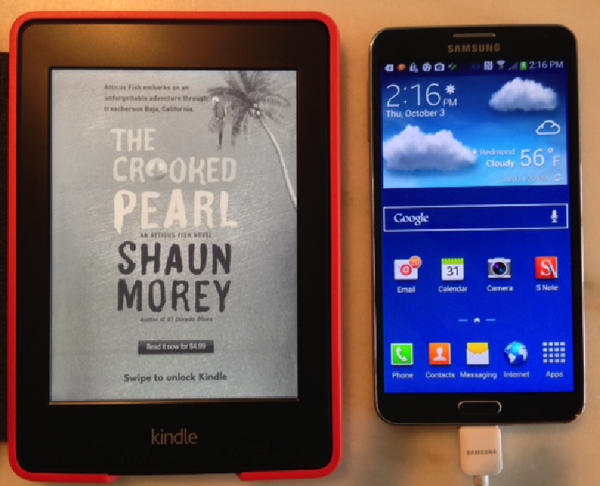
Within 3 hours today I received the 2nd generation Kindle Paperwhite and a Samsung Galaxy Note 3.
NewImage

The screens are almost the same size.

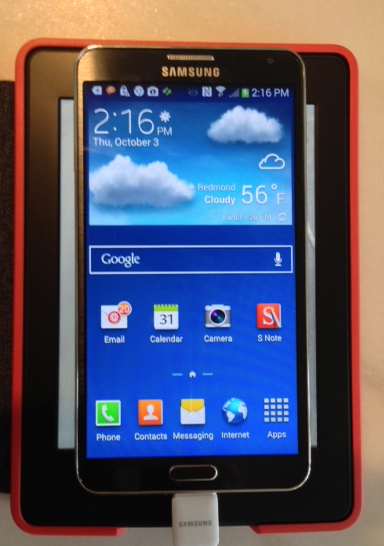
Below, I put the Galaxy Note 3 on top of the Kindle Paperwhite.
NewImage

One of the biggest differences was setup.  Turn on the Kindle Paperwhite.  Connect to my wireless network and the device auto configures.  No logging on.

The Galaxy Note 3.  I need to click on an activation link in my e-mail, enter the IMEI # from the phone and the ICC # from the micro SIM.  Waited an hour for ATT to activate the phone.  Finally works.  

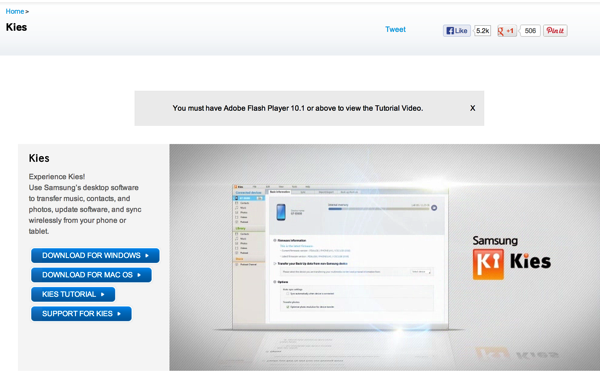
Oh and the Galaxy Note 3 requires Kies 3.0.  you go to http://www.samsung.com/us/kies/ and no version 3.0.  The download is 2.6
NewImage

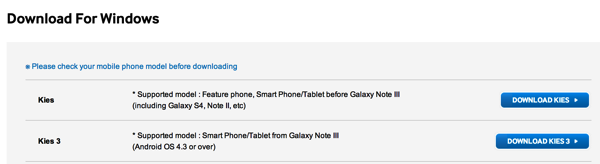
Go to to the UK site. http://www.samsung.com/uk/support/usefulsoftware/KIES/JSP and there is Kies 3.0. Obvious.  Yeh. :-)  I must use version 2.6 with the Galaxy Note 1 and version 3.0 is only for the Galaxy Note 3.  uh huh.  really easy.
NewImage

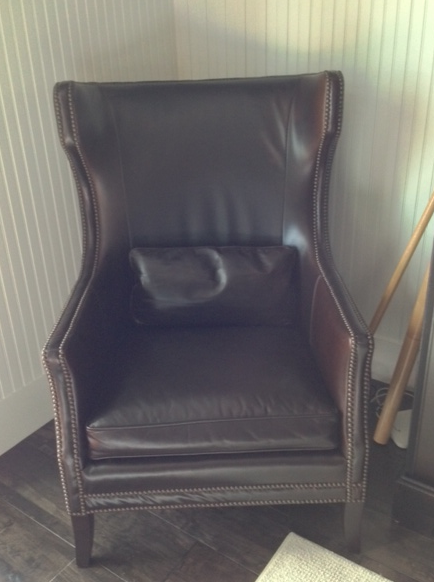
Why would I want a Kindle Paperwhite?  Because when I pick up the Kindle it is my time to read a book with no distractions.  I find it hard to read more than 1/2 hour, sometimes 15 minutes before I feel the urge to check e-mail or browse the web.  When I have the Kindle it is only to read a book in a comfortable chair.
NewImage

So what is the Galaxy Note 3 for?  

1920 x 1280 resolution, quad core 2.3GHz processor, 3 GB of RAM, 96 GB of SSD, pen stylus, bluetooth, wifi - this is compute anywhere with lots of apps.  And I can sit in the same chair in be in work mode.

Also just tested our custom mobile app and it looks perfect at 1920 x 1080.

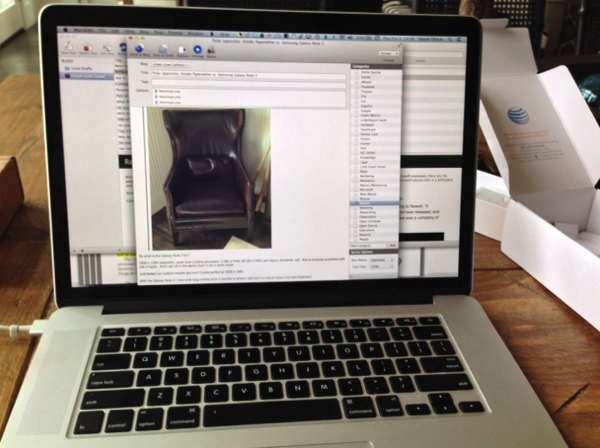
With the Galaxy Note 3 I may write blog entries from it, but this is where I still find it is nice to have a full size keyboard and 2880 x 1800 resolution.
NewImage

Been busy setting up Mobile Devices

I don't know how an everyday person does.  I have been setting up iPhones, moving phone #'s to another IMEI, activating, talking to Apple support, ATT support, cutting a SIM to a micro SIM with a cutter, backing up, restoring.

I wonder if I'll have something interesting to write after a week of getting iPhone 5S, Galaxy Note 3, Kindle Paperwhite.  All these devices are more interesting than a PC/Laptop.  So, glad I stopped working on desktop operating systems in 2002.  :-)

Reflections on a Video Game Maker, Microsoft's 4th Billionaire - Gabe Newell

Microsoft has three billionaires - Bill Gates, Paul Allen, and Steve Ballmer.  Steve Ballmer will soon be leaving day to day operations like Bill and Paul.  Of all the other ex-Microsoft employees there are the wealthy who cashed out - Scott Oki, Charles Simonyi, Nathan Myhrvold, Jim Allchin, Paul Maritz, Mike Maples, and many more millionaires.  There is though one other ex-Microsoft person who is a billionaire, and what is more impressive is he took his Microsoft millions and turned it into over a billion launching another company.

Some may be impressed by the money, but what is more impressive is how Gabe Newell did things different than most.

Gabe is making lots of noise and news lately launching a game platform on Linux.  Gabe knows how to build a game platform as this is what he did at Microsoft 20 years ago.

For 13 years through to the mid-’90s, Gabe Newell was “producer on the first three releases of Windows” at Microsoft. At the time, according to Newell, “it was common wisdom that it wasn’t possible to write a good game in Windows because of, well, unnamed technical reasons.” In 1993 Doom was released, and according to Newell it became the number one most-used program in the entire US, ahead of Windows. When you consider that Id Software was a company of just 12 people, and Microsoft already had hundreds of developers working on Windows, this was quite an achievement.

A young and handsome Gabe Newell, probably from around the mid-'90sNewell was disappointed that this game ran in MS-DOS, rather than Windows, and thus tasked some of his engineers to create a Windows port. According to an interview back in 2007, he then apparently called John Carmack at Id Software to say that Microsoft would do the port for free, and thus the port was eventually released as Doom 95. It is possible that the success of Doom, and Doom 95, showed developers that it was indeed possible to write top-notch games on Windows. It’s also worth noting that WinG, the precursor to DirectX, was maturing at the same time — perhaps it was a combination of factors that finally made Windows the de facto gaming platform.

Here is a video where Gabe reflects on the industry.

Watching the video there are many lessons to be learned.

I have an interest following Gabe.  Gabe was my first interview at Microsoft.  He took one look at my Apple experience and re-routed my whole days of interviews.  Within 5 days I had an offer and joined in Apr 1992.  My life would be quite a bit different if I had stayed at Apple.  I doubt I would have stayed at Apple for as long as I stayed at Microsoft (until 2006).

Apr 4, 2011, Google shifted from analytical data driven to an emotional customer driven design focus

When I left Apple in 1992 for Microsoft I was one of the few Apple employees to move to Microsoft.  Over the years many more Apple employees joined Microsoft, and now many more Microsoft employees have gone to Apple.  

One of the questions many asked when I first joined Microsoft was what is the difference between Apple and Microsoft.  After months of explaining I finally hit upon the following.

Microsoft is an analytical company, doing things that there is data to support the decisions.  What makes people feel good inside the company is having data to support a decision.  Apple is an emotional company where you do things that feel good for the customers.  Usability testing rarely taps into the emotional element of do people like the new service.

This split is a religious one.  Designers on one side.  Developers on the other.  Until April 4, 2011 Google had a shift in the balance and afterwards designers got more votes on what Google shipped.

Here is a post on Fast Company.

How Google Taught Itself Good Design

LONG DOMINANT IN ONLINE SEARCH, ADVERTISING, AND MAPS, GOOGLE HAS SHIFTED GEARS FROM UTILITY TO BEAUTY--AND IS NOW MORE FEARSOME THAN EVER.

...

If you ask a Google designer to mark the shift between Google's old approach to design and its new one, you're likely to get a precise date: April 4, 2011. That's the day Page became CEO. It's also the day Google designers were set free. Within a week of taking over, Page called together the company's top designers, product chiefs, and executives to outline his vision for Google's aesthetic future. Page's ideas meshed with a plan that designers had long thought Google should embrace.

Leading up to 2011 was the reality of 2010 user feedback.

 In 2010, Google conducted a series of user tests to find out how people felt about Android. The results were stark: "A lot of people felt that Android was essential to their lives, but they didn't like Android," Duarte says. The robust abilities of the OS "made them feel small. It wasn't empowering, but daunting." The same could be said for other Google products. When you loaded up something made by Google, you were more likely to feel overwhelmed than welcomed.

How much voice do you give your users?

Do you design for your users or your developers and internal views?

Do you Manage Your Trust?