Will Cars be uber connected? AT&T powers Tesla's Connectivity

At last week’s GigaOm Mobilize AT&T’s Chris Penrose, SVP of Emerging Solutions announced the AT&T deal to be the cell data provider for Tesla.

Tesla turns to AT&T to power its connected car strategy


OCT. 17, 2013 - 11:29 AM PDT

3 Comments

SUMMARY:

At Mobilize 2013, AT&T announced a crucial partnership with Tesla that brings the mobile company into the driver’s dashboard.

This is the start of having the option to your car being uber connected.

In order to take advantage of AT&T’s offerings, the vehicles must be equipped with a modem and a corresponding SIM card to connect to cell towers. With the connection, the car can take advantage of several maintenance, entertainment and safety features. For example, remote engine diagnostics can keep real-time tabs on how the Tesla is performing, and whether it needs to be taken in for servicing. That same program can also help locate a car if it’s stolen, and even offer Tesla engineers access to data on the performance of vehicles over the long term. The modem provides internet access to provide radio services, live weather and traffic, navigation and even internet search for drivers and passengers.

“We think that you should have the ability to turn your car on as a mobile hotspot for your trip, even if you haven’t subscribed to a data plan,” Penrose added.

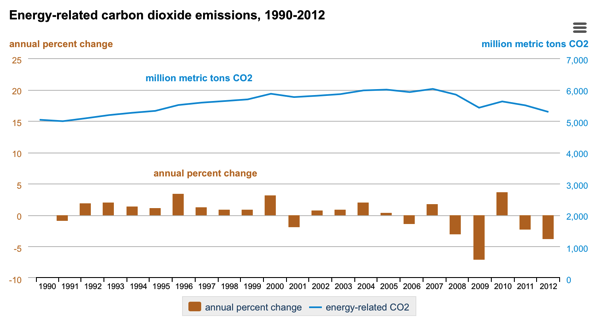
Woohoo!? USA carbon footprint drops to 1994 levels due to natural gas, efficiencies and drop in mfg

Arstechnica reports on USA’s carbon footprint  dropping to 1994 levels.

US carbon emissions hit lowest level since 1994 despite economic growth

Efficiency, drop in manufacturing, and a shift to natural gas all contribute.

Last year, the US saw its lowest carbon emissions since 1994, continuing a downward trend that began in 2008 during the economic crisis. It marks the second year in a row that carbon emissions have dropped despite a growth in gross domestic product. Prior to the last few years, economic growth had been closely tied to increased carbon emissions.

The US Energy Information Administration released the data yesterday after having taken a bit of an unwanted break during the government shutdown. In analyzing the data, it identified a variety of causes for the drop in carbon emissions. As shown above, population size and economic activity both grew last year, which would normally push emissions up. But the energy required for that economic activity dropped, and the carbon intensity of the energy supply dropped as well. Combined, those two factors more than offset the economic growth.

Here is a timeline.

NewImage

There are more cool graphs in the report.  http://www.eia.gov/environment/emissions/carbon/

SSD bubble bursting? Fusion-IO posts lost and executives leaving

NBCNews covers Fusion-IO troubles

The management changes came as Fusion-io reported a loss of $27.9 million, or 28 cents per share, for the quarter that ended Sept. 30. That is compared with earnings of $3.9 million, or 4 cents per share, in the same months last year. After adjusting for acquisition expenses and other special items, it had a loss of 7 cents per share versus earnings of 14 cents per share last year.

Fusion-io's revenue fell to $86.3 million from $118.1 million.

Consumer Reports provides some guidance on using Healthcare.gov (Obamacare), Cookie Mess

Who do you trust trying to use Healthcare.gov (Obamacare).  President Obama's reassurances?  Media covering the efforts?

How about Consumer Reports?  Here is a post they put last week.

Let’s jump to the advice that will get you thinking.

Clear your cookies.

Your next hurdle after creating a functioning user name and password is to reach the identity verification section. If you log in to Healthcare.gov and get nothing but a blank page, what’s likely happening, Simo says, is that in your previous visits to Healthcare.gov, your browser got loaded up with lots of cookies, bits of data and code that are implanted for later retrieval and use by Healthcare.gov. The problem is that the cookie files are bigger than what the website can accept back (yes, a design error). Result: a blank page. Solution: either delete the Healthcare.gov cookies from your browser (typically found in the “privacy” settings in Preferences), or log back in from a browser you’ve never previously used to access Healthcare.gov. That advice rang especially true to me because that's how I finally got an identity verification screen: by switching from my usual Safari browser to another that I rarely use.

If all this is too much for you to absorb, follow our previous advice: Stay away from Healthcare.gov for at least another month if you can. Hopefully that will be long enough for its software vendors to clean up the mess they’ve made. The coverage available through the marketplaces won’t begin until Jan. 1, 2014, at the earliest, and you have until Dec. 15 to enroll if you need insurance that starts promptly.

What is hysterical is the unique ID is the reference ID, a 128 bit unique.  Which is good from a technical standpoint, but not when you use it as the users reference number.

Three weeks may be a short time in government software development, but it is a very long time in Internet time. If you call support, I wish you a good connection as you try to read that 36-character reference ID over the phone.
 
...

A GUID is actually an integer type - it's a 128 bit integer (16 bytes).

It's often represented as a string of 36 characters - but the actual value is a 128bit integer value.

A possible green data center metric, carbon footprint of a Cloud VM

I was at a student panel discussion with Seattle Pacific University's M.A. for Social and Sustainable Management program. Rob Greenwood and I were discussing Environmental topics. Rob would discuss things at a broad industry, and I would discuss specifics within the data center industry and technology companies.

Part of what Rob expressed which aligns with things I observe as well is that many companies have difficulty showing the business value of sustainable efforts. In data centers with cost of power and cooling systems, improving PUE is a standard. Carbon footprint reporting is also gaining momentum. So the data center industry is different than the overall industry in that it is clearer when the efficiency pays off.

Examples are:

Google has been carbon neutral for 6 years.

Google has been carbon neutral for six years. This means that all of the work we do has a total carbon footprint of zero. This includes serving 100 billion search queries and 6 billion hours of YouTube videos a month, supporting 750 million Chrome users and delivering Google Maps in 194 countries. It also includes efforts such as developing self-driving cars and launching Wi-Fi-enabled balloons into the atmosphere.

Apple has one of the largest solar installations at its data center. And, Greenpeace has friended Facebook for its environmental efforts.

So how about this for a game changer. If users wanted more transparency from Cloud providers and required to know the power and carbon impact of a VM? It is not the standard now. This is easy for Google to say the carbon impact. It is zero. Currently no cloud provider makes this disclosure as they don’t want users to know how much power a VM uses. Why? Let’s say you are in AWS with a small VM. What would you think if your VM power use was 20 watts? 1/12 of a 240 watt server environment. Dual processor 6 core AMD with 1 VM per core. But, are some actually putting 2 VMs per core, and the power may be 10 watts per VM. You can see why no cloud provider wants to tell you how much power the VM uses.