Developing a Winning Strategy, surviving the unknown

The Economist has a book review of Strategy: A History.

Why a strategy is not a plan

Strategies too often fail because more is expected of them than they can deliver

Nov 2nd 2013 |From the print edition

Strategy: A History. By Lawrence Freedman. Oxford University Press USA; 751 pages; $34.95. Buy from Amazon.com

The book is 751 pages, and I doubt I could discipline myself to read it.  Although, what is worthwhile is this nugget.

Over time, the word “strategy” has been drained of meaning by ubiquity and overuse. Sir Lawrence Freedman’s aim in his magisterial new book, “Strategy: A History”, is to find a workable definition of what strategy is and to show how it has evolved and been applied in war, politics and business. Above all, he argues, it is about employing whatever resources are available to achieve the best outcome in situations that are both dynamic and contested: “It is about getting more out of a situation than the starting balance of power would suggest. It is the art of creating power.”

A good lesson is in the closing of the review.

The sobering lesson after 630 pages of wide-ranging erudition and densely packed argument is that although it is usually better to have some kind of strategy than not, unless you are prepared to adapt it as circumstances change it is unlikely to do you much good.

I feel good about the strategy for services I am working on as we have spent over 3 years building on an organizational structure which has proven robust to adapt to changes.  What I guess I wound add is you need to think about how your group/company is organized with its staff as to whether they support an adaptable strategy.

GM Green's its data center

I’ve been staring at these browser tabs and have been meaning to post on GM’s green data center efforts.

Here is the official GM press release.  They focused on LEED.

GM’s LEED Gold Data Center Drives IT Efficiency

Fri, Sep 13 2013

WARREN, Mich. – A flywheel for battery-free backup power and in-row cooling that reduces the need for electricity contribute to a 70 percent reduction in energy use at General Motors’ world-class Enterprise Data Center, which has earned Gold certification by the U.S. Green Building Council’s LEED, or Leadership in Energy and Environmental Design, program.

Fewer than 5 percent of data centers in the U.S. achieve LEED certification, according to the building council. GM’s data hub on its Technical Center campus in this Detroit suburb is the company’s fifth LEED-certified facility and second brownfield project.

Arstechnica does a much better job of telling a story.

Waterfalls and flywheels: General Motors’ new hyper-green data center

Ars gets a look inside at the first GM-owned data center in nearly 20 years.

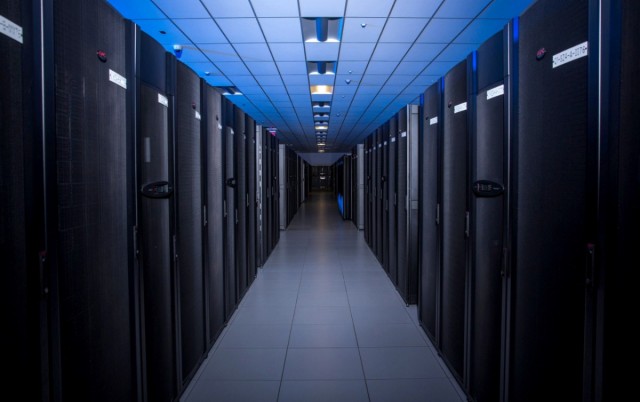
A look down the completed "data hall" of GM's Warren Enterprise Data Center. With 2,500 virtual servers up and running, the center is at a tiny fraction of its full capacity.
General Motors

WARREN, Michigan—General Motors has gone through a major transformation since emerging from bankruptcy three years ago.  Now cashflow-positive, the company is in the midst of a different transformation—a three-year effort to reclaims its own IT after 20 years of outsourcing.

Here are few more details.

Building a cloud, under one roof

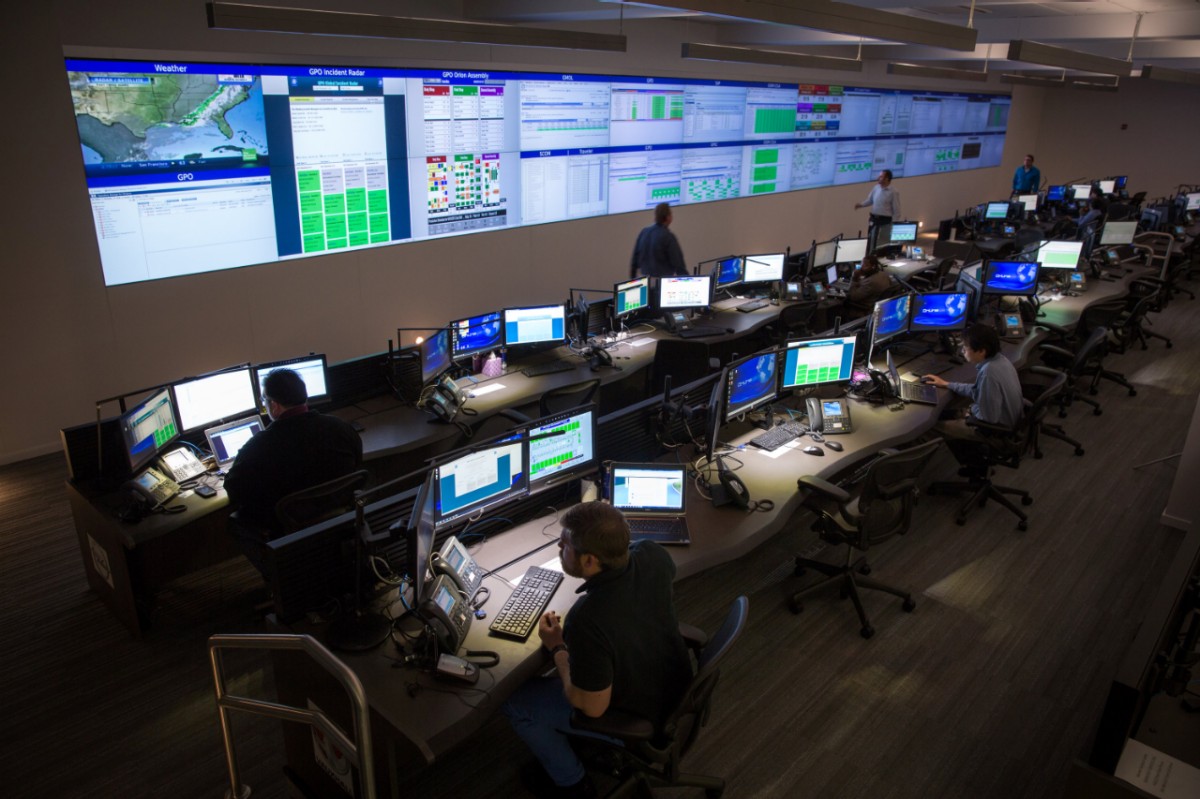
Enlarge/ GM's IT Operations and Command Center, where all of GM's IT infrastructure—including its partner network, OnStar systems, and design and engineering systems—is monitored and controlled.

The first step in that transformation, Liedel said, was converting everyone running its IT operations to GM employees. Next came centralizing control over the company's widely-scattered IT assets.

So far, three of the company's 23 legacy data centers have been rolled into the new Warren data center. That's eliminated a significant chunk of the company's wide-area network costs. "We have 8,000 engineers at (Vehicle Engineering Center) here," Liedel said. And those engineers are pushing around big chunks of data—the "math" for computer-aided design, computer aided manufacturing, and a wide range of high-performance computing simulations

And. GM chose flywheels.

Almost no batteries required

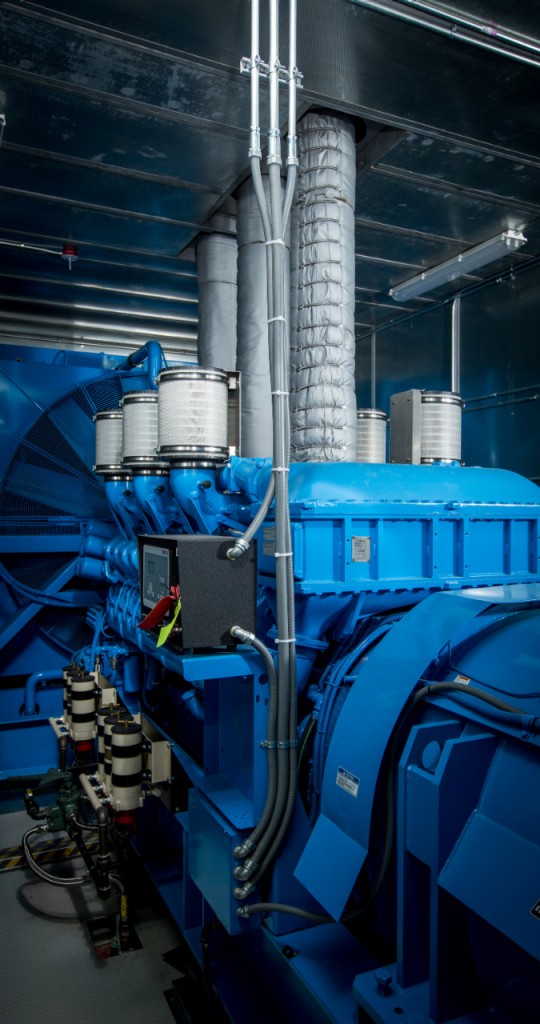
One of the Warren Enterprise Data Center's two diesel generators.

Aside from its energy efficiency, GM's Warren Data Center picks up green cred in the way it handles its emergency power. Instead of using an array of lead-acid batteries to provide current in the event of an interruption of power, the data center is equipped with uninterruptible power supplies from Piller that use 15,000 pound flywheels spinning at 3,300 revolutions per minute.


Are you designing around The Fiction of Memory? your memory is fragile

I spend way too much time thinking about how to think.  It as actually something that has a word for it called metacognition.

Metacognition refers to one’s knowledge concerning one's own cognitive processes and products or anything related to them, e.g., the learning-relevant properties of information or data. For example, I am engaging in metacognition if I notice that I am having more trouble learning A than B; [or] if it strikes me that I should double check C before accepting it as fact.

—J. H. Flavell (1976, p. 232).

My wife says it much easier, “there you go thinking about thinking."

Here is something to get you thinking.  Our memory is fragile.

NewImage

The above is from this Ted Talk by Elizabeth Loftus on The Fiction of Memory.

Why go through all this? Because if you can design systems that account for people’s tendency to not be able to know when they are telling the fiction of their memory, you can see things others can’t.


Greening The Data Center in the HPC scenario

I have been writing on Green Data Centers for 6 years.  This month I hit 2 year anniversary working for GigaOm Research, and thanks to the folks at Verne Global who sponsored a white paper on the Green Data Center topic here is a just released paper for GigaOm Research subscribers on The Value of Green HPC.

Jonathan Koomey, Tate Cantrell, RMS and BMW were interviewed for the paper and provided valuable perspectives the current state of greening a data center in a specific use case, HPC (High Performance Computing).

Table of Contents

The value of green HPC

 Oct. 30, 2013
This report underwritten by: Verne Global
1Executive Summary

Forward-thinking CIOs are anticipating increased regulation of carbon emissions and want lower and more-predictable energy costs over the long term. As part of that process, they are looking at ways to go green. They know that data centers are under scrutiny for how sustainable they are, and they know that demand for data center services is growing while the costs of fossil fuels are already high, getting higher, and becoming difficult to predict.

Green data centers present one solution because they use renewable energy sources, have efficient data center facilities, and use efficient IT equipment. The savings these data centers offer can be transformed into more processing power, which gives new opportunities for increased business revenue. Many of these data centers are located where they can take advantage of an area’s natural resources (cool climates, for example) and sources of power such as wind, geothermal, and hydroelectric.

However, not all applications are suitable for offloading to a data center, whether it’s green or not. Deciding which applications can be placed in a green data center while still satisfying business and performance specifications is critical to success. Among the candidates to consider are high-performance computing (HPC) applications. HPC was once limited to scientific research, but many businesses now use it to analyze large amounts of data and to create simulations and models. HPC applications are compute-intensive and, when applied at scale, require large amounts of energy. However, because users of these applications don’t require real-time responses, you have flexibility in where you place these applications. This means that you can take advantage of the lower energy costs a green data center offers, no matter where it’s located. This report analyzes these topics as well as the following areas:

  • Three factors to consider in choosing a green data center for HPC are the source of the data center’s power, the efficiency of its IT equipment, and the data center’s efficiency.
  • Today’s CIOs have the options of building a new data center, refurbishing an existing data center, using co-location, and using the cloud. Each option needs to be balanced against the following criteria: the requirements of increased data center traffic, government regulations, volatile energy costs, and sustainable practices.
  • Latency is the single most important criterion for choosing the appropriate applications for cloud or co-location. Following latency, other considerations are whether the application must peer with another company, the business requirements, the application architecture, current and predicted application workload, and the application’s resource consumption rate.