AWS coming to China in 2014

AWS has a press release detailing the arrival of AWS to China.

PRESS RELEASE

Dec. 18, 2013, 3:22 a.m. EST

Amazon Web Services Announces Upcoming China Region for its Cloud Computing Platform

AWS signs memorandums of understanding with the Beijing and Ningxia governments to develop cloud computing services


SEATTLE, Dec 18, 2013 (BUSINESS WIRE) -- --Xiaomi, Qihoo 360, TCL, Tiens, NQ Mobile, FunPlus, Kingsoft, Mobotap, and Papaya Mobile among the growing Chinese business community already using AWS

AMZN +1.03% -- Amazon Web Services, Inc. (AWS, Inc.), an Amazon.com company, today announced the upcoming limited preview of its China Region for the AWS cloud computing platform. This will be the fourth AWS Region in Asia Pacific and the tenth Region globally. In the limited preview, which will be deployed in early 2014, a select group of China-based and multinational companies with customers in China will be invited to begin using AWS Cloud services in the AWS China Region to build their businesses and run their applications in the cloud. Businesses and software developers can apply for access to the limited preview in the AWS China Region today athttp://www.amazonaws.cn .

One nugget in the AWS blog is the business is a bit different in China than other sites.

Our business model will be slightly different here than in the other AWS Regions. You will need to create an AWS account that is specific to the Region. We will be posting additional information on AWS China website as it becomes available.

Here is the news China AWS site.  Below is the site with Google Translate to english.
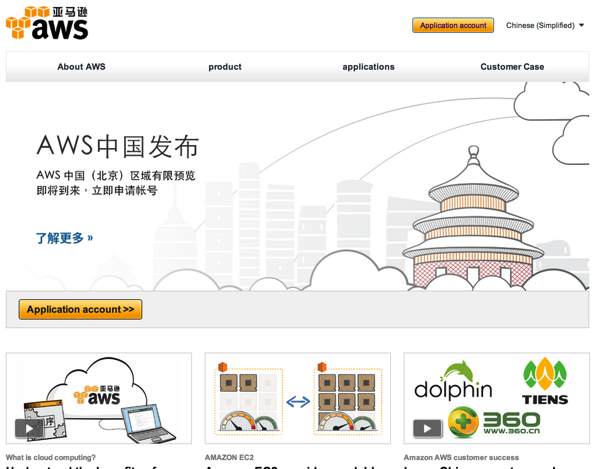
NewImage

1.5% sales tax savings, Apple's Remote Data Center Receiving Opportunity

GigaOm’s Katie Fehrenbacher went more in depth on Apple’s Reno Data Center than I did.

Apple makes progress on its solar-powered data center in Reno, but (of course) it’s controversial


18 MINS AGO

No Comments

Apple's solar farm next to its data center in Maiden, North Carolina
SUMMARY:

Apple’s Reno data center is already underway, but not surprisingly it’s a bit controversial: Apple has a deal for an 85 percent reduction on its property taxes.

In Katie’s post she points to another article about the receiving operations that is behind schedule. On page 2 of the article is an extra 1.5% sales tax savings.

Key to the sales tax break, however, is the ability to ship the computer equipment to a storefront inside a tourism improvement district. Under Nevada law, state officials can exempt a company from all but 2 percent of its 7.5 percent sales tax obligation. But if Apple opens a receiving center within such a district, it can whittle that remaining 2 percent down to 0.5 percent.

Let’s do simple math and just assume there is $15 million of capital equipment to be put in the 2.5 MW $15 million data center.  So the tax savings is $225,000 for this phase.  Is it worth it to build a receiving building, unload the material from a truck, unpack it, and put it back on a truck, ship it to the data center, unload it again, audit the material.  Doesn’t seem like it would be.  If Apple bought $1 billion of gear the tax savings is $15 million, but Apple needs to build the receiving operations, staff it, and run an extra processing step.  The numbers don’t make sense when you get into the details.

“They need it to work for them and their bottom line, and they’re struggling to make that pencil.”

...

“Owning or leasing a building, staffing the building, making sure the building is secure, paying for the operating costs and paying to transfer the equipment back and forth, and you’re starting to spend some money,” Hill said.

Disclosure:  I do part time freelance work for GigaOm Research.

We'll see if people innovate the use of Robotics in Data Centers

3 years ago I started researching the use of robotics in data centers when someone asked what will change the way data centers are built and operate.  I put this post up back in June 2011 on a robotics expert I saw who was using robotics in interesting scenarios.

President Obama’s media event was fluffy with little technical content.  Especially compared to the hour I spent on the same day listening to Hugh Durrant-Whyte, CEO of NICTA, ex research director at Australia’s robotics efforts.

Hugh Durrant-Whyte 

Research Director 
Professor of Mechatronic Engineering, Appointed 1995

At the Australian Centre for Field Robotics, USYD

My research focuses on two main areas; navigation of autonomous vehicles and senor data fusion. 
In navigation I pioneered the application of Kalman filter and target-tracking methods to the problem of robot localisation. This has had substantial impact in robotics; Many operational mobile robots now use these methods for localisation. I also introduced the revolutionary Simultaneous Localisation and Mapping (SLAM) method. Interest in SLAM is now exploding. My research work is now focused on general probabilistic SLAM problems appropriate to very unstructured, outdoor and underwater, environments.

DatacenterKnowledge has a guest post on the subject of robotics in the data center.  This is the first of three part series.

This week Data Center Knowledge presents a three-part series on data center automation and the potential role of robotics.


I’ll see if the end comes to the same design conclusions I came at how data centers could be changed.

Apple's 1 billion Reno Data Center has 1/66th built, $14.85 mil tax assessment

The media was all over Apple’s $1 bil data center in Reno.

Apple’s largest project in the area, however, is its new $1 billion iCloud data center that includes both a large, rural parcel of land within the nearby Reno Technology Park and plans to build new supporting facilities on the edge of downtown.

I don’t know about you, but my friends had a good laugh at speculation that Apple was building 1 billion worth of data centers in Reno.

Well here is a progress based on RGJ reporting on the tax benefits of the Reno data center.

Meanwhile, the data center is projected to generate more than $142,000 in property taxes for the 2013-14 fiscal year, according to the Department of Taxation. The amount is generated from a total taxable value of $14.85 million based on Washoe County Assessor data.

This construction cost fits with a 2.5 MW data center build.

Today, thanks to its high-profile tenant, the Reno Technology Park is starting to take shape. Earlier this summer, Apple completed its first phase — a 20,000-square-foot, 2.5-megawatt data center.

That is the wonderful power of the Apple brand.  Who else could get the amount of press coverage for a 2.5 MW, $15 mil data center building.  If you say this is the first of four phases, Reno could be 10MW and $60 Mil.  If this is one tenth, then you get 25MW and $150mil.  To get to $1Bil data center you need to multiple this first building by 66.

Wouldn't it be great if IT Services behaved like well mannered house guests, respect the territorial boundaries

The holiday season is a time of travel.  Which means either you are the guest at someone’s house or you are the host of guests.  Benjamin Franklin’s cited as the originator of the classic quote, and here is an article that build on the concept in Psychology Today.

Benjamin Franklin famously said that guests, like fish, begin tosmell after three days. Many of us are inclined to agree. I myself recently struggled to share my space and resources with a houseguest. I wanted to be hospitable yet I experienced an unexpectedly inhospitable reaction to my mackerel-like guest (herein known as “Mack”).  The dissonance was intense. What was up with that? Fortunately, my psychology arsenal includes tools from the psychology subdiscipline ofenvironmental psychology. It is there we find theories and research on human territoriality that explain the trouble with houseguests (at least some of it!). 

What comes to mind though is wouldn’t life be better if IT services behaved like well mannered house guests and respect the territorial boundaries of the host.

How many of you are frustrated when new IT service change your routine?

Houseguests then, are stressful to the extent that they disrupt our routines and usurp the high amount of control we normally enjoy in this personal territory. If their routines interfere with ours or if their presence restricts our normal uses of home spaces, stress is likely. 

Unfortunately new IT services don’t leave like a house guest, so their habits now influence yours.

How many of you think some of the IT services that come in leave a bad smell in your clean operations?

Of course, territoriality isn’t the whole picture. Among other things, increased household labor also makes guests “smelly” (often more of an issue for women in traditionally gendered households where they bear the brunt of cooking and cleaning). The moral of this story: if you want to stay a welcome houseguest, it probably pays to respect your host’s home as a primary territory, and to keep your visit short.