Facebook figures out the way to bring down Data Center Cost is Lean

The idea of Lean started in Manufacturing and has spread through construction.  Now Facebook has chosen to build its 7th data center with Lean Construction techniques.

Faster, Leaner, Smarter, Better Data Centers

Friday, March 07, 2014 · Posted by  at 1:30 AM

Four years ago, Facebook broke ground on its first greenfield data center project in Prineville, Oregon. In the years since, we’ve deployed six iterations of that design, culminating in the first building currently under construction at our new campus in Altoona, Iowa. With facilities around the world, we constantly challenge ourselves to improve our data center designs to maximize efficiency, reduce material use, and speed up build times.

At this year’s Open Compute Summit, we previewed what we believe will be a step change in those ongoing efficiency efforts: a new “rapid deployment data center” (RDDC) concept that takes modular and lean construction principles and applies them at the scale of a Facebook data center.

We expect this new approach to data center design will enable us to construct and deploy new capacity twice as fast as our previous approach. We also believe it will prove to be much more site-agnostic and will greatly reduce the amount of material used in the construction. And with today’s exciting news from my colleague Joel Kjellgren, we will get to test these theses: Our newly announced second building at our Luleå, Sweden, campus will be the first Facebook data center to be built to our RDDC design.

If you want to watch a video that shows the presentation you can go to this one. http://youtu.be/yu8jin33G64?t=21m50s

I found this information thanks to GigaOm’s Derrick Harris who was at the Open Compute Summit.

The first method Facebook is employing, called the “chassis approach,” is actually more similar to an automobile assembly line, where the chassis is built separately and then built upon from there. In Facebook’s case, the chassis is a 12-foot by 40-foot unit that will sit above rows of racks and house lighting, cable trays, and everything else that typically goes above a row of servers. Facebook data center engineer Marco Magarelli wrote in the blog post detailing the new methods that the company chose the chassis approach over standard containers “to avoid shipping the empty space that will eventually be occupied by the racks.”

How a chassis is built and delivered. Source: Facebook

How a chassis is built and delivered. Source: Facebook

Sample instructions for putting together the pieces in the flat pack. Source: Facebook

Sample instructions for putting together the pieces in the flat pack. Source: Facebook


If AWS is invincible, then why fund a direct competitor? DigitalOcean gets $37.2 mil

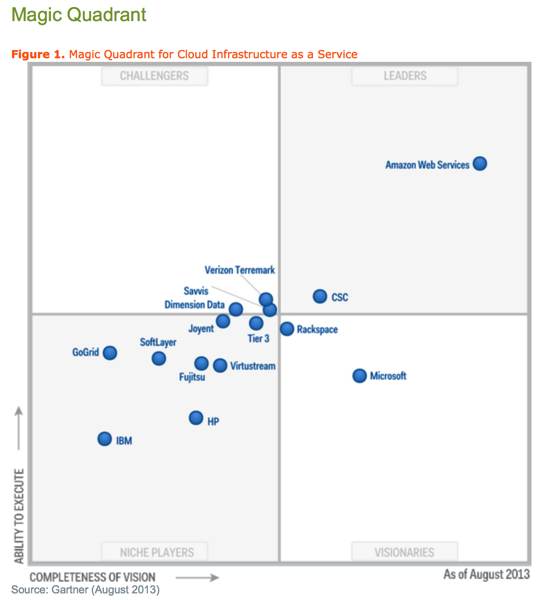
The way some people talk AWS has already won the cloud battle and the spoils are left to the rest.  The beauty of the cloud and their customers is as fast as VMs can be spun up, new businesses can figure out better ways to spin up VMs.  Here is Gartner’s infamous magic quadrant on IaaS.

NewImage

So how’s this for a change.  DigitalOcean doesn’t show up anywhere in this graphic.  Yet has just received $37.2 mil series A funding and has spun up its 1,000,000 VM.

DigitalOcean Growth

In the past 15 months and with only a handful of engineers we’ve been able to hit some amazing milestones. We’ve launched over 1,000,000 virtual servers, processed 18,000,000 events, opened new datacenter regions in San Francisco and Singapore, for over 100,000 customers.

NewImage

DigitalOcean had a simple vision.  Make life easier for the developer.  Vs. Amazon make more money.  Make things stickier, make it hard for people to leave AWS.

We started DigitalOcean in the summer of 2011 with a simple mission: to make developers lives easier. We thought that the other players in the space had made IaaS too complicated. We focused on user experience and simplicity. Guiding ourselves with a single principle, can we build a product that we would love ourselves?

With three engineers we built the first version of our product and with help from the Hacker News community our growth exploded when we announced our SSD powered cloud.

Part of the problem AWS is having in its efforts to make it harder for people to leave it makes it harder to get started as well.

Lean At Amazon, the future is not where you would think, but good for data center geeks

It is rare to get a document written about Amazon.com’s processes.   McKinsey has a post on an interview with Mark Onetto.  Who is Mark?

Marc Onetto

Marc Onetto biography

Vital Statistics

Born September 3, 1950, in Paris, France

Education
Graduated with an MS in engineering in 1973 from École Centrale de Lyon and with an MBA in industrial administration in 1975 from Carnegie Mellon University’s Tepper School of Business
Career Highlights

Amazon.com (2006–13)

  • Senior vice president of worldwide operations and customer service

The most surprising part was what Marc says is the next frontier lean-management principles applied to software creation.

Next frontiers

Perhaps the biggest challenge I see is the application of lean-management principles to software creation, which is highly complex, with numerous opportunities for defects. Software engineers have not yet been able to stop the line and detect defects in real time during development. The only real testing happens once the software is completed, with the customer as a beta tester. To me, this is unacceptable; we would never do that with a washing machine. We would not ask customers to tell us when the washer leaks or what’s wrong with it once it has arrived at their homes. I’ve tried to address the problem, and some of Amazon’s computer-science engineers have looked at it, but it is still one of the biggest challenges for lean.

Lean is still in, and growing

Lean production techniques are 50 years old and McKinsey has a post discussing what’s next for Lean.

Next frontiers for lean

Lean-production techniques have been revolutionizing operations for 50 years. Advances in technology, psychology, and analytics may make the next 50 even more exciting.

February 2014 | byEwan Duncan and Ron Ritter

When the first issue of McKinsey Quarterly rolled off the printing presses, 50 years ago, nearly everyone in senior management thought that manufacturing operations had been perfected. Henry Ford’s great innovation, the moving assembly line, had been refined over the previous five decades, had served as the arsenal of democracy during World War II, and by the mid-1960s was operating efficiently, at great scale, in a wide range of industries around the world.

The authors think Lean is as big as Henry Ford’s assembly line.

Lean is one of the biggest management ideas of the past 50 years. No less than Ford’s original assembly line, it has transformed how leading companies think about operations—starting in assembly plants and other factory settings and moving more recently into services ranging from retailing and health care to financial services, IT, and even the public sector. Yet despite lean’s trajectory, broad influence, and level of general familiarity among senior executives, it would be a mistake to think that it has reached its full potential.

So what is next?  What gets done by the information companies

The future of lean is exciting. Its tools for eliminating waste and for increasing value as customers define it are being enhanced by huge gains in the volume and quality of the information companies can gather about customer behavior, the value of the marketing insights that can be integrated with operations, and the sophistication of the psychological insights brought to bear on the customer’s needs and desires. These advances bring new meaning to the classic lean maxim “learning to see.” The contrast between where companies are now and where they’ll be 20 years on will seem as stark as the difference between a static color photograph and a high-definition, three-dimensional video.

Who would want the Target CIO job? Current CIO resigns amid breaches

Target’s data breach is infamous, and now the CIO has resigned.

Target CIO resigns amid breach investigations

  • Article by: JENNIFER BJORHUS , Star Tribune 
  • Updated: March 5, 2014 - 12:16 PM

Target shakes up its information technology management following last year’s theft of customer data.

hide

Beth Jacob, Target vice president and chief information officer, resigned in the wake of the data breach that jeopardized the financial and personal information of tens of millions of customers. The company announced Jacob's departure Wednesday. 2013 file photo.


One of my good friends just said he was going to make a job change and they want him because of his skills in data centers and software.

What caught my eye is the exiting Target CIO is an MBA who started out as an buyer.

Jacob, who holds an M.B.A. from the University of Minnesota, first joined the company in 1984 as a department store assistant buyer when it was known as Dayton’s, then left and returned in 2002 to Target as director of guest contact centers. She was promoted to CIO and executive vice president of Target Technology Services in 2008, and reported to Steinhafel.

Jacob ran Target’s technology infrastructure during a period of rapid change, including the relocation of some of its technology operations to India. Critics have noted that she has deep operations experience but lacked the information technology background that many see as increasingly important for a CIO at a major corporation.

Being CIO is really hard, and seems even harder if you don’t have an information technology type of degree.

I wonder if the new Target CIO will be more technical?