Barron's thought Twitter was too expensive in Nov 2013, Feb 2014, and May 2014

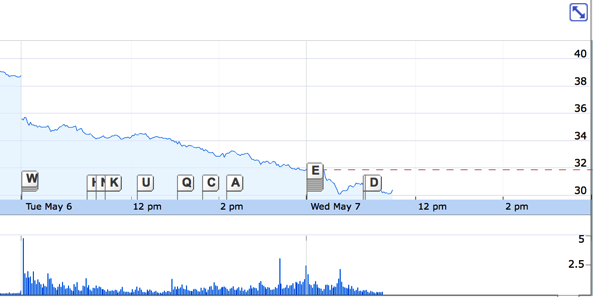
Twitter has a second day of decreasing stock price.
NewImage

Some are surprised the stock is falling.  Barron’s has been saying for months that TWTR was too expensive.  Twitter is important for so many things, but that doesn’t mean it shouldn’t its stock shouldn’t have a fair market value.

  • Why Twitter Could Fall Further - Barron's

    online.barrons.com/.../SB500014240531119047100045793672...
    Barron's
     
    Feb 8, 2014 - Barron's was bullish on Twitter prior to last November's initial public offering, but we warned that investors shouldn't pay more than $30 for the ...
  • Beat-Up Twitter Is Still Too Rich - Barron's

    online.barrons.com/.../SB500014240531119038438045795364...
    Barron's
     
    4 days ago - Even after a 47% drop from its late-December high of $74, Twitter looks ...Barron's wrote negative follow-ups ("Twitter: Priciest Stock Since the ...
  • The Case for Selling Twitter - Barron's

    online.barrons.com/.../SB500014240531119042276045791998...
    Barron's
     
    Nov 15, 2013 - The social-media company's big spending in infrastructure and global expansion will undercut its stock, writes S&P Capital IQ.

USA Secretary of Interior Chooses Lake Sammamish as 1 of 8 Urban Wildlife Refuge Partnerships

There is a new (in 2013) Secretary of Interior who is the ex CEO of REI, HQ in Seattle.  Sammamish Review covers the Secretary of Interior’s visit to Lake Sammamish to announce the Urban Wildlife Refuge Initiative.

The partnership will help connect people in the Seattle metro-area to the great outdoors and, in particular, efforts to restore kokanee salmon runs in the Lake Sammamish Watershed.
“Children have become increasingly disconnected from nature,” Jewell said. “The Lake Sammamish Urban Wildlife Refuge Partnership seeks to reverse this trend by providing meaningful opportunities for urban residents in the region, especially young people, to get outdoors and engage in hands-on learning and conservation of kokanee salmon and its habitat.”

Below is a picture of Lake Sammamish looking to the South with Mt. Rainier in the background.  Where the little red rectangle is where I have lived for over 20 years.  Bald Eagles are regularly in trees.  Otters are in the lake eating crawfish.  And sometime in future hopefully more kokanee salmon.

NewImage

Going with RFID doesn't mean errors are gone, errors just show up in different places

A common perception is RFID is error free.  Airbus just announced it has an integrated RFID nameplate and in the press announcement is error-proof.

These tags will contribute to value-chain visibility, error-proof identification

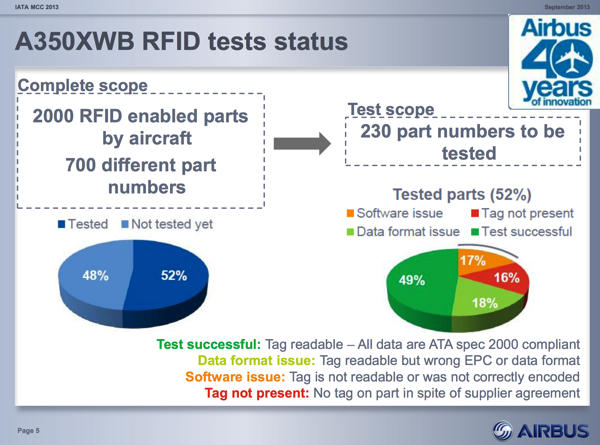
Keep in mind the media and marketing folks are not process engineers or software/hardware engineers.  Here is presentation by an Airbus engineer at a conference where errors are discussed.

NewImage

A lot of things need to happen that people don’t think about.  Now you could argue that this was a test.  But with 51% error rate, how long will it take the error rate to be below 0.1%?  To get lower error rates you need to put in audit systems to find errors and reconcile them.

One of the problems Airbus and I think Boeing has is they are storing data on the RFID tags which by the way is the craziest damn idea.  Now it may seem like a good idea to store the data on the device.  Imagine having 10,000 eventually 100,0000 or 1,000,000 RFID tags with data stored on them, syncing the data from all those devices will create a data management nightmare.  Tags get damaged.  Remote devices don’t sync data.  They get bad data written to them.  How do you handle security access to write data to the device.  Read from the device.  Can just anyone walk into an airplane equipment and collecting data on the devices that respond to RFID?  Secure organizations prohibit USB devices.

Even though I am discussing RFID, many of these same issues apply to any kind of monitoring system.  Errors exist in all kinds of systems.  To reduce errors no different than reducing downtimes at some point can be addressed with redundancy.  Having multiple data feeds for the same thing reduces the chance of errors.


Don't Think Social Issues are Important in the work place? Social Threats are close to Physical Threats

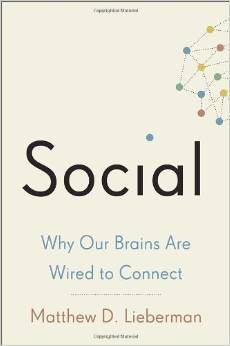
The latest book I am reading is Social by Matthew B. Lieberman

NewImage

Two points made that can open your mind up.

Our brains evolved to experience threats to our social connections in much the same way they experience physical pain .

We intuitively believe social and physical pain are radically different kinds of experiences, yet the way our brains treat them suggests that they are more similar than we imagine.

Lieberman, Matthew D. (2013-10-08). Social: Why Our Brains Are Wired to Connect (p. 5). Crown Publishing Group. Kindle Edition.

So much of work and school thinks being social is bad and a distraction, but you cannot turn off being social.

Based on the latest cutting edge research, the findings in Social have important real-world implications.  Our schools and businesses, for example, attempt to minimalize social distractions.  But this is exactly the wrong thing to do to encourage engagement and learning, and literally shuts down the social brain, leaving powerful neuro-cognitive resources untapped.