Netflix Open Connect Division Staff - 20 SW, 10 Network, & 10 Operations

Arstechnica posts on a presentation by Netflix’s David Fullagar director of content delivery architecture.

There are cool details like the staff.

The network team

Netflix’s Open Connect division has about 40 people, Fullagar said. About 20 are software engineers who either build software for Netflix servers or work on the company's management software, which runs on Amazon’s cloud network and performs functions such as load balancing. Another 10 Open Connect employees are network architects, and another 10 are in operations.

There are two types of hardware used.

Netflix stores video on two types of boxes that it designed, one that’s heavy on HDDs and another that’s all SSDs. Netflix built them in part because it couldn’t find the right mix of compute and storage capabilities in products from hardware vendors.

The HDD unit is a 4U-sized chassis that holds 216TB on 36 drives of 6TB each. It has 64GB RAM, a 10 Gigabit NIC, and some SSD for frequently accessed content.

The smaller, 1U, SSD-only unit contains 14 drives of a terabyte each, 256GB of RAM and a 40 Gigabit NIC. About 75 percent of the cost of both the HDD and SSD boxes is taken up by storage. Each unit uses Intel CPUs.

How many are there?

Netflix stores video on two types of boxes that it designed, one that’s heavy on HDDs and another that’s all SSDs. Netflix built them in part because it couldn’t find the right mix of compute and storage capabilities in products from hardware vendors.

The HDD unit is a 4U-sized chassis that holds 216TB on 36 drives of 6TB each. It has 64GB RAM, a 10 Gigabit NIC, and some SSD for frequently accessed content.

The smaller, 1U, SSD-only unit contains 14 drives of a terabyte each, 256GB of RAM and a 40 Gigabit NIC. About 75 percent of the cost of both the HDD and SSD boxes is taken up by storage. Each unit uses Intel CPUs.

If you didn’t make it to the NY event, it looks like the presentation in repeated for the Uptime Symposium attendees.

Designing Netflix's Content Delivery System
Presenter: David Fullagar, Director of Content Delivery Architecture, Netflix

Tuesday, May 20, 2014
2:35 - 3:05 p.m.

The way people consume video-based content has changed dramatically over recent years. At the forefront of this evolution is Netflix, today's undisputed video-streaming service leader. Due to the personalization of on-demand video delivery service, no two subscribers watch the same content at exactly the same time. Now bits and bytes of this digital content must be ready for delivery on-demand to more than 44 million Netflix customers, placing incredible pressure on the content delivery infrastructure.

To tackle this challenge, David Fullagar, Director of Content Delivery Architecture at Netflix and his team, have custom designed the content delivery network (CDN)—Open Connect. During this presentation, Mr. Fullagar will share the Open Connect hardware design and the open source software components of the server that support these massive streaming demands. These cost-efficient designs are suitable for any high-volume provider of large media files to enable faster, cheaper Internet for all.
 

Data at Center of Gun Purchasing, Requests Information on Supplier's Business Practices

Data Centers are the center of the data for companies.  WSJ has a post on Data being at the Center of evaluating gun purchases.

Jersey City has begun requiring gun companies that supply its police department with weapons to disclose more about their business practices, an effort that is being watched by law-enforcement agencies in other cities.

Gun-control advocates and firearms industry representatives said Jersey City is the first municipality in the nation to demand such information. Questions include how firms dispose of old weapons and comply with background-check laws, and whether they make semiautomatic rifles—often called assault weapons—for sale to civilians, according to bid documents viewed by The Wall Street Journal.

This is an interesting shift to try and change the gun industry.

Activists hope that public police departments can leverage their purchasing power to push gun manufacturers to invest in safer weapons and not sell to retailers that have track records of selling to criminals.

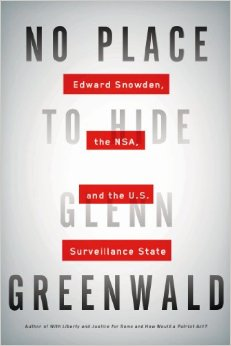
Will You read Glenn Greenwald's Book on Edward Snowden "No Place to Hide"

May 13, 2014 Glenn Greenwald’s “No Place to Hide” will be released.

NewImage

There are all kinds of reviews coming out.

Books|Snowden's Story, Behind the Scenes

New York Times-6 hours ago
The title of the journalist Glenn Greenwald's impassioned new book, “No Place to Hide,” comes from a chilling observation made in 1975 by ...
 
The Man Who Knows Too Much
-GQ Magazine-13 hours ago


The Economist lets you know the perspective in the book which will give you an idea whether you want to read it or not.

Fans of Mr Snowden and Mr Greenwald will find much to enjoy in this colourful play-by-play and exploration of classified NSA activities. But critics can expect to come away unmoved. This is because Mr Greenwald is less a journalist than an activist—an écrivain engagé—a bias that he wears as a badge of honour.

As a result, the book is remarkably one-sided: Mr Snowden is the whistleblowing hero; Mr Greenwald righteously fights on the side of the angels. Even sympathetic readers will have a hard time accepting everything Mr Greenwald, a former litigator, argues in his case against American intelligence. Indeed, in some cases a bit of intelligence-gathering seems sensible, such as when the NSA snooped on a handful of UN delegations to find out their positions prior to a vote on sanctions against Iran. Disclosing this also seems unnecessarily harmful. But in Mr Greenwald’s telling, all American surveillance comes out looking badly.

The book is at its best when it shines light on Mr Snowden’s motives. He plainly acted with conviction, and he will likely go down in history as a hero. Yet Mr Greenwald fails to let readers reach their own conclusions about the NSA and Mr Snowden’s conduct, preferring to impose his partisan views. Perhaps that is to be expected when the storyteller is not just a messenger but also a protagonist.

Alibaba's Data Centers - Hangzhou, Qingdao Beijing, and Hong Kong

WSJ reports on Alibaba’s IPO and its data centers.

The launch of the Hong Kong data center also comes as Alibaba’s two main shopping sites–Taobao and Tmall– have been trying to expand outside mainland China, beginning with Hong Kong, Taiwan and Singapore. According to Alibaba’s website, the company has data centers in three mainland Chinese cities: Hangzhou, Qingdao and Beijing.

...

Alibaba said it built the new data center in Hong Kong in cooperation with a unit of Towngas, a Hong Kong gas company. Alibaba didn’t say how much it spent on the facility.

Hiding Your Moves on the Internet by acting like a Criminal is not Effective

The Guardian has a post on Janet Vertisi’s efforts to hide her pregnancy on the internet. 

Attempts to stay anonymous on the web will only put the NSA on your trail

The sobering story of Janet Vertesi's attempts to conceal her pregnancy from the forces of online marketers shows just how Kafkaesque the internet has become

The bit of irony is The Guardian hid the origin of the presentation Janet made which is here on Mashable.

How One Woman Hid Her Pregnancy From Big Data

For the past nine months, Janet Vertesi, assistant professor of sociology at Princeton University, tried to hide from the Internet the fact that she's pregnant — and it wasn't easy.

Pregnant women are incredibly valuable to marketers. For example, if a woman decides between Huggies and Pampers diapers, that's a valuable, long-term decision that establishes a consumption pattern. According to Vertesi, the average person's marketing data is worth 10 cents; a pregnant woman's data skyrockets to $1.50. And once targeted advertising finds a pregnant woman, it won't let up.

The part that had me laughing is when she figured out her process of being invisible made her more visible as a potential criminal.

Genius, right? But not exactly foolproof. Vertesi said that by dodging advertising and traditional forms of consumerism, her activity raised a lot of red flags. When her husband tried to buy $500 worth of Amazon gift cards with cash in order to get a stroller, a notice at the Rite Aid counter said the company had a legal obligation to report excessive transactions to the authorities.

"Those kinds of activities, when you take them in the aggregate ... are exactly the kinds of things that tag you as likely engaging in criminal activity, as opposed to just having a baby," she said.

What Janet was doing in her efforts to hide her pregnancy and her purchasing behavior, is she was doing the same things a criminal does to hide their activity.  If you want to hide, then blend into a crowd like camouflage.

Background matching is perhaps the most common camouflage tactic. In background matching, a speciesconceals itself by resembling its surroundings in coloration, form, or movement. In its simplest form, animals such as deer and squirrels resemble the “earth tones” of their surroundings. Fish such as flounder almost exactly match their speckled seafloor habitats.