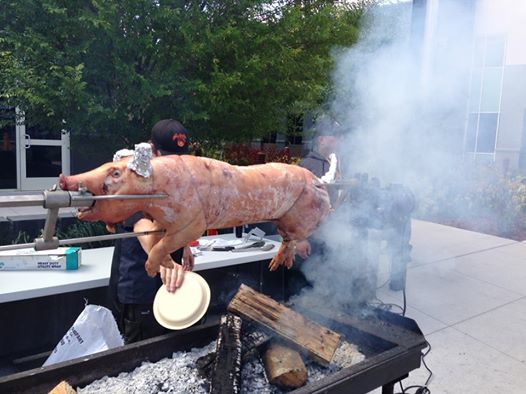
I headed down to the bay area yesterday, and there were probably 20 people on the plane who were heading to Uptime Symposium. We all landed from SEA to SJC at 9:10a and everyone was off to Uptime, except me. I had a meeting at Facebook and was able to go to 6th annual Sam Choy Lunch.
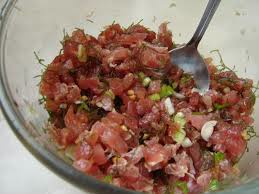
The food was awesome pork, chicken, fish, beef, and the long long line for the Poke
Hey Everyone! Today, Tuesday May 20th we are having our 6th Annual Sam Choy Luau at Hack Square!
DatacenterDynamics SF is coming up on June 17, 2014 at the Santa Clara Convention Center. Note the change of location from SF to Santa Clara. I’ve been to DCD in SF, Chicago, NY, London, and Seattle.
The program looks pretty full with up to 5 halls open for presentations.
Looking forward to catch up with data center friends at the event. Note: I need to be in SF for another event that evening so I will be leaving mid afternoon. Don’t look for me at the cocktail reception.
Proving the current tape format will satisfy the requirements of tape storage well into the future
VALHALLA, N.Y., May 19, 2014–Citing its use of proprietary NANOCUBIC™ and Barium Ferrite (BaFe) particle technologies, FUJIFILM Recording Media U.S.A., Inc.,a subsidiary of FUJIFILM Corporation, the leading global manufacturer of data storage media, today announced thatin conjunction with IBM, a new record inareal data density of 85.9 billion bits per square inch on cost-efficient linear magnetic particulate tape has been achieved. This breakthrough in data densityequates toa standard LTO cartridge capable of storing up to 154 terabytes of uncompressed data, which is 62 times greater than today’s current LTO6 cartridge capacity.
People thought tape was long dead, but with these latest offerings it looks like Tape is around for a bit longer.
If you had Amazon’s Werner Vogels, Google’s Urs Hölzle, IBM/SoftLayer’s Lance Crosby, Microsoft’s Scott Guthrie, Rackspace’s Taylor Rhodes in one room, what would you ask?
There are 5 questions listed. Being an insider and seeing how stuff works behind the scenes I have a tougher question than the readers sent in.
Tell me how your team is better than the Competition?
Anyone who knows how things work know there are teams of people who work on the Cloud infrastructure. If you trace cause of outages the human factor is hard to miss. The Cloud automation is created by teams of people as well.
HBR has a post on The New Science of Building Great Teams.
The New Science of Building Great Teams
by Alex “Sandy” Pentland
If you were looking for teams to rig for success, a call center would be a good place to start. The skills required for call center work are easy to identify and hire for. The tasks involved are clear-cut and easy to monitor. Just about every aspect of team performance is easy to measure: number of issues resolved, customer satisfaction, average handling time (AHT, the golden standard of call center efficiency). And the list goes on.
Why, then, did the manager at a major bank’s call center have such trouble figuring out why some of his teams got excellent results, while other, seemingly similar, teams struggled? Indeed, none of the metrics that poured in hinted at the reason for the performance gaps. This mystery reinforced his assumption that team building was an art, not a science.
And one of the insights on team performance.
Patterns of communication, for example, explained why performance varied so widely among the seemingly identical teams in that bank’s call center. Several teams there wore our badges for six weeks. When my fellow researchers (my colleagues at Sociometric Solutions—Taemie Kim, Daniel Olguin, and Ben Waber) and I analyzed the data collected, we found that the best predictors of productivity were a team’s energy and engagement outside formal meetings. Together those two factors explained one-third of the variations in dollar productivity among groups.
Here is the HBR video on Team Performance.
Here are Barb’s 5 question from readers.
1: When will all the major clouds support the same set of APIs?
2: When will they support migration of data/workloads from one cloud to another natively?
3: What comes after the race to the bottom in cloud storage prices plays out?
4: When will we see a true cloud exchange?
5: How can we be sure our data is safe in your cloud from prying eyes?