The way some people act, Machine Learning is something new. It is something that has been around for quite a while. To give you an idea Microsoft Research has 622 publications on the subject.
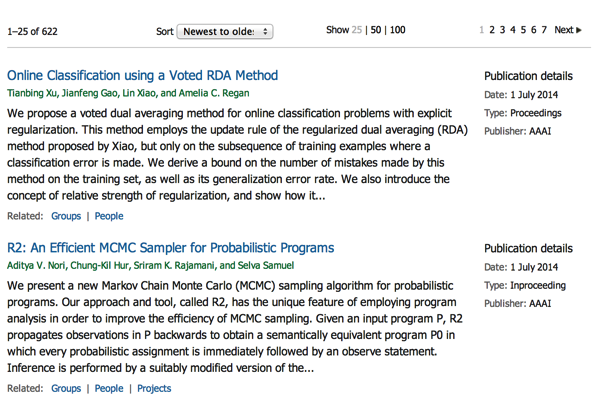
Google has 371 on the same subject.
Your Custom Text Here
The way some people act, Machine Learning is something new. It is something that has been around for quite a while. To give you an idea Microsoft Research has 622 publications on the subject.
Google has 371 on the same subject.
Dell is a private company now and is going through a transformation. USAToday has an article on a Michael Dell interview.
It's a challenge Dell relishes after feeling handcuffed by the expectations from the market for a public company undergoing a significant makeover. "The market encourages (public companies) to not make investments in new areas," he says, wincing at the notion. "It is short-term focused."
IDC chimes in.
A private Dell allows it to move at its own speed to transform to an end-to-end technology solutions company without quarterly pressures from Wall Street and comparisons to rivals HP, Lenovo and Microsoft, says IDC analyst Matthew Eastwood, who closely follows Dell.
More and more companies are realizing being private has advantages vs. being public.
For now, the ending appears happy. "What I saw at Dell's analysts' meeting (in May) was a relaxed, confident Michael Dell," Moorhead says. "He is no longer under the thumb of Wall Street. He can make moves at his pace."
How many companies like Twitter who have gone public wish the old days of being able to take risks were part of DNA? Like the days before the IPO.
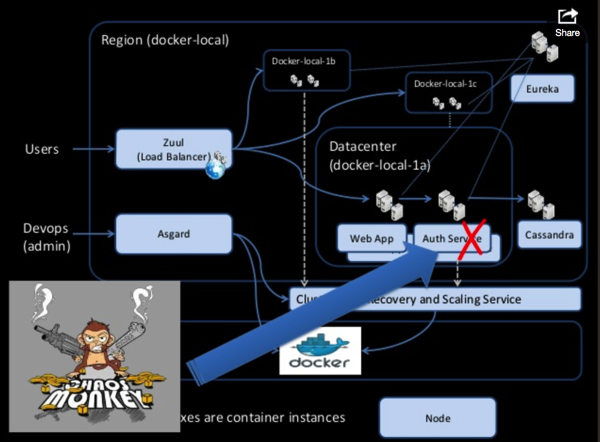
At IBM Impact which was going on the same time as Data Center World in LV, IBM presented Docker used to run NetflixOSS. If you know the NetflixOSS, you’ll recognize the modules - ZuuL, Asgard, Cassandra, and the infamous Chaos Monkey. Docker is throughout the system.
Back in Jan 2014, IBM presented at NetflixOSS’s event on running on IBM Softlayer.
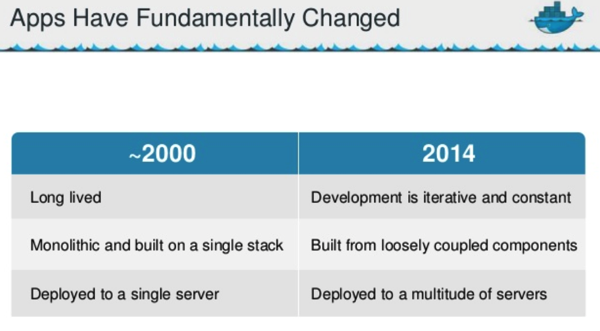
One of the reasons why VMs succeeded and VMware is it virtualized a server. Which allows the server hugger habit to morph into server VM huggers. The trouble about this is VMs are large which brings overhead for deployment, storage, management. Which is great if you are selling management tools like VMware. Now that users are realizing VMs don’t save as much money as they thought, there is a clear need for something better.
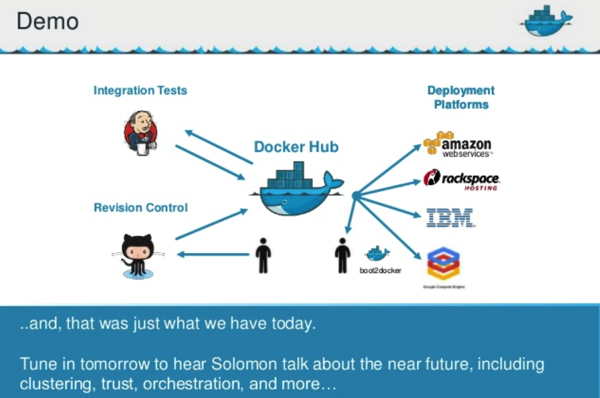
This where Dockers comes in.
The server huggers are in the past. The current and future has huggers maybe hugging their services for users instead of servers.
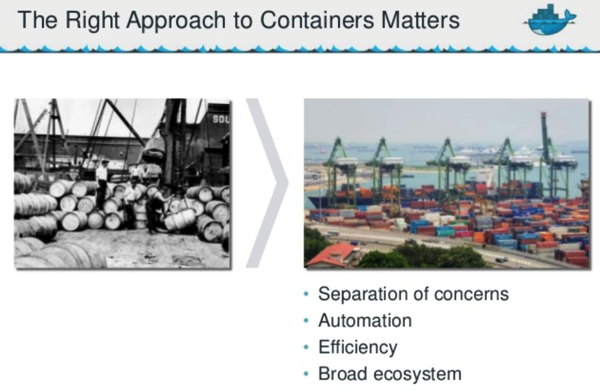
This move can also be illustrated by the move from old way of shipping goods and the use of containers which supports abstractions of concerns, automation, efficiency, and bigger ecosystem
Why go through this effort? If you want to have a future that looks like this. Where your services can be easily deployed to a range of cloud environments including your own private cloud.
Microsoft posts on how they are assigning non-US IPv4 addresses to US customers given they have run out of IPv4 addresses.
IPv4 address space has been fully assigned in the United States, meaning there is no additional IPv4 address space available. This requires Microsoft to use the IPv4 address space available to us globally for the addressing of new services. The result is that we will have to use IPv4 address space assigned to a non-US region to address services which may be in a US region. It is not possible to transfer registration because the IP space is allocated to the registration authorities by Internet Assigned Numbers Authority.
At times your service may appear to be hosted in a non-US location.
Service and Data are located where deployed
It is important to note that the IP address registration authority does not equate to IP address physical location (i.e., you can have an IP address registered in Brazil but allocated to a device or service physically located in Virginia). Thus when you deploy to a U.S. region, your service is still hosted in U.S. and your customer data will remain in the U.S. as detailed in our Trust Center: http://www.windowsazure.com/en-us/support/trust-center/privacy/
We are currently working with a few major IP geo-location database companies to update the location of these IPs which should help alleviate the issues this may be causing.
It’s too bad in this post, no mention is of IPv6 and what the longer term plan is.