State of the Art Font is more readable than the Rest - Microsoft's Sitka

You won’t hear much about Microsoft’s Sitka font.  It is part of IE11 and in Windows 8.1.  Being an old font guy, I still get a kick out of studying fonts.  Long long ago I worked on typography at Apple and Microsoft.  What is Sitka?  I found the best explanation here on myfonts in an interview with the designer Matthew Carter.

The most recent project where you collaborated with technicians and scientists is Sitka, a new serif family that comes with MS Windows 8.1. You worked in close collaboration with Microsoft’s Kevin Larson, famous for his legibility research, and with the designers at Tiro Typeworks. Did the process change your mind about science? Type designers are often very suspicious of legibility research.

Yes, and I was too. I’ve always taken an interest in it, but I often found it was not useful for me as a designer. What I wanted was to find legibility research papers that told me things that I didn’t already somehow know by common sense. When we did Bell Centennial, we were obviously very concerned about legibility — it was for phone books, six-point type on bad paper. But we researched things in a very primitive way. I would put up two different versions of the figure ‘2’ on the wall for example and then we walked back until maybe one of them was indistinct… It was very seat-of-the-pants. 

When it came to the academic study of legibility, I did not find anything that I could use in a practical way. But then when I met Kevin Larson and got involved in this, it became very interesting. He has very definite ideas about how we read but at the same time he’s not overly dogmatic. Also, there are now better tools that study eye movement, and better understanding of how the brain reads. Talking to Kevin and the rest of the group at Microsoft, I was very intrigued. 

I would work on the design up to a certain point, then hand it over to Kevin, who would do whatever stage of testing was appropriate. He would generate results and tabulate them, and find very good graphic ways of expressing why this was better than that. Still, a lot of the results were ambiguous or even contradictory. There are still things about reading and the testing of legibility that we don’t understand. But I think we’ve sort of advanced the state of the art regarding this particular kind of typeface and what is useful about testing.

Matthew and Kevin have presented before on this topic in 2013.


Designing with Science

When Fri 11 Oct 1020
Where Krasnapolsky A
What Perspective alteration
Who Matthew Carter,Kevin Larson

Reading psychologists have shown that we recognize words by first recognizing individual letters, then using the letters to build up a word. This implies that if we want to study how to make a word more readable that we should be studying how to make letters more recognizable. We have developed a type design process where we iteratively conduct scientific letter recognition tests and use the results from the tests to inform design decisions. Using the results of these tests will require careful consideration as a typeface is a beautiful collection of letters, not a collection of beautiful letters. We will talk about the kinds of results that letter recognition tests might uncover and how those results could be used in practice.

Some of the research of typography and readability is in this research paper.

Abstract

In this paper we demonstrate a new methodology that can be used to measure aesthetic differences by examining the cognitive effects produced by elevated mood. Specifically in this paper we examine the benefits of good typography and find that good typography induces a good mood. When participants were asked to read text with either good or poor typography in two studies, the participants who received the good typography performed better on relative subjective duration and on certain cognitive tasks. 

What’s Sitka look like.  I have Windows 8.1 on my Mac and moved the Sitka Fonts to my Mac OSX system.  If you want to see the results here is the Microsoft post.

One of the advantages of the Sitka font comes from the optical scaling addressed by its different weights. Research has shown that different letter spacing, stroke sizes, and x-height can have a positive effect on the readability of different sizes of text. An optical family contains styles specifically optimized for each size and use case – rather than trying to be one-size-fits-all, like many of the typefaces common on the Web. Thus, you can get terrific legibility in text, and style in display sizes, all with the same family. Reading view for example uses Sitka Small, which is designed with thicker strokes, larger x-height, and looser letter spacing, for image captions, and Sitka Banner, designed with thinner strokes and tighter letter spacing, for the article titles.

In this picture we show three of the optical weights of Sitka at the 2.0em size.

In this picture we show three of the optical weights of Sitka at the 2.0em size. From this you can see how the tighter letter spacing and thinner widths employed in Sitka Heading are a better reading choice for text at this size.

In this picture again we show the same three optical weights of Sitka this time at the 0.8em size.

In this picture again we show the same three optical weights of Sitka this time at the 0.8em size. It is easy to see how the greater x-height, and looser letter spacing employed in Sitka Small is substantially better for reading the text at this size.

California's Drought impacts Hydropower decreasing from 20% to 10% of energy mix

US Energy Information Agency released data on the effect of the California drought on energy production.

California drought leads to less hydropower, increased natural gas generation

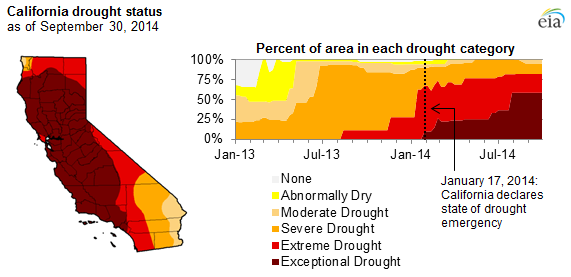
graph of California drought status, as explained in the article text

Source: U.S. Department of Agriculture Drought MonitorNational Drought Mitigation Center

The drought in California continues to increase in severity since California's governor declared a state of drought emergency in January 2014. As of September 30, 58% of the state was classified as experiencing exceptional drought, the most intense drought category. These dry conditions limit hydropower generation, requiring generation from other sources to make up for the shortfall.

Bad news is Hydropower has decreased due to the drought from 20% to 10%.

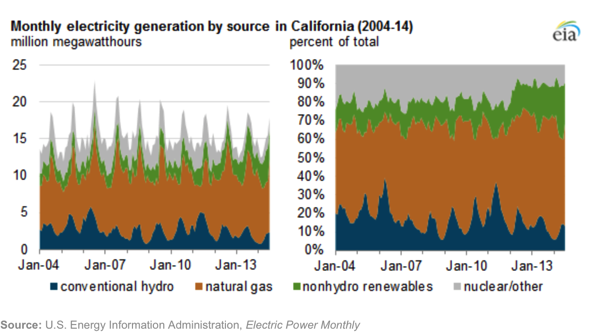
California's drought, which began in 2011, has resulted in a significant decline in hydropower generation. On average, hydropower accounted for 20% of California's in-state generation during the first six months of each year from 2004 to 2013. During the first half of 2014, however, hydropower accounted for only 10% of California's total generation. Monthly hydropower generation in 2014 has fallen well below the 10-year range for each individual month.

Good news is Wind and Solar grew to be bigger than hydropower.

California's drought, which began in 2011, has resulted in a significant decline in hydropower generation. On average, hydropower accounted for 20% of California's in-state generation during the first six months of each year from 2004 to 2013. During the first half of 2014, however, hydropower accounted for only 10% of California's total generation. Monthly hydropower generation in 2014 has fallen well below the 10-year range for each individual month.

In the below graph you can see the % of power coming from the various sources.

NewImage

One Good thing about a Break up, Fighting Change is Not Accepted

HP hit the news with its breakup following eBay/Paypal, and there are even rumors of Cisco.

With HP and eBay breakups already underway, could Cisco be next?

4 HOURS AGO
SUMMARY:

In its present state, Cisco is too big and slow to compete in a downsizing world of IT vendors, according to RBC Capital Markets analyst Mark Sue.

...

Given that Hewlett-Packard is already bifurcating itself into an enterprise company and a PC-and-printer vendor, eBay is breaking out PayPal as a separate entity, and Elliott Management is pushing EMC to spin out VMware, it’s clear that big companies are under tremendous pressure to “maximize shareholder value” by breaking themselves apart.

The main focus on what most people write is how much better it is financially to split the companies up.  So is that the only reason to split, because financially it is a better deal?

One thing a split does is there are going to be massive changes in the organizations.  Who is responsible for what.  How big do teams need to be.  If economies of scale worked perfectly, then it should be less efficient to be split.  Too many times the way things are done is people protecting their territory.  When your territory is split in pieces you can’t say no don’t split my group up.  You will split and be a participant or we will add you to the list of people who should be part of the layoffs.  Oh, yeh, I am totally supportive of the split.  Count me, and keep my job.

99.99% available services, Are Tiers relevant? The Cloud may be more disruptive than misinformed

Uptime Institute has a post in Response to an AFCOM post on Tier Standards.


An abbreviated version of this column was written for Data Center Knowledge in response to an interview with AFCOM Denver Chapter President Hector Diaz, on September 11, 2014.

...

The Tier standards offered by the Uptime Institute can often be confusing at present.

Tiers are summarized as these 4 levels.

  • Tier IV - Fault tolerant site infrastructure
  • Tier III - Concurrently maintainable site infrastructure
  • Tier II - Redundant capacity components site infrastructure (redundant)
  • Tier I - Basic site infrastructure (non-redundant)

So when you want a highly available service you would assume you need a Tier 3 or 4 data center.  But for services like Netflix, eBay, and Google, there are 3-5 data centers running services where a data center can go down and services are still available.  I don’t ever hear these guys talking about they have built Tier 3 or 4 data centers.  Heck, Netflix proudly says they don’t need data centers, using Amazon and Google Cloud Services.

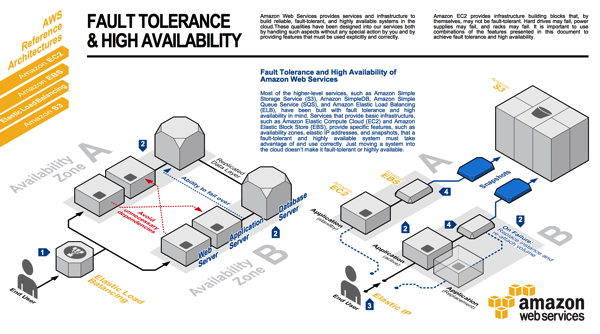
Given 99% or more of start up are using the cloud to build services and following guidance like AWS architecture for high availability services, are Tier ratings of data center relevant?

NewImage

Instead of talking about tiers, highly available cloud services talk about availability zones.

Regions and Availability Zones

Amazon EC2 is hosted in multiple locations world-wide. These locations are composed of regions and Availability Zones. Each region is a separate geographic area. Each region has multiple, isolated locations known as Availability Zones. Amazon EC2 provides you the ability to place resources, such as instances, and data in multiple locations. Resources aren't replicated across regions unless you do so specifically.

Amazon operates state-of-the-art, highly-available data centers. Although rare, failures can occur that affect the availability of instances that are in the same location. If you host all your instances in a single location that is affected by such a failure, none of your instances would be available.

NewImage


While AFCOM and Uptime Institute debate Tier Standards, the technology community is moving to Availability Zones practices. 

Netflix just survived the unavoidable rebooting of 10% of its cassandra servers in AWS due to Xen maintenance.  And Netflix has survived a variety of data center outages in AWS as well.

A State of Xen - Chaos Monkey & Cassandra

 
On Sept 25th, 2014 AWS notified users about an EC2 Maintenance where “a timely security and operational update” needed to be performed that required rebooting a large number of instances. (around 10%)  On Oct 1st, 2014 AWS sent an updated about the status of the reboot and XSA-108.


While we’d love to claim that we weren’t concerned at all given our resilience strategy, the reality was that we were on high alert given the potential of impact to our services.  We discussed different options, weighed the risks and monitored our services closely.  We observed that our systems handled the reboots extremely well with the resilience measures we had in place.  These types of unforeseen events reinforce regular, controlled chaos and continued to invest in chaos engineering is necessary. In fact, Chaos Monkey was mentioned as a best practice in the latest EC2 Maintenance update.