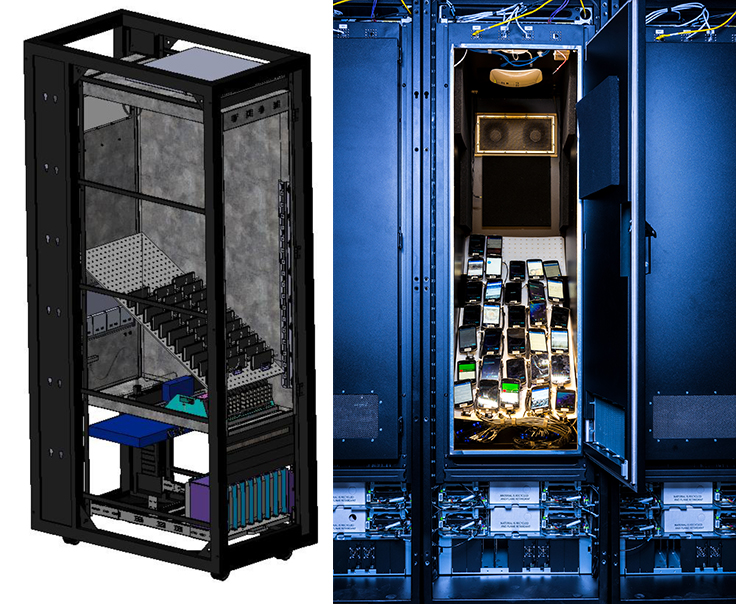
Facebook has made the switch to mobile first and part of that is they need to test a lot of mobile devices. Facebook posted their latest testing efforts hosted in a data center here.
Here is what the enclosure looks like.
Your Custom Text Here
Facebook has made the switch to mobile first and part of that is they need to test a lot of mobile devices. Facebook posted their latest testing efforts hosted in a data center here.
Here is what the enclosure looks like.
Ted has a video explaining the Chinese Zodiac.
one of the insightful parts was how asking the your sign says how old you are without asking your age.
Listening to the presentation more it occurred that sometimes it is helpful to organize people into smaller groups so they can interact. Dividing people into groups of 12 is what the China Zodiac system does. The western monthly zodiac is not nearly as useful.
So what is the Chinese zodiac, exactly? Most Westerners think of Greco-Roman zodiac, the signs divided into 12 months. The Chinese zodiac is different. It's a 12-year cycle labeled with animals, starting with a Rat and ending with a Pig, and has no association with constellations. For example, if you were born in 1975, you are a Rabbit. Can you see your zodiac sign there? Our Chinese ancestors constructed a very complicated theoretical framework based on yin and yang, the five elements and the 12 zodiac animals. Over thousands of years, this popular culture has affected people's major decisions, such as naming, marriage, giving birth and attitude towards each other. And some of the implications are quite amazing.
1:57 The Chinese believe certain animals get on better than the others. So parents choose specific years to give birth to babies, because they believe the team effort by the right combination of animals can give prosperity to families. We even refer to the zodiac when entering into romantic relations. I'm a Pig; I should have perfect romance with Tigers, Goats and Rabbits. Chinese people believe some animals are natural enemies. As a Pig, I need to be careful with a Snake. Raise your hand if you are a Snake. Let's have a chat later.
Hello, World!
To run Internet services requires many teams to interact. What makes things harder is there are not a clear set of rules to support Good Ways for the teams to interact. The ways tend to develop organically. Speaking of organic I was looking at a presentation John Boyd created called "Organic Design for Command and Control." Slide 10 had the positive and negative interactions of command and control. This made me think of how teams interact. The slide deck is here. and the slide I was looking at is this one.
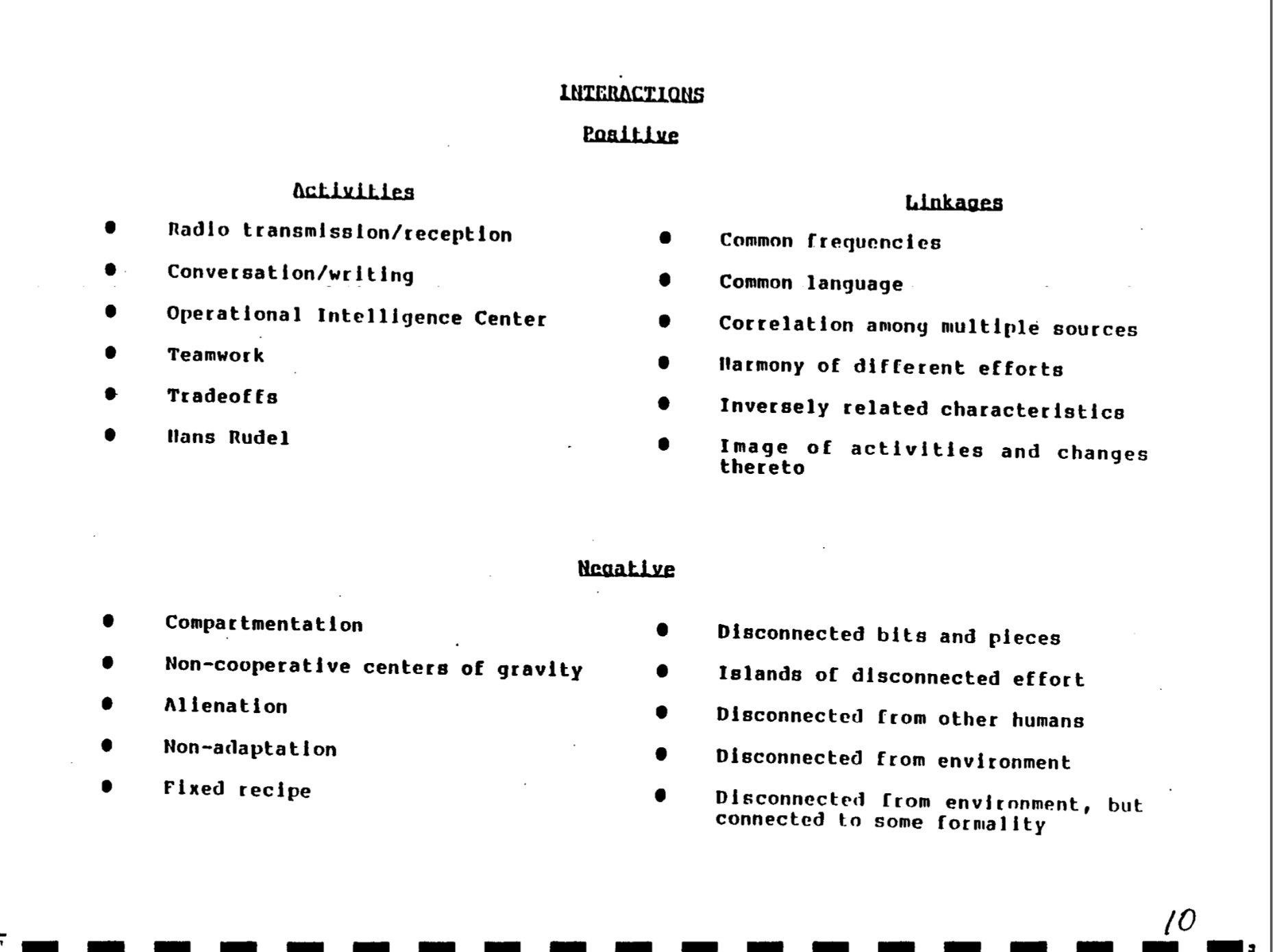
I've been staring at this slide for a while and let me translate this into how it applies to teams. If more managers spent time reducing the negatives and increasing the positives the teams will work so much better.
Ted has a talk by Blaise Aguera Y Arcas.
We're on the edge of a new frontier in art and creativity — and it's not human. Blaise Agüera y Arcas, principal scientist at Google, works with deep neural networks for machine perception and distributed learning. In this captivating demo, he shows how neural nets trained to recognize images can be run in reverse, to generate them. The results: spectacular, hallucinatory collages (and poems!) that defy categorization. "Perception and creativity are very intimately connected," Agüera y Arcas says. "Any creature, any being that is able to do perceptual acts is also able to create."
one of the best parts in the closing which Blaise has gotten good at given this is his 3rd TED talk.
16:00
In closing, I think that per Michelangelo, I think he was right; perception and creativity are very intimately connected. What we've just seen are neural networks that are entirely trained to discriminate, or to recognize different things in the world, able to be run in reverse, to generate. One of the things that suggests to me is not only that Michelangelo really did see the sculpture in the blocks of stone, but that any creature, any being, any alien that is able to do perceptual acts of that sort is also able to create because it's exactly the same machinery that's used in both cases.
16:37
Also, I think that perception and creativity are by no means uniquely human. We start to have computer models that can do exactly these sorts of things. And that ought to be unsurprising; the brain is computational.
16:50
And finally, computing began as an exercise in designing intelligent machinery. It was very much modeled after the idea of how could we make machines intelligent. And we finally are starting to fulfill now some of the promises of those early pioneers, of Turing and von Neumann and McCulloch and Pitts. And I think that computing is not just about accounting or playing Candy Crush or something. From the beginning, we modeled them after our minds. And they give us both the ability to understand our own minds better and to extend them.
When you build your own data centers going green is pretty straight forward to source renewable energy. When you live other data centers you can take the position that you can't do anything unless your landlord provides green energy. You can request, but that is about it.
Akamai posts on its initiative to invest in local renewable energy projects directly.
Green is the Warmest Color
Rob Morton By Rob Morton June 28, 2016 10:30 AM
0 Comments
AddThis Sharing Buttons
Recently, Akamai announced the company's plans to expand its sustainability initiatives through an innovative renewable energy procurement strategy. Unlike many of its peers in the tech industry, Akamai does not operate its own data centers. That means, for example, we don't have roofs on which to install solar panels, which is one key way of generating your own renewable power.
So, what does the company that operates the world's largest distributed computing platform do? Akamai plans to initiate long term investment in renewable energy projects, geographically aligned with network operations and commensurate with aggregate network energy usage that includes third-party, co-location data centers. Simple, right?
To learn more about Akamai's green initiatives, please visit:
http://www.datacenterdynamics.com/power-cooling/akamai-plans-to-go-50-percent-renewable/96180.article
https://www.greenbiz.com/article/akamai-will-power-internet-sun-and-wind
http://www.datacenterknowledge.com/archives/2016/05/11/akamai-pledges-to-source-renewable-energy-for-data-centers/