Need to bring my Yellow/Red Referee cards to DC Conference

I count myself extremely lucky hanging around some of the thought leaders in the data center industry. In the past I would travel with and spend time at conferences with Mike Manos when he ran Microsoft's data center group and Olivier Sanche when he ran eBay's data center group. I still get to hang with the thought leaders and one of the things I see too often are the sales guys who would circle like sharks around a target, waiting for when they could move in. Most of the time the sales sharks keep their distance.

Sometimes though the sales sharks commit when there is no opening and they interject themselves in to an existing conversation. After a minute if the sales shark doesn't back off, we figure out whose turn it is to save the DC executive from the sales shark.

What do you do? We typically joke about it later. I can tell you never do any of these sales sharks score a "so glad that guy interrupted our conversation to tell me about his product/service." So, how do you stop the sales shark predator behavior? Is this just part of what comes with going to a DC conference?

The idea I had years ago, and I still have them is a package of Yellow and Red referee cards used by soccer referees.

If I pull a yellow card and have one of our friends take a picture we would have record of committing a foul, interrupting a conversation. We could then share the image with others, and hopefully the sales shark would go away. This could be pretty funny too. Dude perfect has their own youtube video.

if we wanted to make it even funnier we could make it like a photobomb with someone inserting themselves with a yellow card.

Can you see the Future of Data Centers? It's coming

I just spent the week at DatacenterDynamics Webscale in San Jose and had many, many conversations with lots of laughs. It's now Saturday morning and at 4:30a I started to think about what the future of data centers will look like. Many of the conversations came together.

Some announcements came this week can be used to show the changes that are coming.  One is Google's post on Deepmind with Jim Gao.

Major breakthroughs, however, are few and far between — which is why we are excited to share that by applying DeepMind’s machine learning to our own Google data centers, we’ve managed to reduce the amount of energy we use for cooling by up to 40 percent. In any large scale energy-consuming environment, this would be a huge improvement. Given how sophisticated Google’s data centers are already, it’s a phenomenal step forward.

Another is Coolan being acquired by Salesforce.

Coolan, was founded by Amir Michael, formerly a hardware engineer at Google GOOG 0.56% and Facebook FB 0.32% , two companies that know quite a bit about deploying massive amounts of computing hardware. Coolan, which has ten employees, has scored an unknown amount of venture funding from North Bridge Venture Capital and Social Capital.

Michael’s work at Facebook contributed to the launch of the Open Compute Project, an effort to make the design specifications for efficient and powerful data center hardware available to anyone.

I have had the pleasure of having awesome conversations with Jim and Amir where we can all geek out on challenges in the data center. Since none of these conversations were with intent of writing a blog post, there are details I can't share and quite frankly I can't remember the details. :-) But the high level concepts stick around in long term memory and repeat.

So what is the future of data centers? It is people like Jim, Amir, and a few others who see the changes that could be made. How data is the basis for insight and discovery. Amir writes in a blog post.

These last few years have been some of the most fulfilling of my career. Together with my brother and co-founder Yoni, we successfully launched a company that brought transparency to hardware operations. We hired a talented team of engineers who developed tools that empower our customers to track and analyze infrastructure reliability for increased uptime and optimized efficiency.

Building a startup is an awesome journey, and I’m incredibly proud of the work we’ve done. Once the transaction has closed, the Coolan team will help Salesforce optimize its infrastructure as it scales to support customer growth around the world.
— http://www.coolan.com/blog/2016/7/21/salesforce-signs-definitive-agreement-to-acquire-coolan

If you want to know what the future data centers is going to look like you need to talk to people like Jim Gao, Amir Michael, and others who have a passion to make changes with data and transparency in operations.

Chinese Zodiac used to organize people

Ted has a video explaining the Chinese Zodiac.

one of the insightful parts was how asking the your sign says how old you are without asking your age.

Listening to the presentation more it occurred that sometimes it is helpful to organize people into smaller groups so they can interact. Dividing people into groups of 12 is what the China Zodiac system does.  The western monthly zodiac is not nearly as useful.

So what is the Chinese zodiac, exactly? Most Westerners think of Greco-Roman zodiac, the signs divided into 12 months. The Chinese zodiac is different. It's a 12-year cycle labeled with animals, starting with a Rat and ending with a Pig, and has no association with constellations. For example, if you were born in 1975, you are a Rabbit. Can you see your zodiac sign there? Our Chinese ancestors constructed a very complicated theoretical framework based on yin and yang, the five elements and the 12 zodiac animals. Over thousands of years, this popular culture has affected people's major decisions, such as naming, marriage, giving birth and attitude towards each other. And some of the implications are quite amazing.

1:57 The Chinese believe certain animals get on better than the others. So parents choose specific years to give birth to babies, because they believe the team effort by the right combination of animals can give prosperity to families. We even refer to the zodiac when entering into romantic relations. I'm a Pig; I should have perfect romance with Tigers, Goats and Rabbits. Chinese people believe some animals are natural enemies. As a Pig, I need to be careful with a Snake. Raise your hand if you are a Snake. Let's have a chat later.

Hello, World!

The Good and Bad Ways that Teams Interact

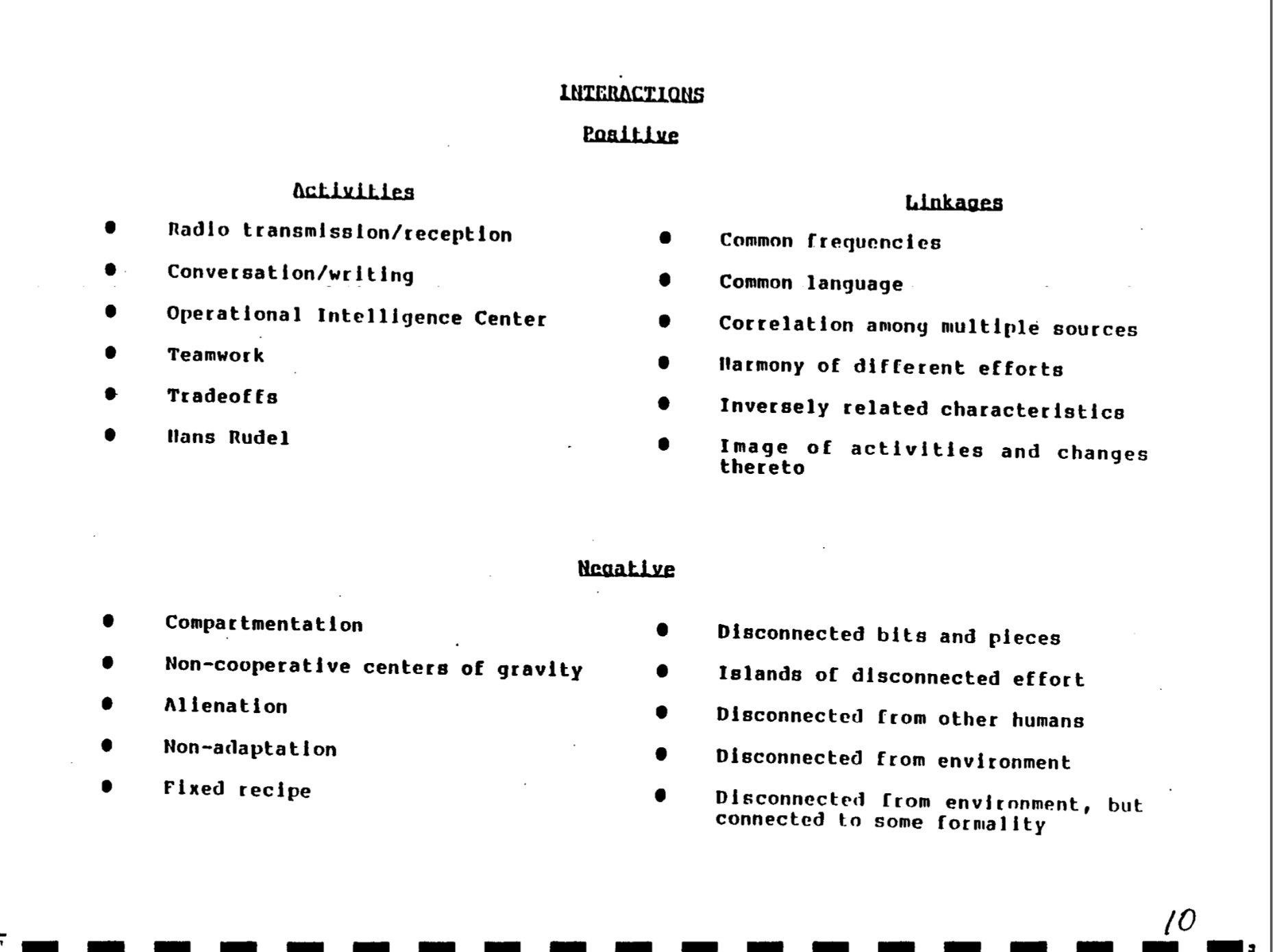
To run Internet services requires many teams to interact. What makes things harder is there are not a clear set of rules to support Good Ways for the teams to interact. The ways tend to develop organically. Speaking of organic I was looking at a presentation John Boyd created called "Organic Design for Command and Control." Slide 10 had the positive and negative interactions of command and control. This made me think of how teams interact. The slide deck is here. and the slide I was looking at is this one.

I've been staring at this slide for a while and let me translate this into how it applies to teams. If more managers spent time reducing the negatives and increasing the positives the teams will work so much better.