Good example of networking at 7x24Exchange conference

The top benefit of attending a conference like 7x24 Exchange is networking. Meeting new people and building better connections with people you know. Kieran Begnan, CEO of Integration Facility Solutions posted a LinkedIn post that has had 48 likes and 10 comments.

This is both a good example of networking at 7x24 Exchange and a good way to post about your experience on LinkedIn to share with others. The 48 likes has spread the word to many more. Note this post has had over 4,500 views in 2 weeks. 

China’s JD.COM shares its automated warehouse and logistics system

Axios posts on JD.COM’s automated warehouse. https://www.axios.com/china-jd-warehouse-jobs-4-employees-shanghai-d19f5cf1-f35b-4024-8783-2ba79a573405.html 

 “JD.com, a Chinese e-commerce gargantuan, has built a big new Shanghai fulfillment center that can organize, pack and ship 200,000 orders a day. It employs four people — all of whom service the robots.

What's going on: Welcome to the creeping new age of automation. When the talk turns to Chinese big tech — rivals to Google, Amazon and the rest of Silicon Valley — the names usually cited are Alibaba, Baidu and Tencent. But scrappy JD, with a respectable $58 billion market cap, is investing aggressively to be added to the pantheon.”

JD.COM shares its vision is similar to Amazon’s Jeff Bezos.

”The rap on JD has beenthat it is far less profitable than Alibaba. But JD responds that, as Jeff Bezos expanded Amazon, its logistics buildout is proof it is investing in itself.

  • "Everything is about scale," says CTO Chen Zhang, speaking with a small group of reporters at its Beijing headquarters.
  • "When you invest in technology, you don't worry about spending money. You worry whether you can get to scale. When scale comes, profit will come."”
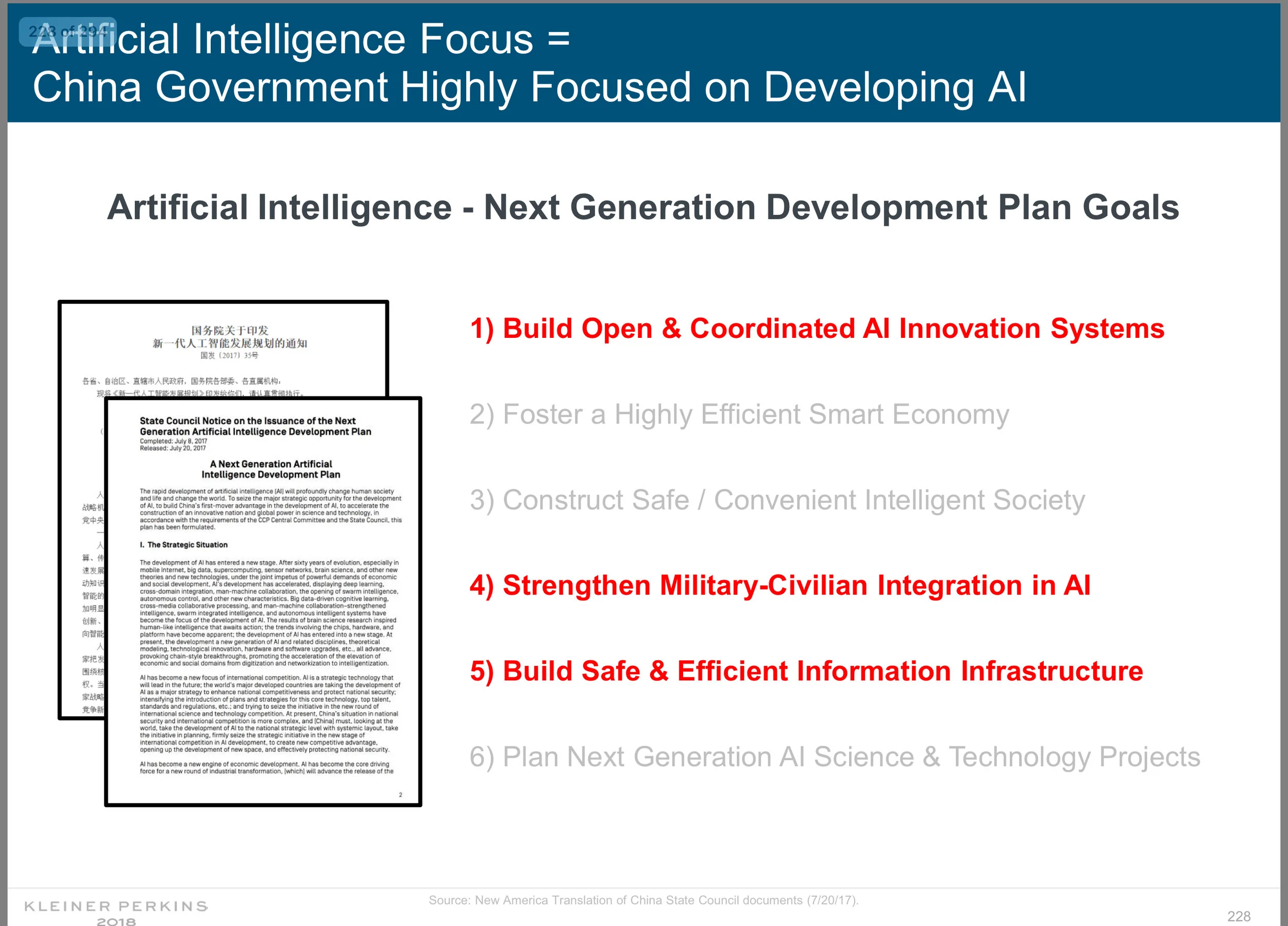
The one slide out of 294 Mary Meeker’s 2018 Internet Report that shows great insight

Mary Meeker is famous for her 2018 Internet Trends report. Here is the link that you can go through it. http://kpcbweb2.s3.amazonaws.com/files/121/INTERNET_TRENDS_REPORT_2018.pdf?1527701640 

It is 294 slides. 

Out of all the slide, here is the one that caught my eye as demonstration of the insight Mary has.  This is slide # 228.

In this one slide Mary covers the state of China’s AI efforts and 6 goals that are part of the plan. This is something that had occurred to me a couple of years ago, but hadn’t summarized it as well as Mary did. 

When you plan your AI and ML efforts you need to account for what China is doing and how your efforts will be impacted by China’s effort.

FullSizeRender.jpg

Six basic plots support most stories told, which stories do you like to tell?

Storytelling is valuable skill. Studying it helps you get better. There is a category that was added to this blog for storytelling. A recent BBC article nicely covers the idea that there are six basic plots.

Researchers analysed over 1700 novels to reveal six story types – but can they be applied to our most-loved tales? Miriam Quick takes a look.
By Miriam Quick
25 May 2018
“My prettiest contribution to the culture” was how the novelist Kurt Vonnegut described his old master’s thesis in anthropology, “which was rejected because it was so simple and looked like too much fun”. The thesis sank without a trace, but Vonnegut continued throughout his life to promote the big idea behind it, which was: “stories have shapes which can be drawn on graph paper”.

If you want to see the origin of concept check out this video that is good for a laugh.

The computer analysis of the story was covered 2 years ago in MIT Technology Review.

Kurt Vonnegut came up with this idea of the shape of stories for his master's thesis in anthropology at University of Chicago.

If you are still curious check out the paper which goes into depth on the idea that there are six shapes dominate stories.

Here is the shape of Harry Potter and the Deathly Hollows.

Screen Shot 2018-05-30 at 10.00.54.png

Applying Rubber Duck Debugging idea to Modeling Projects

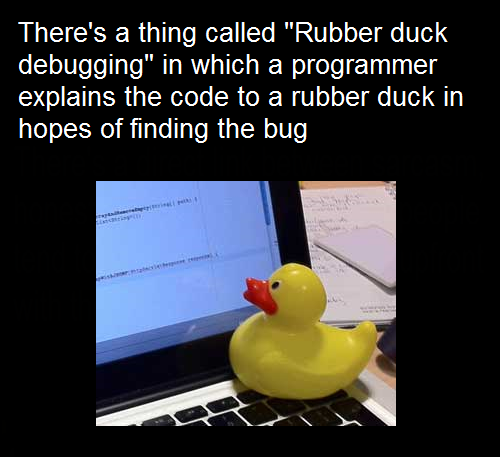
In software development there is the idea of Rubber Duck Debugging.

Rubber duck debugging
From Wikipedia, the free encyclopedia
In software engineering, rubber duck debugging or rubber ducking is a method of debugging code. The name is a reference to a story in the book The Pragmatic Programmer in which a programmer would carry around a rubber duck and debug their code by forcing themselves to explain it, line-by-line, to the duck.[1] Many other terms exist for this technique, often involving different inanimate objects.

Many programmers have had the experience of explaining a problem to someone else, possibly even to someone who knows nothing about programming, and then hitting upon the solution in the process of explaining the problem. In describing what the code is supposed to do and observing what it actually does, any incongruity between these two becomes apparent.[2] More generally, teaching a subject forces its evaluation from different perspectives and can provide a deeper understanding.[3] By using an inanimate object, the programmer can try to accomplish this without having to interrupt anyone else.
tumblr_n70ml7ecgq1rhavdko1_500.png

I've been working on how to model projects and I have turtles in my model and I guess I could start talking to them to debug the process.

I started with the cubes. then added arrows and pawns on a dungeons and dragons grid. I am off to a data center next week to review the project ideas and I am ready for them to laugh at my turtles and modeling.

You are probably laughing, but the ideas I am coming up with are pretty good. The purple turtle frequently likes the ideas I tell him. :-)

fullsizeoutput_1c5f.jpeg