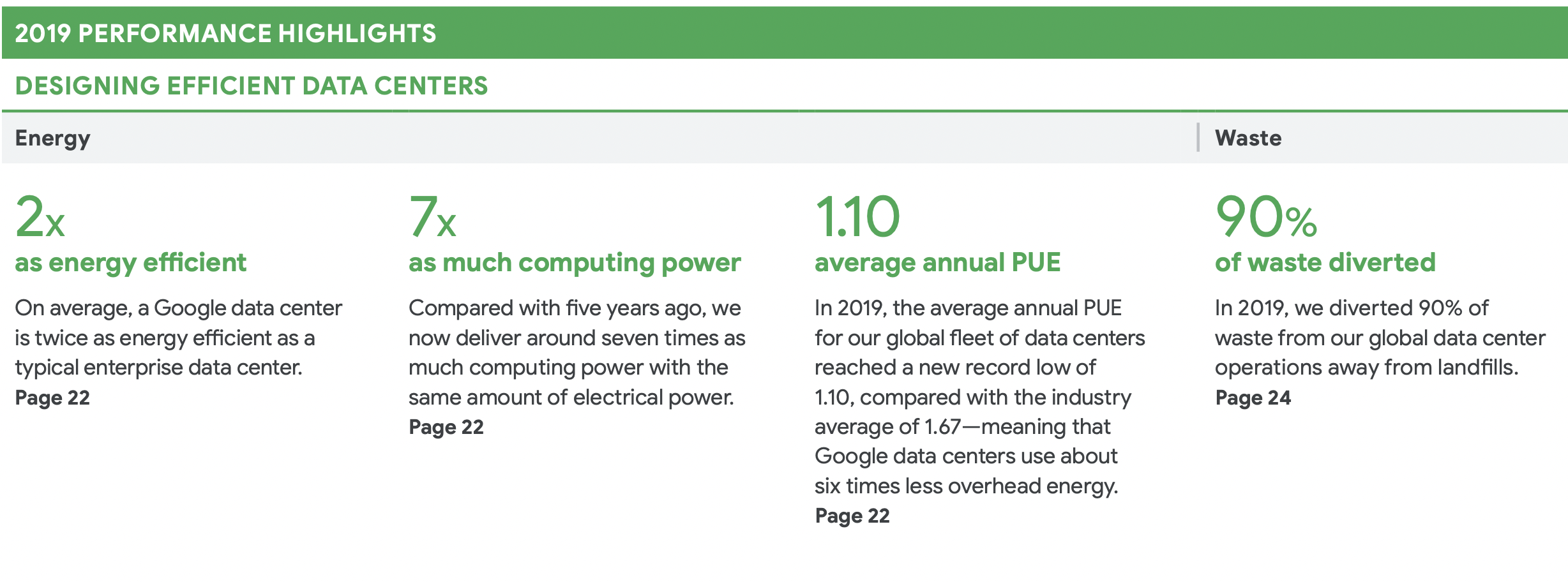
Next 20 years of Google's Environmental Impact after 20 years of effort

Google published its 2020 Environmental Impact report and it is nice.

But reading the report it missed something. I looked at who the Google Executive referenced in the report and it is Ruth Porat Alphabet and Google CFO. Ah. it reads like a financial statement. Well I guess it is a report. Urs Hölzle Senior Vice President of Technical Infrastructure is also a co author.

Google discusses the next decade which is also good. But it was missing something still.

What would I write? Make it more of a challenge. What is it Google could achieve in 20 years. What could it dream. What is it a Gen Z new hire would want to spend working on thet is worth 20 years of their time which il almost is double their life.

The past results are good if you know about PUE, energy efficiency, power per watt, but that is a small fraction of people.

Getting people excited about the future and what could be done is a much bigger audience.

a1.png

Learning what makes a great organization. Ron Westrum's words and reused.

A friend pointed to Andrew Shafer’s post on developer ideas. in one of his slide decks he points to Westrum Typology. When I first saw it I thought it was Western Typology. No Westrum. Westrum who? looking it up Ron Westrum created the Westrum Typology. Has Ron written anything. One book. A book with 5 stars ratings on amazon.com. A book on how the Sidewinder missile was developed.

In the mid-1950s a small group of overworked, underpaid scientists and engineers, working on a remote base in the Mojave Desert, developed a weapon no one had asked for but that everyone was looking for. Sidewinder is the story of how that unorthodox team at China Lake, lead by the visionary Bill McLean, overcame Navy bureaucracy and more heavily funded projects to develop the world’s best air-to-air missile.

Got more curious after buying the book and wrote to Ron and asked him for other things to read. One of the paper’s Ron wrote was on information flow and its impact on safety.

“Not only is information flow vital to the organization’s ‘‘nervous system,’’ but it is also a key indicator of the quality of the organization’s functioning. “

“The important features of good information flow are relevance, timeliness, and clarity.”

“By examining the culture of information flow, we can get an idea of how well people in the organization are cooperating, and also, how effective their work is likely to be in providing a safe operation.”

Ron is 75 and has spent a long time studying organizations. It is interesting that the DevOps community has picked up on his Typology.

A DevOps book Accelerate: The Science of Lean Software and DevOps: Building and Scaling High Performing Technology Organizations has a chapter with much of Ron’s ideas integrated.

What is biggest challenge for Greening Data Center? Cultural change

I have been writing on green data centers for so long and I got bored after a while as it was all the same. People were resistant at first. Greenpeace put pressure on some companies. There were people early on who saw the benefits of greening their data center efforts. Now almost everyone has a green data center effort. but are the data centers really that much greener than 10 years ago? No, most are not. They may have sourced energy from renewable energy sources, but is that all it takes. Is this sustainable?

What is needed is a cultural change.

One of the interesting ways to look at the situation is from this cultural typology by Ron Westrum.

Table 1: The Westrum organizational typology model: How organizations process information (Source: Ron Westrum, "A typology of organisation culture)," BMJ Quality & Safety 13, no. 2 (2004), doi:10.1136/qshc.2003.009522.)

westrum.png

Sourdough baking as a feedback loop to a better state of mind

On Mar 7, 2020 I started my effort to bake sourdough ordering from King Arthur Baking. I love to cook and have not been a big baker, and decided to give it a try. I was lucky and started this effort before covid got so many others into baking. I had flour, active yeast, and my new sourdough. It has now been over 7 months and I now bake sourdough once every two days. Luckily I got a new gravel ebike that I will write about and ride over a 100 miles a week now and can eat my sourdough without worrying about weight gain.

below is my first batch of baguettes that tasted good, but they looked horrible.

Untitled.jpg

Now my sourdough boules look like this.

Untitled+2.jpg

I have tried different recipes. Different flours. Watched many videos. And got a much better feeling for when the dough is right. Nice thing this got me to experiment with my pizza dough recipes and they got better too.

I knead the dough which some consider a waste of time. I use the kneading time as part of meditation exercise and I figure out many different tough issues. If my mind is not in the right state I cannot see if the dough is right. Seeing things for how they are is one of the hardest things

Untitled 3.jpg

Some ask if I use my pizza over to bake the sourdough. Nope. I use a regular oven and Lodge Dutch oven which makes it so I can easily bake my sourdough when I travel by car and can bring all my supplies. At some point I’ll work on baking sourdough in my pizza oven, but that is much more time consuming. After months of practice I’ve worked on how I bake as if it a classic process engineering problem with my own time and motion studies. Now I can make one batch which is for two loaves. Bake one. Have other for slow fermentation in the fridge. Two days later bake that one. Now I am only making dough twice a week and having fresh sourdough every other day.

After 7 months of baking sourdough I have a regular meditation feedback system that helps me work on tough issues and lets me share bread that is so much better than what I have bought in bakeries or stores.

Great Leadership by Admiral Levering Smith made Polaris success, not PERT

In my research of how PERT became a myth of project management’s power. The key to the success of the Fleet Ballistic Missile program Polaris was great leadership, decentralized organization, and an esprit de corps to save the world from nuclear war. One of the people I ran across was Admiral Levering Smith and reading about the Admiral reminds me of some of the great project managers like Sheila Brady (System 7) and Dennis Adler (Windows 95). I have been lucky to work on both of the operating systems at Apple and Microsoft and saw first hand how these people worked.

Below are highlights from a memorial of Admiral Levering Smith that is here.

Levering knows of his patient, open approach to each new goal—using, and giving credit for, every sound idea and accomplishment. Levering's leadership style was almost the antithesis of that of the textbook, dynamic, emotional leader about which stories are told. He was a leader because he respected the goals of his superiors, respected the responsibilities he had been given, and respected the capabilities of those working for and with him, and he made this apparent to everyone without ever a touch of ego.

Raborn almost immediately drafted Levering from White Sands to lead this work because of his reputation as the navy's preeminent expert on rockets and solid propellants. It was the beginning of an assignment that ultimately produced the most convincing and effective of the nation's strategic deterrent weapon systems.

Levering's planning, which Admiral Raborn accepted, included an innovative and critically important approach to the definition of the requirements toward which everyone on the team worked.

The oceanographers and strategists didn't work in isolation. It was Red's and Levering's contention that the entire team should participate so that each member recognized the critical issues and the relative importance of the goals. A "board of directors" was formed, which was called "the steering task group." Red was the chairman, and Levering was the responsible architect of what the task group was to do. Represented were the leaders of the participating universities, the navy commands who would need to support the program, and the responsible executives of the prime contractors and the critical subcontractors. Part of the strategy was to put on the steering task group not the program directors but their bosses. It was a powerful task force, and it spent three months defining the total program including schedules, costs, performance goals, and the distribution of the task among the members. This was a revolution in management. It wasn't a "method"; it was pure Levering— understand the problem; agree on the approach and risks; and define and agree on the real requirements, the schedule relationships, and the resources required. Once the program was defined and understood, the steering task group met nearly monthly agreeing on changes, modifying plans, and adjusting resources. Everyone was focused on the total task, not an individual element. An example of early goal setting was the range of the Polaris. If the Polaris didn't go 1,200 nautical miles, it couldn't justify its existence; similarly, if its accuracy didn't meet a minimum, it shouldn't be created. However, if the accuracy was adequate and the range approached 1,500 to 2,000 nautical miles, a lot of sea room opened up to improve the invulnerability of the submarine. There were no fixed specifications, just the bottom limits to ensure a total system effectiveness— again, pure Levering. Supplementing this broad policy, Levering Smith and Red Raborn initiated and encouraged a true team effort among the military, civil service personnel, and contractors. Adversarial conditions were quickly sorted out and eliminated. In addition, the facts—failures as well as triumphs—were always available to the world outside of the Department of Defense and Congress as needed. This concept had never penetrated normal Washington procurement mores, but it was the foundation for a monumental success. We must hope that history recognizes Levering's fine hand and mind in creating such an environment. This was real management.

He was what he appeared to be: a highly intelligent, rational, practical engineer with immense respect for those around him, particularly those with good ideas and a reasonable approach to developing them. And above all, he was a gentleman.

To be continued.