Two smartest guys in construction - Pete Kangas and Chris Heger - a great learning experience

Pete Kangas is now retired and he has updated his LinkedIn Profile. Pete and I have known each other for over 10 years and we have regularly discussed so many topics over this time.

pkangas.jpg

In 2012 Pete said let me introduce you to the smartest guy at Turner Construction. And I met Chris Heger.

aChrisHeger.png

When I met Chris the first thing he did was discuss Industrial Engineering ideas for 10 minutes. Mogensen, Gilbreth, and many other topics. After 10 minutes, it was clear that Chris was not your normal construction person who had the aptitude to change the way construction works. To accelerate the discussions I told Chris that I was an Industrial Engineer and knew well his concepts. For my time studying Industrial Engineering at UC Berkeley I do not think I ever heard anyone say get a job in construction. I decided to take my IE degree and go into High Tech and worked at HP in logistics.
aHP.png

What does a guy like me who worked at HP, Apple, and Microsoft who spent no time in the real estate, construction, or facility operations group know about who the smart construction people are. Well, I know lots of smart people from those the companies and how they work. When it comes to construction that was not my expertise, but I got a good introduction to construction working with Olivier Sanche while he was at eBay and Skanska was the construction company. Skanska wanted help and decided to hire me to work with eBay and that was when I got an idea of how construction companies work.

aSkanska.png

So why do I think Pete and Chris are the smartest guys in construction. I find this quote summarizes it well.

Because when it comes down to it, what I think makes someone smart is their desire to learn more, and their desire to use what they’ve learned to solve problems moving forward.

https://www.psychreg.org/what-does-it-mean-to-be-smart/

This is the 1st in a new series of blogging I plan on spending the month on and probably longer.

For those of you know Pete, you can send your congratulations on his LinkedIn Page.

Pete is here in Seattle as well as Chris. We regularly discuss ways to change construction and how to use information technology. And with Pete’s retirement we will continue to have many more discussions on how construction can change by solving some really hard problems.

One example of being smart is the following. The idea of choosing a better way to do things could be explained with the “Fork in the road” metaphor.

A fork in the road is a metaphor, based on a literal expression, for a deciding moment in life or history when choice of presented options is required and once chosen the choice cannot be reversed.

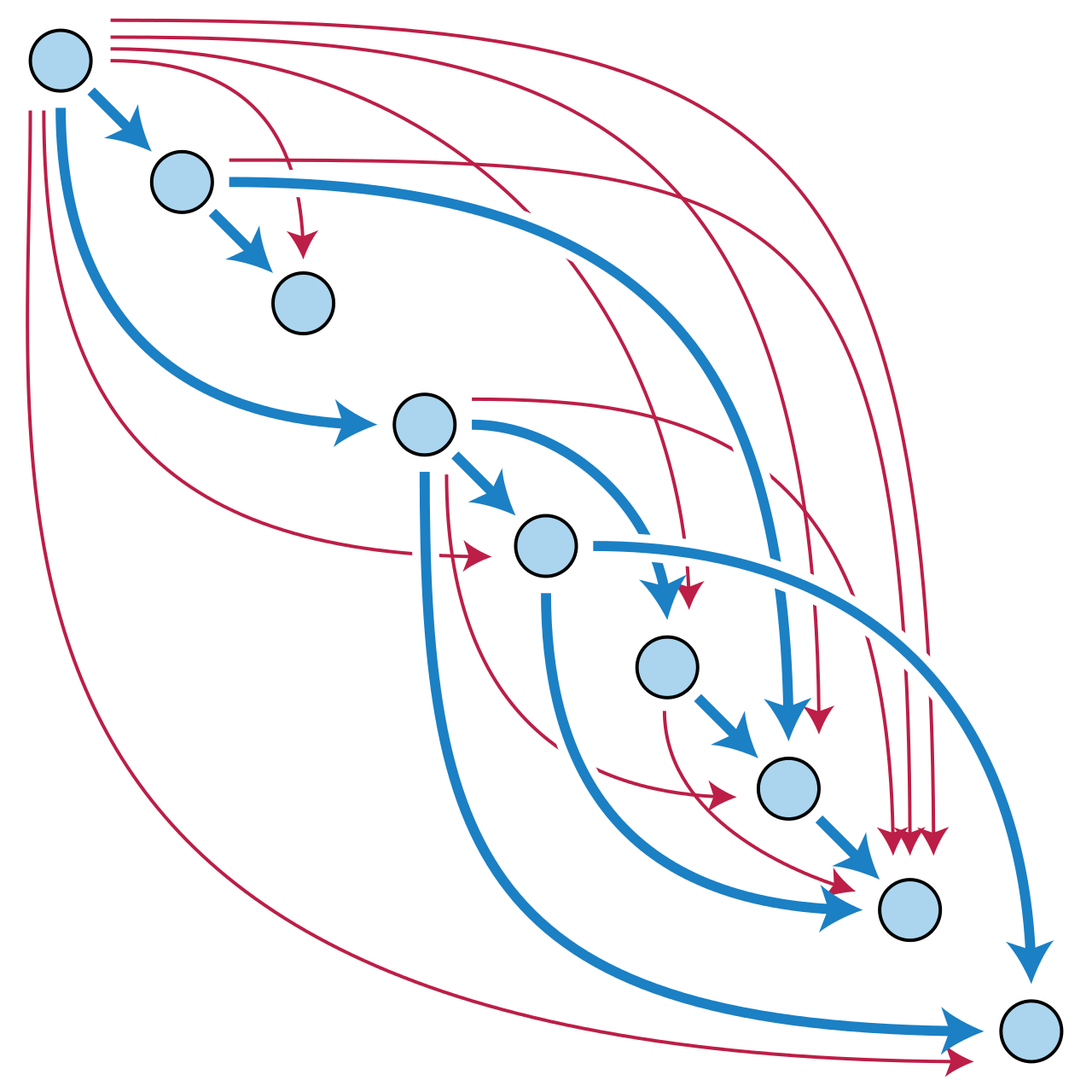
Computerizing the fork in the road does not work, but you could if you choose a smarter way to model the paths possible as a Directed Acyclic Graph. (DAG)

In mathematics, particularly graph theory, and computer science, a directed acyclic graph (DAG or dag /ˈdæɡ/ (listen)) is a directed graph with no directed cycles. That is, it consists of vertices and edges (also called arcs), with each edge directed from one vertex to another, such that following those directions will never form a closed loop. A directed graph is a DAG if and only if it can be topologically ordered, by arranging the vertices as a linear ordering that is consistent with all edge directions. DAGs have numerous scientific and computational applications, ranging from biology (evolution, family trees, epidemiology) to sociology (citation networks) to computation (scheduling).

Sometimes events are not associated with a specific physical time. Provided that pairs of events have a purely causal relationship, that is edges represent causal relations between the events, we will have a directed acyclic graph.[38] For instance, a Bayesian network represents a system of probabilistic events as vertices in a directed acyclic graph, in which the likelihood of an event may be calculated from the likelihoods of its predecessors in the DAG.[39] In this context, the moral graph of a DAG is the undirected graph created by adding an (undirected) edge between all parents of the same vertex (sometimes called marrying), and then replacing all directed edges by undirected edges.[40] Another type of graph with a similar causal structure is an influence diagram, the vertices of which represent either decisions to be made or unknown information, and the edges of which represent causal influences from one vertex to another.[41] In epidemiology, for instance, these diagrams are often used to estimate the expected value of different choices for intervention.[42][43]

There are only a few people who get the idea of a DAG in construction. Two of which are Pete Kangas and Chris Heger. Can you name another?
Transitive_Closure.svg.png

Data Centers look like Light Industry, but are Heavy Industry

Chatting with a low carbon construction executive who does not work in data centers make an interesting observation that data centers are like “Light Industrial” buildings. At first I said yeah data centers are light in that they are cleaner, no heavy mineral use like iron, coal, etc. But the observation was wrong. Because Light vs Heavy industry is primarily based on the capital cost. A warehouse distribution center is light industry. A manufacturing plants is a heavy industry. Data centers are 10X more expensive that a warehouse and it can easily have 10X the value of assets to run the data center.

Here is an example list of heavy industries


1. Chemicals and plastics
2. Steel and oil refining, production
3. Mining
4. Industrial machinery
5. Mass transit (railways, airlines, shipbuilders)

Read more: http://www.investopedia.com/terms/h/heavy_industry.asp#ixzz2AtKTXuBR
Follow us: @Investopedia on Twitter

In this Information Age, data centers should be on the list of heavy industries because of the capital equipment investment required. And data centers have the potential to be so much greener than the traditional heavy industries.

Two stories on greener construction

Microsoft posts its own story on geothermal wells for heating and cooling its new campus.

“We knew we wanted our new campus to be zero-carbon in its daily operations,” says Katie Ross, global sustainability lead for Microsoft real estate. “So we had to think outside the box on how to provide heating and cooling needs for these buildings. That’s really what drove us to geoexchange technology.”

In the rest of the story was nice to see Mike Green who I have met on another occasion is referenced.

For Mike Green, senior project manager for the Thermal Energy Center, the outcome will be worth the effort in building a sustainable future. The campus project is also building cisterns for 200,000 gallons of rainwater, diverting 95% of its demolition waste from landfills and reducing embodied carbon in building materials by at least 30%. Embodied carbon is carbon released in the manufacturing, production and transportation of construction materials.

“I’ve been in construction my entire 40-plus-year career and have never done a project that has such a commitment to the environment like the Thermal Energy Center,” says Green, building systems director of OAC, a construction and project management firm.

SeattleTimes has a guest opinion post by Anthony Hickling on carbon impact of construction material. In this article Anthony references the above Microsoft project for using its carbon material analysis tool.

For example, Microsoft is investing in a multibillion-dollar refresh of the company’s main campus east of Seattle. This project leveraged the Embodied Carbon in Construction tool, a calculator that was conceived by the industry, incubated by CLF and is now administered by a new nonprofit called Building Transparency. This tool compares the sustainability attributes of similar materials throughout design and construction to enable data-driven decisions that facilitate carbon-smart building material selections (think lower carbon concrete, steel, etc.). Since its launch in late 2019, this free tool already has attracted more than 12,000 users who together are signaling market demand for products with lower carbon footprints.

I’ll be syncing with Anthony in a couple of weeks to discuss his efforts and share my own regarding greener construction methods.

The Data Center Con Game

The con game has gone on for your so long and much of the attention has been on the political environment lately.

There are also con games in the data center industry.

Curious on how some people can fooled I found this article on the history of con and how it works. The article does a good job of covering the various techniques used by a con person. Reading them will help you spot the con. But as the article points out many times the conned defend the con game and the con person.

Here is a few paragraphs that cover this.

In 1822, a Scottish con man, Gregor MacGregor, convinced countrymen seeking easy wealth and their neighbors’ better lives to buy bonds, land and special privileges, fill two ships and sail to an idyllic country, the Land of Poyais

MacGregor priced land in Poyais to make it affordable to Scottish tradesmen and unskilled workers who had heard of promising South American investments but lacked the means to take advantage of them. Poyais had a distinctive flag, its own currency and a diplomatic office in London. The only problem was that Poyais did not exist. Most of those who sailed died on the Mosquito Coast of Honduras. Some of the few survivors were so taken in that they refused to accept that Poyais did not actually exist and argued that it was MacGregor who had been defrauded.

Please stop embedding information in serial numbers, Apple finally is taking this step

MacRumors covers the effort by Apple to switch to random serial numbers and stop embedding manufacturing information in the serial number with a sequence of higher numbers as more are built.

In an internal AppleCare email this week, obtained by MacRumors, Apple said the new serial number format will consist of a randomized alphanumeric string of 8-14 characters that will no longer include manufacturing information or a configuration code. Apple said the serial number format transition is scheduled for "early 2021," and confirmed that IMEI numbers will not be affected by this change.

Some people and organizations are stuck in the old school of a serial number has to be a sequence. It helps them count. They have a bean counter mindset.

a person, typically an accountant or bureaucrat, perceived as placing excessive emphasis on controlling expenditure and budgets.

In Arstechnica some are whining about the change.

Serial numbers are used in online forums, repair shops, and company IT departments to expedite troubleshooting and other tasks by quickly learning more about the machine in question—for example, whether a computer that is exhibiting a problem is part of a certain set of models manufactured in a certain time period that all have that issue. Some of the information will still be accessible after either booting the machine up or taking it apart.

But let’s look at what a random serial number approach does. #1 is u can make the number of characters shorter which has how many hours accumulated across customer support issues. The manufacturing process is much easier to assign a random number, then associate the relevant information required for support and service like manufacturing date, production run, manufacturing location. The current serial number has benefits in case of theft to determine information about the unit without logging into an Apple system to check the serial number information. If you log in, there is now an event at a given from an IP address that could help support recovery of stolen devices.

It is change that makes things easier in the long run, and a minor inconvenience for those who built their processes around the existing numbers.

One of these days serial numbers will be QR codes that can be quickly looked up for product status.