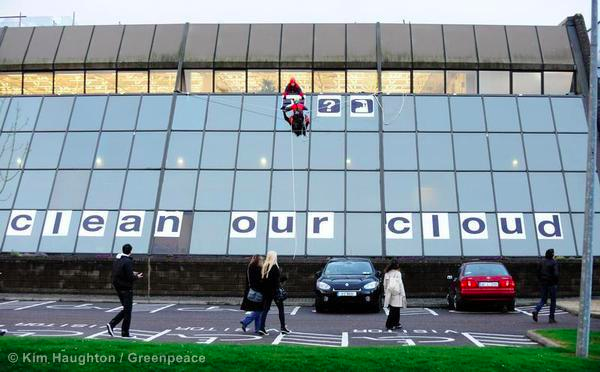
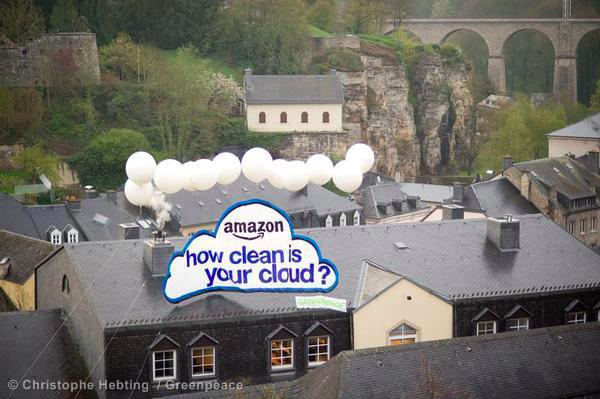
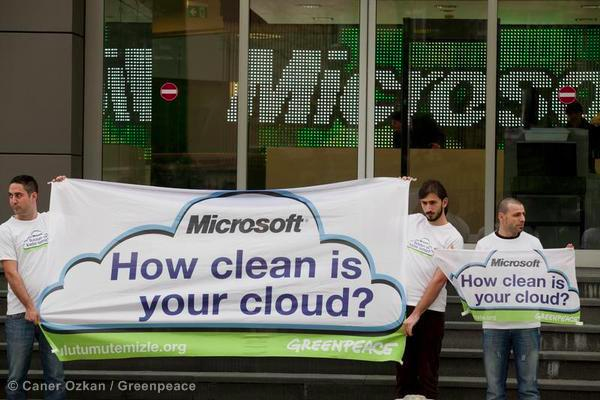
It looks like Greenpeace is pretty serious about the Dirty Cloud campaign. They have created the following videos and have put banners up at data centers.
Your Custom Text Here
It looks like Greenpeace is pretty serious about the Dirty Cloud campaign. They have created the following videos and have put banners up at data centers.
Amazon.com is hiring a lot and expanding its data center presence. This is bringing more and more people to Amazon.com's office in Seattle. The main offices in South Lake Union are in a much more convenient location for restaurants and drinks.
The Brave Horse Tavern is right next to some of the offices.
I've been to this location a variety of times to attend AWS events. And, a nice sunny April day in Seattle was able to visit the Tavern.
Here is a review of the location by a frequent local.
Over the last couple years Tom Douglas has expanded his bevy restaurants quite substantially. The Brave Horse Tavern is one of three restaurants housed in the historic Terry Building in the South Lake Union area. The two-story building is a warm respite from the modern, but a little cold, glass and steel Amazon buildings that surround it on three sides. In the same building you’ll find Cuoco and Ting Momo.
The Brave Horse is a little different from Tom Douglas’ other locations in that the bar has a much more significant part in the scheme of things. This location is about beers, burgers, pretzels; watching games on the many TVs; gathering after work with friends for a quick game of shuffleboard or darts. Having said that, it’s much more than a standard tavern or standard tavern fare.
The Tavern has a Woodstone oven which is great for...
Brick Oven Pretzels ~ malt boiled, hearth roasted
hearth roasted asparagus
melty teleme cheese, grated egg,
green garlic bread crumbs 10.penn cove clams, brave horse brew 10.
And, gave me more ideas on what to cook at home.
Forbes goes into depth reusing James Hamilton's post.
Can Solar Reduce The Impact Of Two High-Profile Data Centers? Amazon Engineer Weighs In [Updated]
6 comments, 4 called-out+ Comment now
Solar arrays may not be able to provide the power density needed by data centers, one expert argues. (Image credit: AFP/Getty Images via @daylife)
Solar power may be not be best way to reduce the environmental impact of sprawling data centers built by companies such as Apple and Facebook, James Hamilton, an Amazon vice president and distinguished engineer argued on his personal blog last Saturday.
James Hamilton writes an analysis of Facebook's and Apple's solar panel deployments.
I love solar power, but in reflecting carefully on a couple of high profile datacenter deployments of solar power, I’m really developing serious reservations that this is the path to reducing data center environmental impact. I just can’t make the math work and find myself wondering if these large solar farms are really somewhere between a bad idea and pure marketing, where the environmental impact is purely optical.
And closes with this.
Looking more deeply at the Solar Array at Apple Maiden, the panels are built by SunPower. Sunpower is reportedly carrying $820m in debt and has received a $1.2B federal government loan guarantee. The panels are built on taxpayer guarantees and installed using tax payer funded tax incentives. It might possibly be a win for the overall economy but, as I work through the numbers, it seems less clear. And, after the spectacular failure of solar cell producer Solyndra which failed in bankruptcy with a $535 million dollar federal loan guarantee, it’s obvious there are large costs being carried by tax payers in these deployments. Generally, as much as I like data centers, I’m not convinced that tax payers should by paying to power them.
As I work through the numbers from two of the most widely reported upon datacenter solar array deployments, they just don’t seem to balance out positively without tax incentives. I’m not convinced that having the tax base fund datacenter deployments is a scalable solution. And, even if it could be shown that this will eventually become tax neutral, I’m not convinced we want to see datacenter deployments consuming 100s of acres of land on power generation. And, when trees are taken down to allow the solar deployment, it’s even harder to feel good about it. From what I have seen so far, this is not heading in the right direction. If we had $x dollars to invest in lowering datacenter environmental impact and the marketing department was not involved in the decision, I’m not convinced the right next step will be solar.
Given this information, I wouldn't hold my breath for a solar panel at Amazon for a few reasons.
Amazon has a press release on the acquisition of Kiva Systems.
Amazon.com to Acquire Kiva Systems, Inc. SEATTLE--(BUSINESS WIRE)--Mar. 19, 2012-- Amazon.com, Inc. (NASDAQ:AMZN) today announced that it has reached an agreement to acquireKiva Systems, Inc., a leading innovator of material handling technology.
“Amazon has long used automation in its fulfillment centers, and Kiva’s technology is another way to improve productivity by bringing the products directly to employees to pick, pack and stow,” said Dave Clark, vice president, global customer fulfillment, Amazon.com. “Kiva shares our passion for invention, and we look forward to supporting their continued growth.”
“For the past ten years, the Kiva team has been focused on creating innovative material handling technologies,” said Mick Mountz, CEO and founder of Kiva Systems. “I’m delighted that Amazon is supporting our growth so that we can provide even more valuable solutions in the coming years.”
Most of you have probably never heard of Kiva Systems. I have. Why? Because, I used to be a distribution logistics geek. I studied the subject in college. Worked in Distribution Logistics and packaging engineering at HP. Apple actually hired me for my distribution logistics expertise away from HP and I worked on Apple's distribution system for years before moving to hardware product development and software product development.
One of the things that distribution logistics teaches you is supply chain management principles. When I worked on hardware development the connection is obvious. Working on software, I would think of bits and information as a supply chain issue as the bits move. The data center is a factory to support the movement of bits in a supply chain. It is interesting when you start to think of things as abstractions that are simply bits of information.
So, who is Kiva Systems and why are they so interesting. Kiva moves material to the person on robotic carts. The software is quite intelligent to keep the fast moving items closest to the material handlers, and move the slow moving items further away. This is no different than storage and caching issues in an operating system.
Read more about Kiva implementations in these markets.
The WSJ does a pretty good job of giving background on Kiva Systems
Robots on the March
How Kiva's robots run a warehouse
- To complete an order, Kiva's squat orange robots fetch tall movable shelves, or pods, that have the items needed, bringing them to the human "picker."
- A laser pointer tells the human which item needs to be picked from each shelf. The worker, who stays in one place, scans a bar code to confirm it is the right item. It's placed in the order box, which sits on another one of the mobile pods.
- New pods arrive steadily with additional items as needed. Items are grouped together to fulfill the orders.
- Pods filled with completed orders are taken by the robots to the shipping door, where a human tapes them closed in preparation for final transport.
But, here is an easier way to understand what Kiva System is.
Here is a TED talk by the founder.
Here is a IEEE Spectrum video on YouTube.
This will make for fun conversations with some of friends who work on logistics.
Amazon.com most likely figured out how much more efficient it is to move material with robots. The old way of thinking about robots is like this video.