Religion of Apple, Steve Jobs says Google’s ‘Don’t Be Evil’ Mantra is ‘Bullshit,’

Being an Apple user is a religious experience for some, believing surrounding yourself with iPhone, iPods, iTunes, Quicktime, MacBook, and Apple TV will make you a better person.  Seriously, I’ve seen this many times.  I worked at Apple from 1985 – 1992, and joined “at that time” evil Empire Microsoft 1992 – 2006.  Now I am independent of these religious views, and watch as many technologies are debated on almost a religious level.

The Economist has a cover story on “The Book of Jobs”

The Economist print cover

Tablet computing

The book of Jobs

It has revolutionised one industry after another. Now Apple hopes to transform three at once

Jan 28th 2010 | From The Economist print edition

Illustration by Jon Berkeley

APPLE is regularly voted the most innovative company in the world, but its inventiveness takes a particular form. Rather than developing entirely new product categories, it excels at taking existing, half-baked ideas and showing the rest of the world how to do them properly. Under its mercurial and visionary boss, Steve Jobs, it has already done this three times. In 1984 Apple launched the Macintosh. It was not the first graphical, mouse-driven computer, but it employed these concepts in a useful product. Then, in 2001, came the iPod. It was not the first digital-music player, but it was simple and elegant, and carried digital music into the mainstream. In 2007 Apple went on to launch the iPhone. It was not the first smart-phone, but Apple succeeded where other handset-makers had failed, making mobile internet access and software downloads a mass-market phenomenon.

The religious tone of the article continues as the author discussed the Power of Jobs.

As rivals rushed to copy Apple’s approach, the computer, music and telecoms industries were transformed. Now Mr Jobs hopes to pull off the same trick for a fourth time. On January 27th he unveiled his company’s latest product, the iPad—a thin, tablet-shaped device with a ten-inch touch-screen which will go on sale in late March for $499-829 (seearticle). Years in the making, it has been the subject of hysterical online speculation in recent months, verging at times on religious hysteria: sceptics in the blogosphere jokingly call it the Jesus Tablet.

The enthusiasm of the Apple faithful may be overdone, but Mr Jobs’s record suggests that when he blesses a market, it takes off. And tablet computing promises to transform not just one industry, but three—computing, telecoms and media.

Preacher Steve makes another claim that is caught in Wired Magazine – Google’s “Don’t be Evil” Mantra is Bullshit.

Google’s ‘Don’t Be Evil’ Mantra is ‘Bullshit,’ Adobe Is Lazy: Apple’s Steve Jobs (Update 2)

Read More http://www.wired.com/epicenter/2010/01/googles-dont-be-evil-mantra-is-bullshit-adobe-is-lazy-apples-steve-jobs/#ixzz0eIsdbKCy

On Google: We did not enter the search business, Jobs said. They entered the phone business. Make no mistake they want to kill the iPhone. We won’t let them, he says. Someone else asks something on a different topic, but there’s no getting Jobs off this rant. I want to go back to that other question first and say one more thing, he says. This don’t be evil mantra: “It’s bullshit.” Audience roars.
Read More http://www.wired.com/epicenter/2010/01/googles-dont-be-evil-mantra-is-bullshit-adobe-is-lazy-apples-steve-jobs/#ixzz0eIsnUlct

Then there is an Adobe statement about Flash which reminds of the Adobe Type Manager’s problem in the Mac OS.

About Adobe: They are lazy, Jobs says. They have all this potential to do interesting things but they just refuse to do it. They don’t do anything with the approaches that Apple is taking, like Carbon. Apple does not support Flash because it is so buggy, he says. Whenever a Mac crashes more often than not it’s because of Flash. No one will be using Flash, he says. The world is moving to HTML5.
Read More http://www.wired.com/epicenter/2010/01/googles-dont-be-evil-mantra-is-bullshit-adobe-is-lazy-apples-steve-jobs/#ixzz0eIsw6YKj

The Economist closes on death and resurrection.

If Mr Jobs manages to pull off another amazing trick with another brilliant device, then the benefits of the digital revolution to media companies with genuinely popular products may soon start to outweigh the costs. But some media companies are dying, and a new gadget will not resurrect them. Even the Jesus Tablet cannot perform miracles.

It looks like Steve Jobs is rallying his troops to fight a Holy War of Mobile – Google and Flash are his enemies.

Read more

Nicholas Carr says iPad marks end of PC Era

On Nicholas Carr’s blog RouchType he makes the point that the iPad marks the end of the PC era.

Hello iPad, Goodbye PC

JANUARY 27, 2010

The New Republic has published my commentary on Apple's iPad announcement. I reprint it here:

The PC era ended this morning at ten o’clock Pacific time, when Steve Jobs mounted a San Francisco stage to unveil the iPad, Apple’s version of a tablet computer. What made the moment epochal was not so much the gadget itself - an oversized iPod Touch tricked out with an e-reader application and a few other new features - but the clouds of hype that attended its arrival.

Tablet computers have been kicking around for a decade, but consumers have always shunned them. They’ve been viewed as nerdy-looking smudge-magnets, limited by their cumbersome shape and their lack of a keyboard. Tablets were a solution to a problem no one had.

Keep in mind the iPad is the start of a wave of tablet devices.

The transformation in the nature of computing has turned the old-style PC into a dinosaur. A bulky screen attached to a bulky keyboard no longer fits with the kinds of things we want to do with our computers. The shortcomings of the PC have created, the iPad hype suggests, a yearning for a new kind of device - portable, flexible, always connected - that takes computing into the cloud era.

Nicholas makes an interesting observation that the iPad is good for three handed people.

But will it succeed? The iPad is by no means a sure bet. It still, after all, is a tablet - fairly big and fairly heavy. Unlike an iPod or an iPhone, you can’t stick an iPad in your pocket or pocketbook. It also looks to be a cumbersome device. The iPad would be ideal for a three-handed person - two hands to hold it and another to manipulate its touchscreen - but most of humans, alas, have only a pair of hands. And with a price that starts at $500 and rises to more than $800, the iPad is considerably more expensive than the Kindles and netbooks it will compete with.

What is needed is the iBjorn, a modified Baby Bjorn to carry iPad devices.

image

One alternative Apple could do is have one-handed typing keyboards like right-handed Dvorak, but I doubt they’ll choose this as it is too big a shift to give users a different keyboard layout.

File:KB Dvorak Right.svg

it is interesting to think of the ergonomics of input comparing the iPad vs. iPhone.  One handed which is faster?

We’ll see how well the iPad does.  It reminds me of the adoption of the original Mac.  The world went crazy (in Apple’s view) for the Mac.  But, sales didn’t turn out as well as expected until the Mac Plus. Thank god Apple had the Apple IIGS to continue bringing in revenue.  Back in 1985 when I worked for Apple I was working on the IIGS.  Later, I worked on the Mac II.

Apple will have a revenue stream to allow it to ride out the adoption of the iPad.

We’ll see if people grow a third hand, start buying iBjorn’s to use the device while standing or find one handed use acceptable.  Apple will sell out for the first 3 – 6 months,  The real test will be Xmas sales in Dec 2010.

You know Apple has the iPad plus prototypes in the works.

Read more

Complex technology projects, learn from Apple System 7 Blue Meanies

One of the most enjoyable projects I worked on was Apple’s System 7.  There were many lessons I learned working on that project, one of which is “don’t tell the whole development team to innovate.”  Because if everyone innovates, the system doesn’t work.

For all the years I spent working on Windows Operating Systems from 1992 to 2006, the last client OS i worked on was Windows XP, running the Technical Evangelism team. 

When Windows Vista (aka Longhorn) came after Windows XP, I recognized the pattern from System 7 pushed too far as Jim Allchin and the rest of the executives ordered innovation in all parts of the OS.  We saw powerpoints for features that had little hope of seeing the light of day.

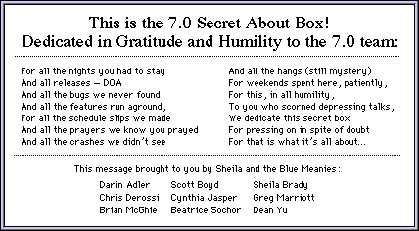
One big lesson that worked well to ship System 7 was “Blue Meanies.”  Who are the Blue Meanies?  Here is the secret about box with the people.

System 7.0.1:

Help! Help! We're being held prisoner in a system software factory!

The Blue Meanies

Darin Adler
Scott Boyd
Chris Derossi
Cynthia Jasper
Brian McGhie
Greg Marriott
Beatrice Sochor
Dean Yu

What did they do?

While the Meanies have sometimes been characterized as the "coders of System 7", the Mac OS was by then sufficiently large that major subsystems such as QuickDraw and QuickTime were developed and maintained by specialized groups, and the Meanies primarily focused on getting the pieces to work together.

If you have a complex project where there is a lot of innovation which causes conflicts between groups when don’t work, think about creating a group of people whose job is to get the pieces to work together.

Some may call this architecture, but getting systems to work together many times require the skills of implementation, not just architecture.  The Apple System Blue Meanies did it all.

In your complex data center projects who are the Blue Meanies on your project?

Read more

My Apr 2009 predicion of an Apple Netbook (iPad) full day battery, 3g, keyboard, phone, wifi, and iPhone apps

I am down in SJ and friends are discussing the iPad.  Then I remembered my post on Apri 6, 2009.

Imagine a Netbook with full day battery life, 3G network, keyboard, phone, wifi, and iPhone apps.  This device could probably be always on like an iPhone.  With a bluetooth headset you can leave the Apple Netbook in your carrycase.

The one area I got wrong is it is not a phone. Which is a smart move by Apple.  Probably 90% of the iPad users will also have an iPhone.  Don’t give users the option of not having an iPad only.

The one thing that would keep me from buying an iPad is given it is iPhone OS, there is no support for the Dvorak Keyboard.

The Dvorak Simplified Keyboard layout

The Dvorak Simplified Keyboard (pronounced /ˈdvɒrɔːk/) is a keyboard layout patented in 1936 by August Dvorak, an educational psychologist and professor of education[1] at the University of Washington in Seattle,[2] andWilliam Dealey. It has also been called the Simplified Keyboard or American Simplified Keyboard but is commonly known as the Dvorak keyboard or Dvorak layout.

Although the Dvorak Simplified Keyboard (“DSK”) has failed to displace the QWERTY keyboard, it has become easier to access in the computer age, being included with all major operating systems (such as Microsoft Windows, Mac OS X, Linux and BSD) in addition to the standard QWERTY layout. It is also supported at the hardware level by some high-end ergonomic keyboards.

I’ve been typing on the Dvorak keyboard since 1987 when I worked on Apple keyboards for the Mac.  Unfortunately, the Dvorak keyboard is a niche not worth the iPhone OS to support.

Read more

Data Center Site Selection – NC rides Apple and Google Wave

Hickoryrecord.com has an article highlighting 5 North Carolina counties promoting the data center corridor. Below is a picture of Apple’s under construction data center.

5 counties promote data center corridor

Robert C. Reed

image

Construction is under way on the $1 billion Apple data center in Maiden.

By John  Dayberry | Hickory Daily Record

Published: October 28, 2009

Maiden - Scott Millar said establishing an information technology corridor stretching northwest from Charlotte could transform the region's economy.

"Partnering with Caldwell, Burke, Alexander and Iredell counties to market this to the world may give all the counties new business opportunities," said Millar, president of the Catawba County Economic Development Corp.

But what I found mind blowing is there were 40 site selection consultants at the event.

On Tuesday and Wednesday, Millar and other economic development officials from the five counties outlined plans for a North Carolina data center corridor during a marketing event that attracted nearly 40 U.S. site selection consultants specializing in data center locations.

The regional economic development group is riding the Google and Apple and wave.

California-based Google opened a $600 million data center in Caldwell County in 2008.

When Apple announced plans for its $1 billion Maiden data center in July, economic development officials saw magnified potential for a data center corridor in the region.

Apple's arrival in the region also heightened interest on the part of site selection consultants from New York, Chicago, Atlanta, Washington, D.C., and other cities, Millar said.

Attendance at the Data Center Information Exchange blossomed.

"Eight (consultants) came the first year, 18 came last year and 38 came this year," Millar said.

"We're getting attention."

But do you think 40 site selection consultants know how to pick data center sites.  I would maybe guess 4 out of the 40 really know what they are doing.  But, how do you find the people who know what they are doing?  Do you think these guys know where Apple and Google is going to buy next?  Why buy where Apple and Google already bought?

There is a even a site selection magazine.

Site Selection Magazine, a nationally recognized publication, recently acknowledged a region anchored by financial data centers in Charlotte, Apple in Catawba County, Google in Caldwell County and the state's data center in Rutherford County as an emerging data center cluster that is attracting attention within the industry.

The site is here.

And, while all these site selection consultants were in NC, I was in Missouri, arriving in Kansas City, stopping in Columbia, and about to head to St. Louis.  One of the appealing parts of Missouri is the learning infrastructure.

Read more