Saw Eric Schmidt walking with his Android Phone, made me think who would have thought a Phone made Apple more valuable than Microsoft

I was sitting down at lunch today and Eric Schmidt walked by typing on his Android Phone.  I wonder if I had got my iPhone  out quick enough to take a picture if he would react the way Steve Ballmer does.

Steve Ballmer Will Smash Your iPhone, Mock You

Don't upset Steve Ballmer. You wouldn't like him angry. One Microsoft employee discovered that the hard way at a recent event for the company. As the CEO was making his rounds amongst the employees, the worker pulled out an iPhone to snap a shot of Ballmer. Ballmer grabbed the phone, put it on the ground, and pretended to stomp it. All in good fun, apparently.

What is hilarious is watching Ballmer discussing Google Android in Nov 2007 welcoming the competition.

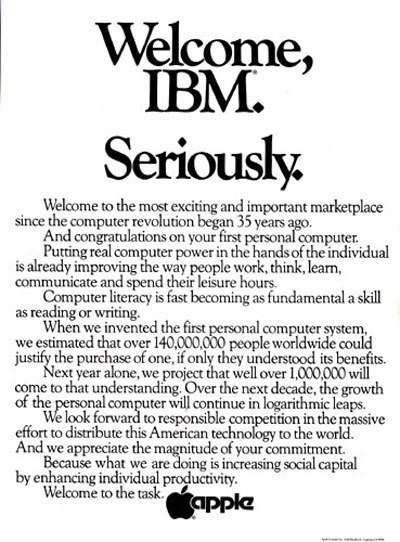
Which reminded me of Apple's welcoming IBM.


And Steve's comment about the iPhone.

But Apple gets the laugh today as they achieved a higher market cap than Microsoft.

May 26 (Bloomberg) -- Apple Inc., the computer maker turned mobile gadgeteer, overtook Microsoft Corp. to become the most valuable technology company on optimism it can keep adding customers for its iPhone, Macintosh computer and iPad.

By 4 p.m. New York time in Nasdaq Stock Market trading, Apple’s market value was at $222.1 billion, higher than Microsoft’s $219.2 billion. That made Apple the most valuable technology firm in the world. It’s also the second-largest U.S. stock by market value, behind oil company Exxon Mobil Corp., valued at $278.6 billion on the New York Stock Exchange.

And IBM has a market cap of $152 billion.  How times change.

Read more

Part 2, Why I didn't buy an iPad, CNET blogger shares his frustration

I wrote on Apri 30 that I got a Thinkpad X200 TabletPC instead of an iPad 3G.  The traffic I had on this post was above average. So, in the spirit of CNET news sharing his post on iPad experience, I'll write a little comparison.

CNET News blogger Brooke Crothers shares his iPad caveat.

by Brooke Crothers

Here's my second take on the iPad: Prospective buyers be warned; it's not a solution to any burning computing problem I know of. At least not yet.

As I wrote last week, with the glaring exception of no Adobe Flash support, I like the iPad's design. At the risk of repeating what many others have said: It's gorgeous, sleek, very portable, and easy to use.

Here is the picture of Brooke's iPad with the stand and keyboard.

image

(Credit: Brooke Crothers)

Here is my Thinkpad X200 Tablet with a Logitech MK605 stand, keyboard, and mouse.  It's nice having the mouse.  I have a logitech web cam which is better than I thought for skype calls.  CDRW/DVD is in the dock.  Video out.  A total of 6 USB ports.

Plus the screen is 8 inches above the desk vs. iPad at desk height.

And, Pen input.

image

Brooke shares some of his frustrations.

Now the bad news. Though I've tried to use the iPad as much as possible, that's getting harder and harder to do. In addition to porting it around the house to read news, watch videos, and do e-mail, I've endeavored to use it on the road too (I have the 3G version). So far, it has turned out to be only marginally useful.

My X200 Tablet is great.  No complaints.  I don't have the battery life of the iPad, but I am rarely away from power that long.

Brooke is more frustrated as he tries to use the iPad instead of a laptop.

It seems--so far, at least--that more often than not I'm banging into its limitations, which usually sends me scurrying back to my laptop. "Hmm, I could be doing this a lot more easily on my laptop?" is usually what comes to mind. Not always, but usually.

The problem is that too many things are done more efficiently on a laptop. And I won't go through the obvious laundry list of what most people use a portable computer for.

That said, I understand I'm overreaching: It's not meant to serve as a laptop replacement. And, further, I understand that there are plenty of people who use the iPad as an e-reader, gaming device, and generally as an enhanced platform for iPhone/iPod apps, as just some examples.

I am sure there are plenty of Mac lovers who are now carrying an iPhone, iPad and MacBook Pro when they travel.

For those of you who think the iPad is in a class by itself.  The NY Yankees classify the iPad as a laptop and are not allowed in the stadium.


Yankees ban iPad

by Chris Matyszczyk

Wherever you feel the need to have your iPad, I am happy. So, it seems, is the TSA. The New York Yankees, though, seem to float on a different boat.

A report from Yahoo Sports suggests that the Yankees have decided in all their infinite, historic wisdom that the iPad falls under its "No laptops" policy.

Spacekatgal, a poster on the IGN boards and who first caught Yahoo Sports' attention, said: "The security people told me it was not allowed and I was turned away at the gates. Why on earth would they have this policy? Terrorism concerns? I couldn't get an answer. I snuck it in under my jacket...I bring it to Fenway all the time and they don't care."

Yes, Boston's hallowed home is renowned for its relaxed and friendly demeanor. And the old "under the jacket" trick was first perfected by Stephen Colbert at the Grammys.

I know the Giants don't score many runs, but this was a little strange.

(Credit: Chris Matyszczyk/CNET)

Read more

Google's Vic Gundotra labels Apple's Steve Jobs as "Big Brother" A Draconian future, a future where one man...

Google's Vic Gundotra goes on the offensive vs. Apple with a declaration of Steve Jobs as a Draconian Big Brother 1984 theme.  eWeek and many others spread the news.

Gundotra met with Google's Android mobile operating system creator Andy Rubin, who told him that it was critical to create a free, open operating system that would enable innovation of the stack. Rubin also told him that if "Google did not act we faced a Draconian future, a future where one man, one company, one device, one carrier would be our only choice."

One of the rumors I heard was Google was tempted to spoof the infamous Mac 1984 commercial, but decided that was going too far.

Here are screen shots from Vic's declaration of a Draconian Future.

image

image

image

The video with the above reference is here.

Now, I find this all quite ironic, having worked for Apple during the Macintosh era, and working in Vic Gundotra's Microsoft organization as well.  Vic is a marketing machine, practicing his speeches to the level of Steve Jobs.

How good is Vic getting? Vic gets mentioned in the a Newsweek article with Steve Jobs as part of the reason why the Newsweek author has got in line to drop his AT&T iPhone for a Verizon Droid phone.

Steve Jobs has created his own precious little walled garden. He's looking more and more like Howard Hughes, holed up in his penthouse, making sure he doesn't come in contact with any germs.

Now Google is saying, hey, nice garden, have fun sitting in it. By yourself.

As Google exec Vic Gundotra said when explaining why Google entered this market: "If we did not act, we faced a draconian future where one man, one company, one carrier would be our future."

...

As sick as I am of my iPhone's dropped calls, I'm even more sick of Apple treating us all like a bunch of idiots, stonewalling and bullying and feeding us ridiculous explanations for the shortcomings of its products—expecting us to believe, basically, that its flaws are not flaws, but strengths.

...

Just this morning, fed up with constant dropped calls on my iPhone, I called Verizon to ask about the HTC Incredible. They told me that phone is back-ordered, and I can expect to wait about 30 days to get one.

And the author even speaks of the wait being worth it.  Which is part of Apple has done extremely well in building anticipation and expectation.

I'm not surprised. And frankly, I think it will be worth the wait.

Is this one of the tipping points for the media to switch from the iPhone to Android?  If I know Vic I am sure he is taking the credit, telling the story inside and outside Google.

How long before Google as the Big Brother becomes a media theme?

Would 1984's Big Brother been less Draconian if they had made their tag line "Do no Evil?"

Free yourself by not being stuck on brands and advertising.

Advertising is a non-personal form of communication intended to persuade an audience (viewers, readers or listeners) to purchase or take some action upon products, ideals, or services. It includes the name of a product or service and how that product or service could benefit the consumer, to persuade a target market to purchase or to consume that particular brand. These brands are usually paid for or identified through sponsors and viewed via various media. Advertising can also serve to communicate an idea to a mass amount of people in an attempt to convince them to take a certain action, such as encouraging 'environmentally friendly' behaviors, and even unhealthy behaviors through food consumption, video game and television viewing promotion, and a "lazy man" routine through a loss of exercise .

Keep in mind advertising is driving many things, here is video to help you give perspective "The Making of 1984."

A more entertaining video is this behind the scenes of 1984 video.

Read more

Gaming Priorities shifting to overall experience vs. performance, Mac more stable than Windows

I found this article about Mac vs. Windows gaming performance, quoting Gabe Newell, making some points that my Apple friends and Mac users will take pleasure in vs. Windows.  The full podcast interview is here.

image

Also, said Newelll,"what's sort of surprising is how much more stable our games are on the Mac." Looking at the early data available from the Steam client, "the Mac is five times more stable than Windows" when using the metric of minutes played versus number of crashes.

Gaming is a segment normally focused on the graphics and processer performance.  System stability is not as high a priority as systems are over-clocked and liquid cooled to dissipate the heat.  Kind of sounds like some data centers with higher density computing and cooling problems.

Gabe Newell is the Founder of Valve Software.

Valve is the creator of Steam, the world’s largest online gaming platform. Steam turns any PC (and soon any Mac) into a gaming powerhouse by providing instant access to a huge library of titles, and by automatically keeping a user’s games completely up to date. With an active user-base of over 25 million, Steam also connects gamers with each other, making it easy to find friends, keep track of each other’s gaming activity, and easily play games together. Since its inception as a service for updating Valve’s own game Counter-Strike, Steam has grown to become a service used world-wide, translated into 21 languages, and with content servers on every continent (save Antarctica, but we’re sure that’s just a matter of time).

Who is Gabe Newell?

After dropping out of Harvard University[1] Newell spent thirteen years working for Microsoft Corporation, ultimately becoming a "Microsoft Millionaire." Newell has described himself as "producer on the first three releases of Windows".

Gabe makes the point that it is less about graphics performance and shifting to a focus on services, less about pixels and more about micro transactions and identity.

Newell remarked during the podcast that graphics performance is much less of a concern overall compared to finding ways to offer a better user experience, such as the greater stability on the Mac. "I think we're starting to enter a period where graphics performance is sort of a solved problem," Newell said. "We're moving away from loss-leading graphics approaches [of consoles] toward more of a service platform. It's less about pixels per second and more about micro-transactions and identity."

If gaming is making this shift to stop being obsessed about graphics and processor performance, does it make sense for data centers to take this same approach as well?

This article particular interesting personally because Gabe Newell was my first interview at Microsoft in 1992 and I was interviewing in Microsoft Mail group. Gabe took one look at my Apple and HP experience on my resume and said "you need to be talking to the Microsoft TrueType group."  I told him, I had enough of TrueType and fonts and was looking to do something different.  Gabe said, "no you are going to interview with TrueType group we are changing your interview schedule now."  My next interview was with Peter Pathe who was my Microsoft hiring manager and coincidentally I am having lunch with next week.

His may not be a household name as Microsoft (NSDQ:MSFT) names go. But Peter Pathe is a big mover and shaker.

After 215 years with the company, he's getting ready to retire and this Microsoft Press Pass Q&A shows off what he's done for the Big M. For one thing, ubiquitous Microsoft Word was Pathe's baby for 15 years.

Gabe Newell was a hard-core Microsoft Windows guy at one time and is now saying the Mac OS X is five times more reliable than Windows.  Who knows maybe after 18 years, I can get a chance to talk to Gabe about his servers in data centers for Steam gaming.

Read more

Story of Adobe & Apple High-Value Digital Image Applications, Adobe's angst developing for the iPad, and how Microsoft missed this battle

This is not a data center post, but one about competition and innovation.

If you are a high-end photographer person you use the RAW imaging format, a higher quality image format vs. JPEG.

A camera raw image file contains minimally processed data from the image sensor of either a digital camera, image, or motion picture film scanner. Raw files are so named because they are not yet processed and therefore are not ready to be printed or edited with a bitmap graphics editor. Normally, the image is processed by a raw converter in a wide-gamut internal colorspace where precise adjustments can be made before conversion to a "positive" file format such as TIFF or JPEG for storage, printing, or further manipulation, which often encodes the image in a device-dependent colorspace.

The RAW Imaging apps are dominated by Adobe Lightroom, Adobe Photoshop, and Apple Aperture.  With Adobe in the dominant position with Photoshop Lightroom

Digital camera raw file support

The camera raw functionality in Adobe® Photoshop® software provides fast and easy access to the raw image formats produced by many leading professional and midrange digital cameras. By working with these "digital negatives," you can achieve the results you want with greater artistic control and flexibility while still maintaining the original raw files.

The battle between Apple and Adobe is about Flash now, and affects other Adobe products. As one of Adobe's product managers points out their Photoshop Lightroom user base has requested an iPad version, but there is no guarantees Apple will approve a Lightroom application.

Adobe announces angst-laden iPad software effort

by Stephen Shankland

Adobe has begun a new effort to bring imaging software such as Lightroom to the iPad and other tablet computers--but the leader of the work also is fretting over the control Apple has over it.

"I love making great Mac software, and after eight years product-managing Photoshop, I've been asked to help lead the development of new Adobe applications, written from scratch for tablet computers. In many ways, the iPad is the computer I've been waiting for my whole life," Adobe's John Nack said in a blog post Thursday. "I want to build the most amazing iPad imaging apps the world has ever seen."

Adobe's John Nack blog post continues.

These aren't idle questions. When the iPad was introduced, I asked what apps you'd like to see Adobe build for it. Among the 300 or so replies were many, many requests for a mobile version of Lightroom. I think that such an app could be brilliant, and many photographers tell me that its existence would motivate them to buy iPads.

Would Apple let Lightroom for iPad ship? It's almost impossible to know. Sometimes they approve apps, then spontaneously remove them for "duplicat[ing] features that come with the iPhone." Other times they allow competitors (apps for Netflix, Kindle, etc.), or enable some apps (e.g. Playboy) while removing similar ones. Maybe they'd let Lightroom ship for a while, but if it started pulling too far ahead of Aperture--well, lights out.

If you are a RAW image user, of which I am for the past ten years, buying a Canon G1 in 2000, let me tell you the story of how Microsoft missed the RAW imaging opportunity, and doesn't have a RAW imaging application even though Microsoft hired Adobe's Lightroom architect Mark Hamburg.

Canon G1 Review, Phil Askey, September 2000

Adobe Lightroom is the one application I use most often with photos.

Adobe® Photoshop® Lightroom® 2 offers powerful new and enhanced features across the entire program to help you streamline your digital photography workflow. Sort and find the photos you want faster, target specific photo areas for more precise adjustments, showcase your talent using more flexible printing templates, and more.

When you look at the history of Lightroom you see mention of Mark Hamburg who Microsoft hired/poached in April 2008.

History

In 2002, veteran Photoshop developer Mark Hamburg began a new project, code-named “Shadowland". Hamburg reached out to Andrei Herasimchuk, former interface designer for the Adobe Creative Suite, to get the project off the ground. [1] The new project was a deliberate departure from many of Adobe’s established conventions. 40% of Photoshop Lightroom is written using the Lua scripting language.

MARK HAMBURG LEAVES ADOBE

Posted by Martin Evening

markh.jpgNews has been announced that Mark Hamburg has decided to leave Adobe after having worked at the company for over 17 years. Mark joined Adobe in the Fall of 1990, not long after Photoshop 1.0 was released and was instrumental in devising many of the ‘wow’ features we have all come to love and rely on daily when we work with Photoshop.

Mark left the Photoshop team after Photoshop 7 shipped and went to work developing a new paradigm in image processing which would finally ship as the product named Adobe Photoshop Lightroom.

The irony of all this is back in 2000 I was working with a team of people at Microsoft who had a vision for RAW imaging use in Windows as a way to bring professional photography to Windows vs. the Mac.  And, the person we had on our team was Mark Hamburg's boss's boss who worked for me.  We had a bunch of other visionaries who understood the quality of images was a huge opportunity vs. JPEG.  But, it was hard to justify the market in 2000-2001.  Once Adobe and Apple shipped their RAW Imaging Applications, Lightroom and Aperture, there was now data to show the size of the market.  So around 2006 Microsoft starts trying to build a RAW imaging application group.

To make this more ironic when Mark Hamburg joined Microsoft, the executives asked Mark who they should hire to add to their development team, and Mark named his previous boss's boss, and said oh BTW he used to work for Microsoft and Adobe, but he works for Google now.  This the same guy who worked for me on RAW imaging in 2000, and likes to stay out of limelight, so you can't find him in a Google Search.  So, Microsoft tries to hire the imaging expert to leave Google, and there is a small group of us hoping he makes the move, but he says no, deciding Microsoft is not for him.  Shortly, after Mark Hamburg leaves Microsoft going back to Adobe.

Adobe's John Nack proudly blogged about Mark  Hamburg's return to Adobe.

Mark Hamburg returns to Adobe

Well, that didn't take so long, did it? :-)

After 17 years on the Photoshop & Lightroom teams, Mark Hamburg left Adobe last year to join Microsoft and work on improving the Windows user experience (as he found it "really annoying"). I'm happy to say that after that brief sojourn, he'sreturning to the Adobe Digital Imaging team. Welcome back, Mark! [Via]

Oh, and to ZDNet's Mary Jo Foley, who wrote at the time of Mark's departure:

Microsoft's competitor to Adobe Lightroom gets another champion... My bet is Hamburg will be instrumental in helping Microsoft bring to market its Photoshop Lightroom competitor.

Er, not so much.

Why did I write this post? 

Because it reminds me of the difficulties of being innovative when people look at you as if you are crazy.  "Where is the data and market research to support what you are proposing?"  My response would like to be "By the time the marketing data exists, you'll have the information to build an obsolete solution. Get out of the way."

Which reminds me the biggest reason we couldn't get RAW Imaging applications going is the lack of an established market and other groups saying they were the ones responsible for imaging applications.

Also, I should write a post on being innovative and lessons learned from friends like Gary Starkweather.

In 1969, Starkweather invented the laser printer at Xerox's Webster research center. He collaborated on the first fully functional laser printing system at Xerox PARC in 1971.[1][2]

At Apple Computer in the 1990s, Starkweather invented color management technology,[3] and led the development of Colorsync 1.0. Starkweather joined Microsoft Research in 1997, where he works on display technology.[4]
Read more