Google TV vs. Apple TV, Microsoft couldn’t last for this battle

The latest move by Google and Apple for the TV experience all require big data centers.  Newsweek covers how these companies are remaking the Tube.

Geek TV

Computer makers take over the tube.

Martin Katz / Xinhua-Landov

For the past few years, tech companies have been trying to find a way to bring the Internet and television to-gether, without much success. Sure, there are lots of little boxes you can attach to your TV that let you download content from the Internet, including Vudu, Roku, TiVo, Boxee, and Apple TV, not to mention game consoles from Microsoft and Sony. Each one gives you a little something different. But no single box gives you the whole Internet.

Now Google is out to replace all those crazy little boxes with Google TV. The software program will come built right into some TV sets and it will basically turn your TV into a computer.

In all the news about Google and Apple there is almost no mention of MSN TV.

image

Because you can’t buy MSN TV anymore.

image

MSN TV is the rebranded WebTV Microsoft acquired.

MSN TV (formerly WebTV) is the name of both a thin client which uses a television for display (rather than a computer monitor), and the online servicethat supports it.

The product and service was developed by WebTV Networks, Inc., a company purchased by Microsoft Corporation and absorbed into MSN (the Microsoft Network). While most thin clients developed in the mid-1990s were positioned as diskless workstations for corporate intranets, WebTV was positioned as a consumer device for web access.

A good friend from my Apple days worked at WebTV which eventually made him a Microsoft employee.  I hired him to help evangelize Windows XP before he moved on to senior architect position in Windows.  Ironically he now works at Google, not on the TV product.

Going back further in time I worked for a short period in the Microsoft Interactive TV team which was run by Craig Mundie.  Craig is the one who drove the acquisition of WebTV.

Microsoft takes notice

In February 1997, in an investor meeting with Microsoft, Steve Perlman was approached by Microsoft's Senior Vice President for Consumer Platforms Division, Craig Mundie. Despite the fact that the initial WebTV sales had been modest, Mundie expressed that Microsoft was impressed with WebTV and saw significant potential both in WebTV's product offering and in applying the technology to other Microsoft consumer and video product offerings

Things have changed a lot in 14 years that WebTV was launched.  The first servers for WebTV were run from their office in an old BMW dealership.

WebTV's online service running from servers in its tiny office, still based in the former BMW dealership

Apple and Google now have some of the top data center infrastructure in the industry.  What has changed in the 14 years is the requirement to use data centers to power the user experience. 

I wonder if part of what contributed to Microsoft’s inability to keep up the MSN/WebTV platform is the lack of data center capabilities during product development.

It is interesting how not to long ago servers were viewed as support devices – file and print servers.   Now servers do the heavy lifting so the client experience is faster, more efficient and more flexible.
Read more

Consumer Reports can't recommend iPhone 4, demonstrates duct tape solution, "don't touch me here"

When I look at the above video, I think an answer could be a "don't touch me here"

Above is a video from Consumer Reports published today that they cannot recommend the iPhone 4.

Lab tests: Why Consumer Reports can't recommend the iPhone 4

Lab test: Apple iPhone 4 design defect confirmed

It's official. Consumer Reports' engineers have just completed testing the iPhone 4, and have confirmed that there is a problem with its reception. When your finger or hand touches a spot on the phone's lower left side—an easy thing, especially for lefties—the signal can significantly degrade enough to cause you to lose your connection altogether if you're in an area with a weak signal. Due to this problem, we can't recommend the iPhone 4.

We reached this conclusion after testing all three of our iPhone 4s (purchased at three separate retailers in the New York area) in the controlled environment of CU's radio frequency (RF) isolation chamber. In this room, which is impervious to outside radio signals, our test engineers connected the phones to our base-station emulator, a device that simulates carrier cell towers (see video: IPhone 4 Design Defect Confirmed). We also tested several other AT&T phones the same way, including the iPhone 3G S and the Palm Pre. None of those phones had the signal-loss problems of the iPhone 4.

Consumer Reports does suggest a fix.

If you want an iPhone that works well without a masking-tape fix, we continue to recommend an older model, the 3G S.

ZDnet makes an interesting point now that Consumer Reports has joined the iPhone 4 antenna debate.

It’s one thing for a blogger like me to go on these rants about the shortcomings of the iPhone 4. But when Consumer Reports, which has the power to drive or halt buying decisions with its recommendations, announces that it cannot recommend the iPhone 4 because of the device’s antenna issues, it carries a lot of weight with mainstream consumers.

Hardcore iPhone fans can try as much as they’d like to discredit the Consumer Reports findings - and some are already doing just that - but they’ll have a hard time convincing mainstream consumers that CR is turning this into something more than it is. After all, this isn’t just some thumbs-down from a tech blogger who had a bad experience with the iPhone. This is Consumer Reports - and that matters.

If someone could come up with an iPhone 4 app that triggers "don't touch me" maybe that would help.

Even though all the noise is about dropped calls.  I wonder how the data transmission rate is affected even if you don't drop a call.  Lower signal strength would slow data transfer and put the iPhone 4 in a higher power consuming state for a longer period, resulting in lower battery life.

I don't have any plans to upgrade my iPhone 3GS.

Read more

Analyst predicts how music Droid will eat Apple's lunch

Barron's reports on an interview with Charter Equity Research Managing Director Ed Snyder.  Who is Ed Synder?

Snyder is a former telecom engineer, who has been covering the telecom industry since Alexander Graham Bell called for Watson. And I have found him mostly right about things telephony, with wires or without. One of his basic tenets throughout the evolution of wireless phones has been that music is the killer application. The key to Apple's (ticker: AAPL) strategy of linking the iPod Touch, iPhone and iPad with one operating system, the iOS family, has been iTunes' central role in managing music, applications and software updates. The easy, seamless ability to transfer music from the iPod via iTunes to the first iPhones was a huge factor in the Apple smartphone's acceptance and continued success. That, in turn, is driving iPad sales.

Ed brings up Music as the killer app for Google.

Now, Snyder suggests that music is the application that could provide Google's (GOOG) open-source Android OS the chance to leap over Apple. The analyst predicts that the next-generation music platform, which is likely to be cloud-based, will be the major battlefield in the smartphone war over the next year or so.

And mentions data centers as a key to Google's strategy.

Snyder says that Google must offer a content-delivery system similar in function to iTunes, but based in a cloud—meaning music is stored in one of Google's famous data-center clusters somewhere and delivered via the Internet and over airwaves to various devices. (ITune libraries sit on the local hard drive of personal computers). He thinks that Google should strike deals with (or, I suppose, buy) one of the many cloud-based streaming-music services already used on wireless devices.

Smartphones, Music, and Data Centers are Google's opportunity to eat Apples' lunch.

How a Droid Could Eat Apple's Lunch

By MARK VEVERKA | MORE ARTICLES BY AUTHOR(S)

Apple's iPhone reigns supreme, but a veteran telecom analyst argues that the momentum belongs to Google's Android system.

APPLE 'S IPHONE IS THE undisputed king of the smartphones, but there is swelling sentiment that Google's Android platform may steal the crown in the end.

Read more

Analyst predicts Video is next big thing for Apple's New Data Center

ComputerWorld covers an analyst that says Video is the next big thing for Apple's giant data center in North Carolina.

Apple's next big thing? Video, analyst says

Clues in future iPhones and iPads, massive data center point to video-based subscription services

By Gregg Keizer

April 21, 2010 02:31 PM ET

Computerworld - Apple's next big thing may be a video platform that combines cameras in the next versions of the iPhone and iPad with the giant data center the company's building in North Carolina, an analyst said today.

Will video be the market battle between Apple iVideo vs. Google YouTube.

Gottheil thinks that Apple is ready to make a major move into video, and based his bet on a series of clues in the company's upcoming hardware, as well as the $1 billion data center in North Carolina that's now hiring personnel.

Apple has the creative audience and a business model already for downloading videos. 

In the same way that Apple changed the market with iTunes App Store.  Why not sell videos authored in the iPhone 4G?

$0.99 amateur videos could make Apple way more money than Google ads on YouTube.  YouTube is stuck with a free business model.  Apple doesn't have to be free.

Video is one the tough authoring and distribution problems that Apple could solve.

In the same way that the iPod changed music.

Will Apple change video?

And, will AT&T make more money as people download videos on 3G.  That new 2 GB data plan can look really expensive.

Speaking of AT&T, their account site went down today.

AT&T's account site crumbles under iPhone owner load

Early eligibility offer for iPhone 4 upgrade swamps site

By Gregg Keizer

June 7, 2010 05:35 PM ET

Computerworld - AT&T's account management site went dark Monday after Apple announced that its U.S. partner would waive contract requirements to allow more customers to upgrade to the new iPhone 4 this month.

The site came back online at about 5 p.m. ET.

Read more

A peak at how bloggers work, when one tries to blog from an iPad

Blogging is an interesting skill to develop.  A friend sent this article on as something I would find interesting as I recently passed on an iPad purchase and bought a Thinkpad.X200 TabletPC.

I'll reference this article with points to help you see how a blogger works.  One of the problems the iPad blog post runs into is the lack of multitasking.

Secondly, there’s the lack of multitasking in the iPad, which makes for working between apps and conducting research painfully difficult. A couple of multitasking apps might be helpful. For instance, BrowserNotes  and MyMultiView allow you to open web pages and a notepad in the same application. There’s also iAnnotate PDF for reading and annotating PDFs. But these apps only go so far. There are still improvements that Apple needs to make for its mobile devices to get the one-open app limitation.

Why is multitasking so important, because part of blogging is you have many things up at same time to pull your research together.

The Wall of Limitations
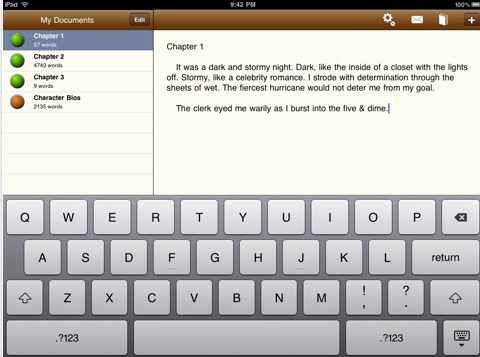
If novel writing were what you wanted to do on the iPad, then you probably could get by just fine. But if the writing you do requires researching, quoting text, embedding URLs, adding images blog posts, and multitasking between apps—all of which is what bloggers do—then the iPad is going to push you back to your Mac desktop or laptop.

Being able to cut and paste is critical.  I use Windows 7 Snipping Tool consistently to grab screen shots and paste them into blog entries.  iPad clipboard functionality is ironically limited compared to use on the Mac.

Thirdly, a big issue for me as a blogger is the lack of a universal clipboard manager. No prolific blogger can pound out writing without a way to retrieve multiple snippets of text from the clipboard. The iPad, of course, like the iPhone, only saves one copy of text at a time. I’m not a developer, but I‘m pretty sure that Apple can include some sort of clipboard manager that can be accessed at least through Mail and word processing apps. There’s enough Mac desktop-based clipboard managers out there that Apple could easily borrow code and produce something similar for the iPad.

I use Windows Live Write a WYSIWG blogging tool.  And, found it painful to hear the writer describe the use of editing tools on the iPad.

Writing Apps 
There are plenty of writing apps for the iPad, beyond Pages, which work great up to a point for text editing. Apps like SimpleNote, MyWritingNook, and even the default Notebook for the iPad can be used draft pieces of writing.

And, don't forget if you are going to write you'll need the external keyboard.

However, I must say that serious writing is best done using an external keyboard. Apple’s wireless keyboard is the one I use, and I found it to be the best keyboard I‘ve ever used. The keys are quick and responsive, and the keyboard‘s small size makes it perfect for the iPad.

The author threw the conclusion at the beginning and I'll use it at the end.

Can You Blog On the iPad?

by Bakari Chavanu Jun 04, 2010

Can you blog on the iPad? The quick and honest answer is, no. Not as effectively as you might like.

This post is written in less than 10 minutes, and that includes reading, bouncing back and forth multitasking to the article.

If you can't hammer a post out in less than 10 minutes, look for another blogging process.

Read more