Google’s Floating Green (Water-Based) Data Center Patent

SlashDot has a post on the Google Navy.

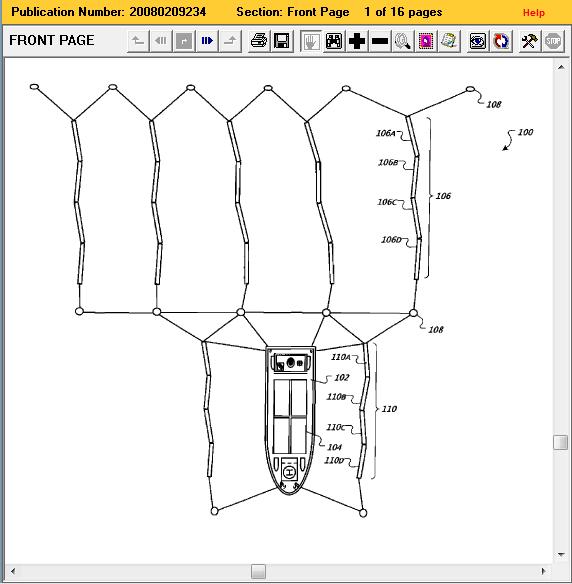
theodp writes"Is Google preparing to launch its own Navy? In its just-published application for a patent on the Water-Based Data Center, Google envisions a world where 'computing centers are located on a ship or ships, which are then anchored in a water body from which energy from natural motion of the water may be captured, and turned into electricity and/or pumping power for cooling pumps to carry heat away from computers in the data center.' And you thought The Onion was joking when it reported on Google's Fleet of Naval Warships!"

DataCenterKnowledge’s Rich Miller adds more details for the data center crowd.

In a startling new take on data center engineering, Google has filed a patent for a “water-based data center” that uses the ocean to provide power and cooling. The patent also confirms Google’s development of a container-based data center, describing “crane-removable modules” to power the computing platforms.

The floating data centers would be located 3 to 7 miles from shore, in 50 to 70 meters of water. If perfected, this approach could be used to build 40 megawatt data centers that don’t require real estate or property taxes.

The patent filing says the data centers would be located 3 to 7 miles offshore, which may signal that Google’s interest in undersea cables goes beyond connectivity between land-based data centers. While the floating data centers would include power and cooling, they would still require industrial strength connectivity. Earlier this year Google said it would partner with five other companies in building an undersea communications cable across the Pacific, which could provide high-speed connectivity to new Google data centers in Asia.

Another alternative for power could be floating nuclear plants.

Russia is already building floating nuclear power plants for Arctic operations.

Given that we are already supposed to be facing the twin threats of terrorism and environmental meltdown, you might think the last thing the world needs is a fleet of floating nuclear power plants (NPPs). Russia disagrees, and confirmed this week that construction has started on the first of seven ships carrying a 70MW nuclear reactor. The ships will provide power to remote coastal towns, or be sold abroad, with 12 countries, including Algeria and Indonesia, said to have expressed interest.

But, keep in mind as some of the slashdot commentators, the sea is a harsh environment.

by Jaktar (975138) on Saturday September 06, @03:36PM (#24903267)

Having served on a Navy ship I can point out a few problems:

First, sea water temperatures vary greatly depending on the part of the world you're operating in. It's not uncommon for surface sea water temps to be in the 85F(30C)+ range for most areas where you're likely to moor a ship. The AC units that we used were barely able to keep the small server room that I ran cool under those conditions.

Second, the motion of the ship caused premature drive failures due to the pitch and roll of the ship. This could be alleviated with solid state drives, but that's a bit off for a data center at the moment.

Lastly, bandwidth and latency are problematic. Sure, Google could just buy a satellite, but they can't modify the 2000ms latency. Depending on ship size and sea conditions, keeping a satellite lock may be an issue as well due to roll.

All I can really say to Google is, good luck with all that!

Keep in mind this could be a defensive patent and not an actual intent for Google to build data centers at sea.

Read more

Sun's Energy Efficient Data Center, The Role of Modularity in Datacenter Design

Sun has a pdf on  Energy Efficient Datacenters - The Role of Modularity in Datacenter Design and a wiki post.

Energy Efficient Datacenters: The Role of Modularity in Datacenter Design

by Dean Nelson, Michael Ryan, Serena DeVito, Ramesh KV, Petr Vlasaty, Brett Rucker, and Brian Day
June, 2008

Virtually every Information Technology (IT) organization and the clients that they serve have dramatically different requirements that impact their datacenter designs. Sun is no exception to this rule. As an engineering company, Sun has cross-functional organizations that manage the company's corporate infrastructure portfolio including engineering, services, sales, operations, and IT.

On the surface, the datacenters supporting these different organizations look as different as night and day - one looks like a computer hardware laboratory and another looks like a lights-out server farm. One has employees entering and leaving constantly, and another is accessed remotely and could be anywhere. One may be housed in a building, and another may be housed within an enhanced shipping container. Beneath the surface, however, our datacenters have similar underlying infrastructure including physical design, power, cooling, and connectivity.

At first I thought the document was going to be able Sun's Containers, but as I continued through the document more details were discussed in modular power, cooling, and cabling. The following is from the summary.

The last thing that a datacenter design should do is get in the way of a company’s ability to conduct business. Traditional datacenter designs can do just that. Cooling via raised floors and perimeter CRAC units limit the ability to increase density and achieve energy efficiency. Power distribution units and under-floor whips limit flexibility and require downtime for reconfiguration. Home-run, under-floor cabling makes growth difficult, impacts cooling and raises costs.


Datacenter designs that facilitate — rather than limit — growth, density, flexibility and rapid change can be a company’s competitive weapon. At Sun, our modular, pod-based datacenters can turn on a dime whenever business directions change, from accommodating new equipment in our pods to expanding our rack footprint by deploying additional Sun Modular Datacenters. We can accommodate growth and increases in density because three key datacenter functions — power, cooling, and cabling — are prepared from day one to support an overall doubling in each area.

The document is 58 pages with the following content.

  • The Role of Modularity in Datacenter Design
    • Choosing Modularity
    • Defining Modular, Energy-Efficient Building Blocks
    • Buildings Versus Containers
    • Cost Savings
    • About This Article
  • The Range of Datacenter Requirements
    • Power and Cooling Requirements
      • Using Racks, Not Square Feet, as the Key Metric
      • Temporal Power and Cooling Requirements
      • Equipment-Dictated Power and Cooling Requirements
    • Connectivity Requirements
    • Equipment Access Requirements
    • Choosing Between Buildings and Containers
    • Living Within a Space, Power, and Cooling Envelope
      • Space
      • Power
      • Cooling
    • Calculating Sun's Santa Clara Datacenters
      • Efficiency in Sun's Santa Clara Software Datacenter
  • Sun's Pod-Based Design
    • Modular Components
    • Pod Examples
      • Hot-Aisle Containment and In-Row Cooling
      • Overhead Cooling for High Spot Loads
      • A Self-Contained Pod - the Sun Modular Datacenter
  • Modular Design Elements
    • Physical Design Issues
      • Sun Modular Datacenter Requirements
      • Structural Requirements
      • Raised Floor or Slab
      • Racks
      • Future Proofing
    • Modular Power Distribution
      • The Problem with PDUs
      • The Benefits of Modular Busway
    • Modular Spot Cooling
      • Self-Contained, Closely Coupled Cooling
      • In-Row Cooling with Hot-Aisle Containment
      • Overhead Spot Cooling
      • The Future of Datacenter Cooling
    • Modular Cabling Design
      • Cabling Best Practices
  • The Modular Pod Design at Work
    • Santa Clara Software Organization Datacenter
    • Santa Clara Services Organization Datacenter
    • Sun Solution Center
    • Guillemont Park Campus, UK
    • Prague, Czech Republic
    • Bangalore, India
    • Louisville, Colorado: Sun Modular Datacenter
  • Summary
    • Looking Toward the Future
  • Read more

    Commoditization, Standardization, or Industrialization of Data Centers

    DataCenterKnowledge has a post on Industrialization and Standardization of data center design.

    The focus on smaller spaces provides greater flexibility, but also allows data center builders to standardize many elements of the process, enabling an “industrialization” of data center design. That term has been adopted recently by the world’s two largest data center operators - Digital Realty Trust and IBM.

    “We’re really seeing the standardization really resonating with a lot of customers,” said Jody Cefola, Site and Facilities Services marketing Manager for IBM. “We liken it to what’s happened in IT, where companies have gone to standardized operating environments in their software.

    Christian Belady has been presenting on this topic for the last 2 years and uses the term commoditization as well, and how the data center industry needs to change.

    “The real driver behind this is the fact that the cost of computation is going down,” said Belady. “The problem is going to get worse. As the price goes down, demand goes up. I think what you’re going to see is the commoditization of the data center. Standardization will create a plug-n-play environment.”

    Part of making Green Data Centers is improving efficiencies, and this can be done by using standard units used across multiple facilities no different than any other industrial process as data center services become a commodity.  There I used the title terms with all the "izations" removed.:-)

    Read more

    Top 2 Green Data Center Building Contractors, Skanska & Turner

    Engineering News Record has an article on the Top Green Contractors.

    For the first time, ENR has produced a ranking of contractors based on the volume of sustainable and "Green" projects they have worked on. The list ranks the top 50 U.S.-based contractors, both publicly and privately held, based on construction contracting-specific revenue on projects that have been registered or certified by third-party organizations as following specific environmental, energy-savings, or sustainability standards.

    image

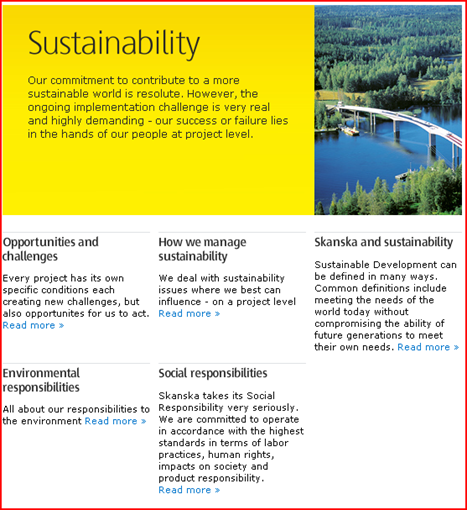
    It can be hard to find details on who the data center construction companies are due to NDA agreements signed, but I have run into Skanska and Turner numerous times.  Keep these two companies in mind when you think of building a Green Data Center.

    Going to Skanska’s web site I found the sustainability section impressive.

    image

    Skanska has a history of sustainable development timeline.

    image

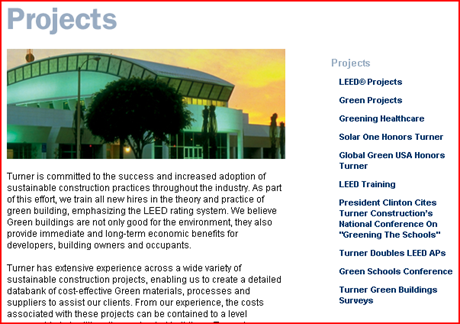
    Turner has their Green Building site which isn’t as interesting a web site as Skanska.

    image

    Read more

    Microsoft Launches Next Generation Data Center in Des Moines, IA – Winning the Data Center PR War?

    Microsoft officially announced its choice of Des Moines, IA to launch its next generation data center. News coverage is all over the web.

    Here is the video from DesMoinesRegister

    The one thing interesting about this announcement is a normal PR event would be the ground breaking where a handful of local officials and company executives smile while holding a shovel of dirt.

    But, Microsoft has been able to escalate the status of a data center to a state press release. With logo’d cupcakes to honor the event.

    photo

    There are tons of press coverage and the blogs have picked up on the Iowa data center as well. Contrast this with Microsoft’s Windows Vista PR team hiring Jerry Seinfeld to get visibility and credibility in the market. A little ironic Microsoft hires a comedian to get respect.

    As DataCenterKnowledge wrote about the economic benefits of Google vs. Microsoft. Iowa is the new test area.

    Many state and local governments have passed tax incentives to attract a Google data center, hoping it will convert struggling regions into high-tech hubs. It's part of a trend in which more economic development agencies are pursuing data center projects. There's no question that favorable environments can create data center clusters, a trend seen in many technology corridors. But here's the secret: If you're focused on developing a data center cluster in your area, you should be chasing Microsoft, not Google.

    My vote is Microsoft will win the Iowa PR data center PR war because:

    1. Microsoft is sharing its data center best practices and the data center industry recognizes this effort.
    2. Microsoft’s Des Moines data center is the launch site for its latest generation of data center design.
    3. Microsoft will hire within the state of Iowa.  Google’s Council Bluffs location will have a large percentage of construction workers and employees coming from Omaha Nebraska.  Why should the state Iowa give tax incentives to help the state of Nebraska? It is only a matter of time before the Iowa tax payers protest Google’s tax breaks.
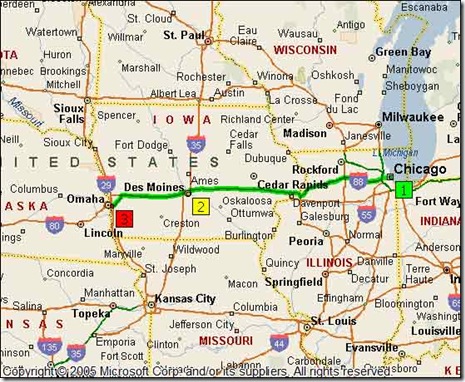
    4. When you look at the map below showing Chicago, Des Moines, and Council Bluffs. A question comes up why would Microsoft build data centers so close to each other? I have my own theories what Microsoft will do.  These  Microsoft guys are smart.


    > map

    Will there be containers in Des Moines?  ComputerWorld’s Eric Lai says yes.

    A Microsoft spokeswoman confirmed that Microsoft plans to house the servers in shipping containers but declined to comment specifically on the size of the facility or the number of servers to be located there.

    "We are still in the process of completing the design of the center. Once that is finalized, we will have an estimate for these questions," she wrote via e-mail.

    However, Microsoft said its $500 million, 550,000-square-foot data center in Chicago will house up to 220 containers, each filled with as many as 2,000 servers, or 440,000 servers. The software maker said the server-filled containers are easier to transport, set up and maintain than servers on conventional racks, though not all observers agree.

    It takes 5 hours to drive a container between Chicago and Des Moines. How’s that for a disaster recovery plan?

    One funny thing about this picture

    photo

    is Gov Chet Culver looks taller and bigger than Mike who is a big guy. Looking up the gov is an college football player so he is probably bigger than Mike.  The gcod thing I found is the governor has an interest in Green.

    Culver began his career as an environmental and consumer advocate in the Iowa Attorney General’s Office.

    We can expect Microsoft’s Data Center to be as green as can be. There is no hydroelectric for carbon neutral power, but 20% of the power is reported to be coming from renewables.


    Read more