How You Operate Affects Your Mileage – BMW M3 beats Prius

Top Gear has a post on their fuel economy test comparing a BMW M3 vs. a Toyota Prius.

Jeremy's miles per gallon test between the BMW M3 and Toyota Prius might have been a little, er, biased. But should your commute be, er, speedy, and you're looking for an excuse to buy the RWD, V8-powered M3 instead of a FWD 4-cyl hybrid...

Simple rules drive the Prius as fast as possible, and have the BMW keep up.

The Prius did 17.2 MPG, M3 did 19.4 MPG.

The full M3 vs Prius Video is here.

The message in the story.  It’s how you drive it that matters.  And, you can get better mileage by simply driving your existing car more efficiently.

Don’t change the car, change your driving style.

What’s this got to do with data centers.  Shouldn’t I relocate my IT resources to green data center space. Someone may think I just built a green data center that is LEED certified with all the latest energy efficiency power and cooling systems.  But, I bet you many don’t know how to operate this unique configuration of data center equipment in the most energy efficient manner?  Have you thought about how you will drive your data center?

If you don’t know how to operate your data center in the most energy efficient manner one company you should look at to run your data center operations is Lee Technologies managed maintenance and facilities operations.

Lee Technologies :: Solutions :: Managed Maintenance
Data Center & Mission-Critical Managed Maintenance
Over 86% of all Data Center Outages are Preventable
Lee Technologies :: Solutions :: Full Lifecycle Support :: Operations & Maintenance PDFInfrastructure failure and human error are the two leading causes of downtime in mission-critical facilities. The leading cause of infrastructure failure is poor maintenance. Our experienced staff has been providing infrastructure solutions for mission-critical facilities since 1983. Lee Technologies provides operations, managed maintenance and facility operations services supporting over 3 Million square feet of data center and mission-critical facility space across the United States.
Maintenance-Crucial
In mission-critical facilities, failure is not an option. That's why, night or day you can depend on Lee Technologies' Managed Maintenance Programs for comprehensive service and support. Our Managed Maintenance services are customized to the specific needs of each client and facility. Whether it's 24/7/365 monitoring, preventative maintenance, or comprehensive facility operations, Lee Technologies has the technology, capability and experience to meet your needs… and exceed your expectations.


Lee Technologies :: Solutions :: Facility Operations
Data Center & Mission-Critical Infrastructure Facility Operations
Lee Technologies :: Solutions :: Full Lifecycle Support :: On-Site Technical Staffing PDFMission-critical facilities utilize the latest technologies to keep the world's information flowing. However, even the most advanced technology is only as good as the people that maintain and operate it. With so much at stake, you don’t want to trust your mission-critical operation to just anyone. You want the right people, in the right place, at the right time... with the right tools, talent and training.
Many studies show that the #1 cause of data center downtime is human error. In an expanding market for high-availability services, finding, keeping and training qualified personnel has become more challenging than ever. That's why a growing number of organizations count on Lee Technologies data center infrastructure facility operations specialists at their mission-critical facilities.

Thanks to a fortunate introduction at Data Center Dynamics London I met Lee Technologies, Lee Kirby who set up a meeting at my beach house last week to discuss data center modeling and maintenance with Bob Woolley, VP of Facilities Operations and Quality Systems & David Gentry, Sr VP of Service while they were in town for their employee holiday party.

I’ve been spending a lot of time investigating modeling ideas and I wanted to see what Lee Technologies executives see as current and future issues to run a Greener Data Center.  We were in agreement on many points, and we discussed ideas on what I could blog in future posts on this site or other areas a boring topic “how to operate and maintain your data center.”

The M3 vs. the Prius is an interesting point for data centers, in that many have built for performance (M3), and the new way is for efficiency (Prius).  But, how you drive has the biggest influence on your energy use.

Also, another company who has embraced this idea is Skanska’s Robert Bellantoni.  Here is his article in DatacenterDynamics Focus. 

The “Fix First” concept is based on the needs of current legacy data centers to make immediate and necessary improvements in their operational efficiency without costly retrofit, redesign or timely rebuilding options.


“The fastest way to needed improvement is often apparent and can usually be fixed with minimum cost,” says Bellantoni. “We conduct a physical audit of the as built state of their current cabinets and rack installation. Most legacy data centers are in a ‘mid-life crisis’ mode as a result of an aging design that may have been the bestof- breed at the time, but did not take critical efficiency and rising operating costs into consideration when creating the original design model.”

Read more

Part 2 – Architect’s Perspective, Microsoft Generation 4 Data Center

David Gauthier and Christian Belady have a new blog post about their architect’s perspective.

Microsoft's Generation 4 Data Center Vision - the Architects' Perspective

Microsoft's Generation 4 Data Center Vision - the Architects' Perspective

By David Gauthier, Data Center Infrastructure Architect and Christian Belady, Principal Power and Cooling Architect, Microsoft Corp.

On Tuesday, December 2, our Global Foundation Services team went public with our Generation 4 Modular Data Center Vision and over the past week a lot of great discussions and questions have been posed from our industry colleagues. Today, we wanted to address some of those questions and share more insight on our Gen 4 plan via a video interview we did with Adam Bomb, a Technical Evangelist at Microsoft's TechNet Edge. 

Some people got the impression that this announcement was solely about a containerized server room rather than a re-thinking of the entire infrastructure. The goal of Gen 4 is to modularize not only the server and storage components, which a number of companies are already doing, but also to modularize the infrastructure, namely the electrical and mechanical systems.  The real innovation is around the commonality, manufacturing, supply chain and integration of these modules to provide a plug-and-play infrastructure along with modularized server environments.  In addition, it is focused on scaling the infrastructure with the business demands, smoothing capital investment, and driving costs down as shown by the following chart.

What are they after?

While we expect these modular innovations to reduce capital investments by 20%-40% or more depending on class, we also expect considerable reductions in operating expenses related to electricity and water consumption. Designing from the start for environmental sustainability has allowed us to focus on using less construction material up front, less energy and water during operation, and also allows us to recycle and reuse components at the end of their useful life. No longer will we be governed by the initial decisions made when constructing the facility. We will have almost unlimited use and re-use of the facility and site. We will also be able to use power in an ultra-fluid fashion moving load from critical to non-critical as use and capacity requirements dictate.

Sounds like they are reinventing what it means to have a Green Data Center.

They have a new video as well.

Read more

Green Lockerbie Data Centre

Lockerbie Data Centres announced its new 800 million pound Scotland project.

Plans to create the world’s largest data centre at Peelhouses outside Lockerbie have been unveiled by Scottish firm, Lockerbie Data Centres Ltd.
A first for Scotland, the £800 million Peelhouses Data Centre and Sustainable Village will give Lockerbie international prestige and make it a leading international centre in I.T. and data storage. The development will enshrine principles of sustainability and address economic, social and environmental aspects of the locality, the region and Scotland as a whole.

Lockerbie Data Centre is emphasizing its Green efforts.

image

Synopsis: Lockerbie Data Centres Limited propose to develop a sustainable village with a range of land uses on the edge of Lockerbie in Dumfries & Galloway.  The development will enshrine principles of sustainability and address Economic, Social and Environmental aspects of the locality, the region, and Scotland as a whole.  The principal element of the development is a two hundred and fifty thousand square metre data storage facility.  This facility will address a world-wide shortage of data storage capacity, and offset the vast energy inputs required by balancing this with local renewable energy sources and the re-use of energy in a new village that will initially provide up to seven hundred and fifty new homes of mixed tenure.  Commercial and business space suitable for companies and individuals working in the Web-Commerce and I.T. industries will also be incorporated into the layout of the village.  The sustainable credentials of the development are based on a grouping of interdependent and interacting circumstances that this locality can provide and which will benefit the existing community and commerce.

image

The environmental sustainability of the project draws together a number of locally available factors. The data storage facility requires a great deal of electrical power, mostly for cooling. The cool climate reduces the load required, but that which is required will be provided partially by a new wind farm and an existing bio-mass generation plant just to the north of the site, with backup from the national grid. Unlike most of the existing data centres in existence, the heat produced by the plant will not be lost as exhaust to the atmosphere, but will form the basis of a community heat and power distribution to the benefit of the new housing and commercial space on site, the new sports centre and swimming pool and the new school in Lockerbie, and possibly also to existing residential properties in the town.

Read more

Microsoft Ups the Sharing – Posts Vision for Modular Data Centers, Generation 4

Mike Manos, Dan Costello, and Christian Belady have a new post uping the ante on sharing Data Center Design.

What is Generation 4?

Generation 4 design has been under heavy engineering for viability and cost for over a year.  While the demand of our commercial growth required us to make investments as we grew, we treated each step in the learning as a process for further innovation in data centers.  The design for our future Gen 4 facilities enabled us to make visionary advances that addressed the challenges of building, running, and operating facilities all in one concerted effort.

To summarize, the key characteristics of our Generation 4 data centers are:

  • Scalable
  • Plug-and-play spine infrastructure
  • Factory pre-assembled: Pre-Assembled Containers (PACs) & Pre-Manufactured Buildings (PMBs)
  • Rapid deployment
  • De-mountable
  • Reduce TTM
  • Reduced construction
  • Sustainable measures
  • Map applications to DC Class

image

The article is quite long with lots of details.

Bottom line: Microsoft is building a modular data center where all parts of the data center are containerized/modularized into building blocks.

Think of it like “building blocks”, where the data center will be composed of modular units of prefabricated mechanical, electrical, security components, etc., in addition to containerized servers.

Their vision

“A highly modular, scalable, efficient, just-in-time data center capacity program that can be delivered anywhere in the world very quickly and cheaply, while allowing for continued growth as required.”

Read more

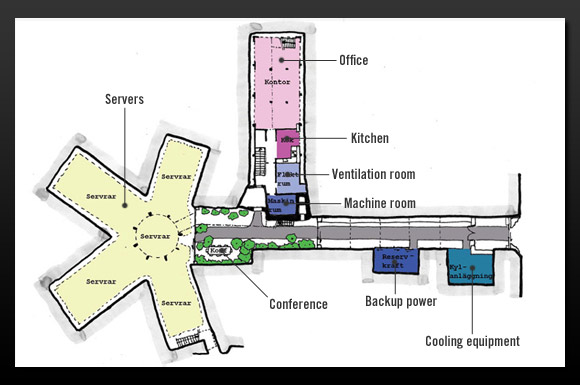
Nuclear Bunker Data Center

Andrew  Dudgell from http://blog.windowsvirtualization.com forwarded me this link.

The world’s most super-designed data center – fit for a James Bond villain

Posted in Main on November 14th, 2008 by Pingdom

This underground data center has greenhouses, waterfalls, German submarine engines, simulated daylight and can withstand a hit from a hydrogen bomb. It looks like the secret HQ of a James Bond villain.

And it is real. It is a newly opened high-security data center run by one of Sweden’s largest ISPs, located in an old nuclear bunker deep below the bedrock of Stockholm city, sealed off from the world by entrance doors 40 cm thick (almost 16 inches).

The hosting company put some serious thinking into how you can make the data center a better environment… for the people.

Work environment with simulated daylight and greenhouses: For a pleasant working environment the data center has simulated daylight, greenhouses, waterfalls and a huge 2600-liter salt water fish tank.

Andrew – thanks for sending the link.

Read more