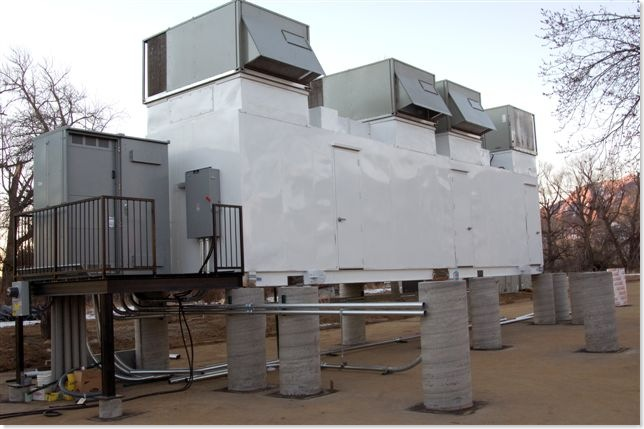
Sun visits Rackable's Ice Cube, leaves Green with Envy

At Uptime Institute Conference, Rackable Systems has their Ice Cube Container parked in the parking lot open for all to visit. While talking to the Rackable staff, it became clear how brilliant they were to have their container easily accessible.  Their traffic has been high, because they are open during the whole conference vs, the few hours the exhibit area is. This means they are open the whole conference to potential customer's visits with their undivided attention with no competing traffic. Rackable staff says this is one of their best shows for interest in containers from qualified customers.

While I was in the Rackable container, Mark Monroe, Sun's Director of Sustainable Computing visited the container to get a little tour. I asked the Rackable guys how the conversation went. They joked, "he left green with envy."

It's funny, and he may have.  I am blogging from the session on modular "containerized" computer room concepts with Sun, Rackable, Intel, and Verari participating in a panel discussion.  There is lively engagement discussing the issues of using containers. The IBM and Dell guys were in the audience as well.

What is interesting to hear is all the different scenarios where people are thinking containers make sense for data center deployments.

One particular interesting piece of data is Verari Systems said the Microsoft Container Data Center deployed in Boulder, CO is operating at a PUE of 1.3, and should be expected to go to 1.2.

Read more

What is Live Mesh? Ray Ozzie's Live Mesh Services Strategy Document

There has been lots of news on Microsoft's Live Mesh. A good read to understand the strategy for Live Mesh is Ray's Ozzie's Services Strategy Update.  Here are a few excerpts

At the back-end, developers will need to contend with new programming models in the cloud. Whether running on an enterprise grid, or within the true utility computing environment of cloud-based infrastructure, the way a developer will write code, deploy it, debug it, and maintain it will be transformed. The cloud-based environment consists of vast arrays of commodity computers, with storage and the programs themselves being spread across those arrays for scale and redundancy, and loose coupling between the tiers. Independent developers and enterprises alike will move from “scale up” to “scale out” back-end design patterns, embracing this model for its cost, resiliency, flexible capacity, and geo-distribution.

CONNECTED BUSINESS – We will extend the benefits of high-scale cloud-based infrastructure and services to enterprises, in a way that gives them choice and flexibility in intermixing on-premises deployment, partner hosting, or cloud-based service delivery. Businesses large and small will benefit from services that make it easy to dynamically connect and collaborate with partners and customers, using the web to enable a business mesh. Business customers of all sizes will benefit from web-based business services. This vision is being realized today through the likes of Office Live Small Business. For enterprises, our new Microsoft Online Services provide managed, service-based infrastructure through offerings including SharePoint, Exchange, OCS, and Dynamics CRM. Our enterprise solution platform extends to the cloud through SQL Server Data Services, BizTalk Services, and many more services to come. At the lowest level within the enterprise data center, we‟ve begun to deliver on our utility computing vision, with Windows Server 2008 and Hyper-V, and through our Systems Center products including Virtual Machine Manager.

Microsoft's container strategy makes sense to enable Microsoft to deploy and scale infrastructure at a rate higher than the rest of the industry. Ray has pushed Microsoft's Mike Manos to build innovative data centers beyond the rest of the industry. Talk about executive support for data centers. Mike is trying to apply Moore's law to data centers as he needs to in order to support Ray Ozzie's strategy.

Read more

Are Containers a Strategic Advantage for Rackable?

Canaccord Adams upgrades Rackable Systems (NASDAQ: RACK) from hold to buy based on container sales opportunity to Microsoft, Yahoo, Amazon, Facebook.

Canaccord Adams upgrades Rackable Systems (Nasdaq: RACK) from Hold to Buy with a $12.20 price target.
Analyst Mark Kelleher said, "We are upgrading RACK shares to BUY from Hold as we believe Rackable's container business will become a key growth driver for the company. We believe that adoption of modular data centers by Internet-based companies such as Microsoft and Yahoo will provide Rackable a differentiated product, and a path to top-line growth. We believe Rackable will meet our expectations for Q1 and will be able to attain its guidance for F2008. Additionally, we are raising our F2009 estimates given our growing confidence in Rackable’s opportunity for container sales at its top customers (Microsoft, Yahoo, Amazon, Facebook) and other potential adopters." [LJ]

This is kind of scary to think that an analyst figures Rackable will be able to grab server sales based on a container strategy. I wonder if Rackable will paint every container with a bright logo to advertise what is in each container? If they do, can Rackable apply for co-advertising dollars for Intel Inside.

thanks again to data center knowledge for their post getting my attention.

Read more

Containers are a New Category Green Data Center Blog

From all the traffic and interest in Containers. I created a new category on my blog for Containers.  In the month of April since Microsoft presented its Container Strategy in more detail at AFCOM, I've written 14 posts.  There have been snippets of information by Microsoft on containers in the past, but it looks like AFCOM was Microsoft's strategic move in Containers.

I expect there to be more news from vendors and customers.

/container/index.html is the link to the category.

I have on my list of things to do is to create RSS Feeds per category, but with Earth Day tomorrow, I won't get to this until later.

Read more

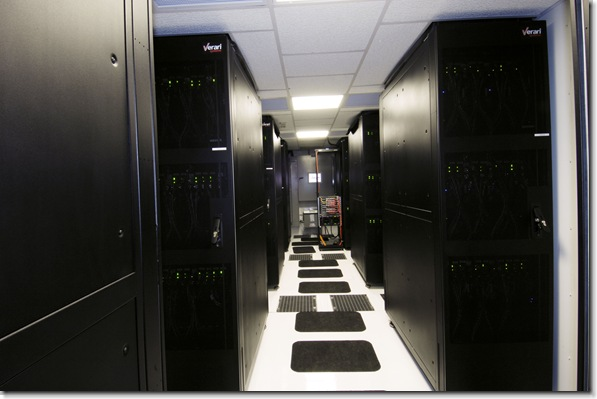
Microsoft Virtual Earth Team Posts Picture of Verari Servers in Wind Powered Data Center

The following picture should not have been posted, and if Microsoft tries to pull it watch out for the Streisand Effect.

Or maybe this part of Microsoft's PR plan on data centers. The Microsoft container placement is interesting to watch.

Thanks to Data Center Knowledge for posting on the link to the Virtual Earth site.

Microsoft Unveils Wind Powered Virtual Earth 3D Data Lab

With Earth Day just a week away, Microsoft unveiled its new wind-powered container-based data lab yesterday at its site in Boulder, Colorado. The containers house data processing servers used in the creation of the 3D city models featured in Virtual Earth online mapping platform. 

Given the computationally intense nature of creating the 3D models, the storage requirements for the operation are staggering. The new lab servers each have 8 “cores”—CPUs essentially—totaling more than 5000 cores and supporting more than 10 petabytes of data. When factored in with lab servers located in the facility’s building--now also wind-powered--the total storage capacity supporting the Virtual Earth operation in Boulder is 15 petabytes. To put this into perspective, a typical consumer camera is around 5 megabytes. It would take three billion of these images to fill the 15 petabytes of storage: the equivalent of 10 photos for every person in the US.

image

image

Read more