James Hamilton Analyzes Google’s Data Center ideas – Water and PUE

James Hamilton analyzes Google’s Data Center publication.

A Small Window into Google's Data Centers

Google has long enjoyed a reputation for running efficient data centers. I suspect this reputation is largely deserved but, since it has been completely shrouded in secrecy, that’s largely been a guess built upon respect for the folks working on the infrastructure team rather than anything that’s been published. However, some of the shroud of secrecy was lifted last week and a few interesting tidbits were released in Google Commitment to Sustainable Computing.

On server design (Efficient Servers), the paper documents the use of high-efficiency power supplies and voltage regulators, and the removal of components not relevant in a service-targeted server design. A key point is the use of efficient, variable-speed fans. I’ve seen servers that spend as much as 60W driving the fans alone. Using high efficiency fans running at the minimum speed necessary based upon current heat load can bring big savings. An even better approach is employed by Rackable Systems in their ICE Cube Modular Data Center design (First Containerized Data Center Announcement) where they eliminate server fans entirely.

Parts I liked about James efforts are #1 – he discusses water.

It’s good to see water conservation brought up beside energy efficiency. It’s the next big problem for our industry and the consumption rates are prodigious. To achieve efficiency, most centers have cooling towers which allow them to avoid the use of energy-intensive direct-expansion chillers except under unusually hot and humid conditions. This is great news from an energy efficiency perspective, but cooling towers consume water in two significant ways. The first are evaporative losses which are hard to avoid in wet tower designs (other less water-intensive designs exist). The second is caused by the first. As water evaporates from the closed system, the concentrations of dissolved solids and other contaminants present in the supply water left behind by evaporation continue to rise. These high concentrations are dumped from the system to protect it and this dumping is referred to as blow-down water. Between make-up and blow-down water, a medium-sized, 10MW facility, built to current industry conventions, can go through ¼ to ½ million gallons of water a day.

The paper describes a plan to address this problem in the future by moving to recycled water sources. This is good to see but I argue the industry needs to reduce overall water consumption, whether the source is fresh or recycled. The combination of higher data center temperatures and aggressive use of air-side economization are both good steps in that direction and industry-wide we’re all working hard on new techniques and approaches to reduce water consumption.

Then #2 PUE.

The section on PUE is the most interesting in that the are documenting an at-scale facility running at a PUE of 1.13 during a quarter. Generally, you want full-year numbers since these numbers are very load and weather dependent. The best annual number quoted in the paper is 1.15 which is excellent. That means that for every watt delivered to servers 0.15W is lost in power distribution and cooling.

This number, with pure air-side cooling and good overall center design, is quite attainable. But, elsewhere in the document, they described the use of cooling towers. Attaining a PUE of 1.15 with a conventional water-based cooling system is considerably more difficult. On the power distribution side, conventional designs waste about 8% to 9% of the power delivered. A rough breakdown of where it goes is 3 transformers taking 115KV down to 13.2KV down to 480KV and then down to 208KV for delivery to the load. Good transformer designs run around 99.7% efficiency. The uninterruptable power supply can be as poor as 94%, and roughly 1% is lost in switching and conductors. That approach gets us to 8% lost in distribution. We can easily eliminate one layer of transformers and either use a high efficiency bypass UPS. Let’s use 97% efficiency for the UPS. Those two changes will get us 4% to 5% lost in distribution. Let’s assume we can reliably hit 5% power distribution losses. That leaves us with 10% for all the losses to the mechanical systems. Powering the Computer Room Air Handlers, the water pumps etc. at only 10% overhead would be both difficult and more impressive.

The 1.15 PUE with pure air-side economization in the right climate looks quite reasonable, but powering a conventional, high-scale, air and water, multi-conversion cooling system at this efficiency looks considerably harder to me. Unfortunately, there is no data published in the paper on the approach and whether it was simply attained by relying on favorable weather conditions and air-side economization with the water loops idle.

And last, #3

The paper concludes that “if all data centers operated at the same efficiency as ours, the U.S. alone would save enough electricity to power every household within the city limits of Atlanta, Los Angeles, Chicago, and Washington, D.C.”. This is hard to independently verify without much more information than offered by the paper. Most of the techniques employed are not discussed in the paper published last week. If the large service providers like Google, Microsoft, Yahoo, Beidu, Amazon and a handful of others don’t publish the details, the rest of the world’s data centers will never run as efficiently as described in the paper. Only high-scale datacenter users can afford the R&D program to spend on increased efficiency and water consumption elimination. I’m arguing it’s up to all of us working in the industry to publish the details to allow smaller-scale deployments to operate at similar efficiency levels. If we don’t, it’ll continue to be the case that US data centers alone will be needlessly spending enough power to support every household in Atlanta, Los Angeles, Chicago, and Washington DC. Each day, every day.

Hopefully other press and bloggers will read James’s post, and provide other points beyond Google’s marketing efforts.

Read more

Who Are You Listening To?

After spending a great week networking with folks at Data Center Dynamics Chicago, I caught TechHermit's post on the latest anti-PUE post by Ken Brill.

A Controversy of lunacy

September 19, 2008

I have been sidelined for the past few weeks with a rooftop air handler replacement project.  As a result I have not been very active here, but the growing lunacy in our industry around efficiency metrics has pulled me out of my long hours to post a slight commentary. 

Data Center Journal posted a video on the growing controversy which attempts to get at the heart of the issue.   Personally I don’t feel that this post is very even handed and it gives Ken Brill and the Uptime Institute a lot of air time with his buffoonish rebuttals of PUE.  The flip side has barely a rebuttal from the Green Grid.  In effect his issues are nomenclature.   Additionally the schizophrenic ramblings has him taking credit for developing the metric 5 years ago, and then publicly flogging the same metric with a different name.  Does anyone else see the utter lunacy in this?

As TechHermit points out I don't want to draw more attention to Ken Brill, and it is not worth fighting Ken as it seems like he is the only one out there fighting the Green Grid and users of PUE, rounding up his believers for the next Uptime Institute Meeting.

Ken has way too much energy and connections in the data center industry to ignore what he is doing. Being an Aikidoist, I've learned to think of how to use the attacker's energy to your advantage.

Aikido (合気道, aikidō?) is a Japanese martial art developed by Morihei Ueshiba as a synthesis of his martial studies, philosophy, and religious beliefs. Aikido is often translated as "the Way of unifying (with) life energy"[1] or as "the Way of harmonious spirit."[2] Ueshiba's goal was to create an art that practitioners could use to defend themselves while also protecting their attacker from injury.

Aikido is performed by blending with the motion of the attacker and redirecting the force of the attack rather than opposing it head-on. The aikidōka (aikido practitioner) "leads" the attacker's momentum using entering and turning movements.

Aikido training is mental as well as physical, emphasizing the ability to relax the mind and body even under the stress of dangerous situations.[42] This is necessary to enable the practitioner to perform the bold enter-and-blend movements that underlie aikido techniques, wherein an attack is met with confidence and directness.[22] Morihei Ueshiba once remarked that one "must be willing to receive 99% of an opponent's attack and stare death in the face" in order to execute techniques without hesitation.[6] As a martial art concerned not only with fighting proficiency but also with the betterment of daily life, this mental aspect is of key importance to aikido practitioners.[43]

TechHermit closes with the following.

I am not giving Ken Brill more airtime on this subject.   Just talking about it feeds this goofy controversy. He is single-handedly splintering the data center community and the tools of media are turning a blind eye.   Wise up.  The Tiering System is out of date, and Ken Brill is in full brand protection mode.  Even Microsoft is more “open source” to ideas than the Uptime Institute.

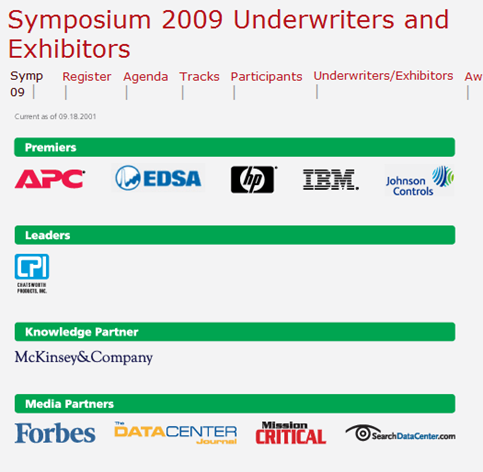
Using Ken's energy he will splinter the data center community in those who look to Uptime Institute for guidance, and those that do not. I've heard rumors many of the top data center vendors are questioning sponsorship for Uptime's Symposium 2009. image


Personally, I am making great connections with those who question Ken Brill's motives.

Who are you listening to? Ken Brill or the rest of the industry?

If you worship Ken Brill's words, you may want to start listening to the other side. But, don't expect the other side to come from Ken's media partners - Forbes, Datacenter Journal, Mission Critical, and SearchDataCenter.com. 

Read more

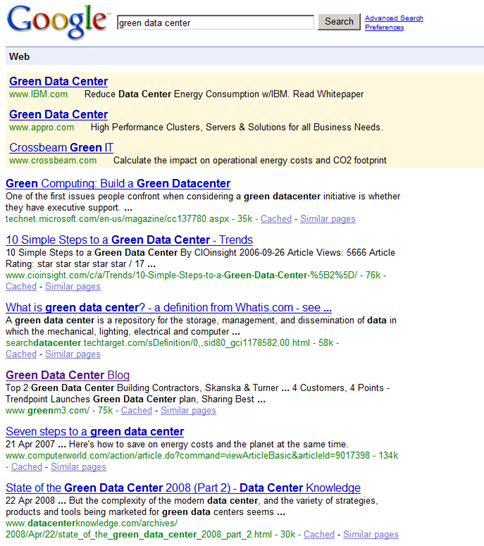
Google Search “green data center”

With this post I’ve hit my 452nd post on the green data center blog. Out of curiosity I wanted to see how well my google search results work for “green data center”.

Good news my TechNet article I wrote a year ago is #1.  My blog is #4.

Not too bad for starting my blog 9 months ago.

Thanks for visiting my blog.

-dave


image

Here are my top 12 search queries according to Google webmaster tools.

image

Note the interest in Intel Atom server. This helps to confirm my ideas on the Little Green Server and people want to run their own energy efficient servers.

Read more

VMWare’s Hidden Competition Strategy Executive, Charles Fitzgerald

This week was a lot of face to face networking and not much time on the Internet and blogging. One of the nuggets of data found is what happened to Microsoft’s Charles Fitzgerald, a general manager who was a big thinker in planning Microsoft’s competitive strategy. As Mary Jo Foley writes.

Charles Fitzgerald, Microsoft’s General Manager of Platform Strategy, is leaving the company to join a startup.

Fitzgerald was Microsoft’s primary spokesperson for Microsoft Java back in 1996. Ever since, he’s been helping Microsoft position itself against its enterprise competitors. On Fitzgerald’s Platformonomics blog, he skewered regularly IBM, Sun, Oracle, Google and other Microsoft competitors.

Most recently, Fitzgerald was focused on explaining Microsoft’s Software+Services strategy to the press and analyst masses. While he was mostly a behind-the-scenes strategist, Microsoft trotted out Fitzgerald whenever the company needed to justify a new strategy/product plan or set the big-picture scene for company critics.

Microsoft officials confirmed that Fitzgerald will be leaving Microsoft “shortly” and declined to name the startup he will be joining. I e-mailed Fitzgerald, asking him about his decision to leave Microsoft. If and when he responds (not holding my breath here), I’ll add his comments.

One friend said Charles joined Pi Corp, Paul Maritz’s company one week before it was acquired by EMC, reporting directly to Paul. Charles had to have known he was joining EMC’s cloud computing efforts, and I wouldn’t be surprised if he know at the time that there were plans to make big changes at VMware (NYSE: VMW) like Paul’s CEO role.

Add up Charles Platform Strategy skills, his lack of visibility to the external world, and VMware’s changes, I place bets he is Paul Martiz’s Competition Strategy Executive. Paul Maritz’s public statements of having no fear of competing against Microsoft is backed by a trusted executive he has planning the strategy.

How good is Paul Maritz?  Valleywag has a post.

Once a high-flyer at Microsoft, Maritz was ousted in one of the software giant's typically obscure internecine battles back in 2000. Since then, he's quietly stewed in exile, starting a small software company which was bought by EMC, VMware's parent.

A lucky break for EMC to have Maritz on its bench. Ignore his cuddly-programmer looks; he is fearsome, and deservedly hated by enemies. Antitrust superlawyer David Boies couldn't make a dent in Maritz's armor when the executive took the stand in Microsoft's 1990s antitrust trial. VMware is up for a bruising battle with Microsoft for its software niche, which involves tools to let a computer server act like several separate ones — but I'm thinking Microsoft is the one we should feel sorry for.

Maritz's generation of leaders has mostly retired at Microsoft, yet most of their replacements' freshly scrubbed faces are still familiar to him. He knows all of Microsoft's dirty tricks, and he will enjoy serving them back at the young ones he once taught them to. This will be fun.

Take 2 executives who were frustrated at Microsoft and put them together in an opportunity to compete, and watch out.  Microsoft now not only has to compete on technical and marketing with VMware, they need to compete against their executive team on strategy.

I’ve searched for Charles’s presence in VMware, but he is hidden which means either he is busy inside VMware or my facts are wrong. If I had to place a bet, Charles is staying under the radar not telling anyone what he is planning at VMware.

Update 9:19a, Aug 7, 2008.

I missed Mary Jo’s post that had the tip of Charles at PiCorp.

According to a few different sources who asked not to be named, Maritz has hired Charles Fitzgerald, Microsoft’s former head of Platform Strategy, to work at Smart Desktop, a division of Martiz’s Pi Corp.

Fitzgerald resigned from Microsoft in January 2008 and neither Microsoft nor Fitzgerald himself would comment on where he was going.

(I tried contacting Smart Desktop to see if Fitzgerald was hired, to no avail. I also tried e-mailing Fitzgerald, but so far, no reply.)

Read more