Why I didn't buy an iPad 3G on Apr 30, opted for a Thinkpad X200 TabletPC

The iPad has sold over a million units since launch in 28 days.

iPad comfortably beats iPhone to 1 million mark - Can other OEMs grab some of the success?

Posted by Adrian Kingsley-Hughes @ 4:20 am

Categories: Industry

Tags: Apple iPhone, Apple iPad, Apple Inc., Tablets, Notebooks...

It took the iPhone 74 days to hit the magic 1 million sales mark. The iPad has accomplished the same feat in under half the time.

“One million iPads in 28 days—that’s less than half of the 74 days it took to achieve this milestone with iPhone,” said Steve Jobs, Apple’s CEO. “Demand continues to exceed supply and we’re working hard to get this magical product into the hands of even more customers.”

The first iPads I saw in public and used was at Microsoft Commons

image 

The Commons, a signature piece in a massive expansion that is adding the equivalent of a Columbia Tower to what the company calls the world's largest corporate campus.

The Commons is a cross between the University of Washington's HUB, University Village and Pike Place Market.

The complex of 14 restaurants, shops, soccer field, even a pub is the gooey filling in the emerging West Campus, a 1.4 million-square-foot town square of four office buildings that will house the company's Entertainment and Devices division, which developed video-game player Xbox and music-player Zune.

I've talked to Microsoft employees who stood in line to buy an iPad when first available.   It is sad that Microsoft made the choice to invest in development of the Surface while Apple choose mobile devices - iPhone, iPod Touch, and iPad.  Which reminds me of data center guys who think bigger is better.  Mobile, smaller, integrated, and agile is the new thinking for data center design.

Mike Manos has an iPad. Olivier Sanche of course.  Bunches of people I know have one as well.  Why didn't I buy one?

My Dell Laptop is 3 years old and I am ready for a mobile device.  Apple has released new MacBook Pros with i5 chips, iPad is shipping.  I used this as a good opportunity to think about how I work and what is the best tool, treating this as a design exercise similar to designing products and data centers.

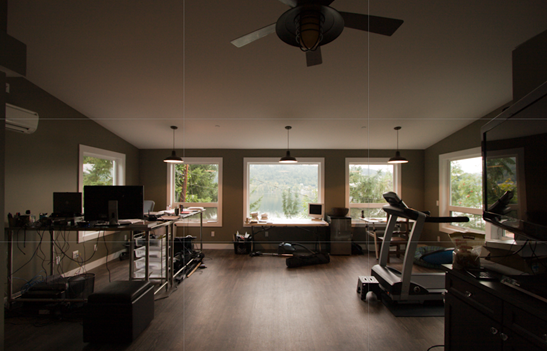
First where do I work?  Here is my home office where I spend all of my time when I am not travelling.  I spend 2 -3 days at a stretch working in my home office.

Here is a picture of my home office.

I have 500 sq ft of space and  a treadmill to exercise given I am not walking much. image
My commute home is down 100 stairs to our small 850 sq ft beach house.

image 

While we are building a new house above.

image

Now that you see my site,  What are the primary tasks I do.

  • Blog with Windows Live Writer.  I've tried to find a better blogging tool on Mac and Windows, and there are bloggers on the Mac who will actually run Windows VM just to run Live Writer.  Blogging is one of my main communication tools, as my clients read my blog regularly.
  • e-mail is where I next spend time.
  • IM using Skype, Messenger, and Office Communicator, vast majority texting, not using voice
  • iPhone for another screen, e-mail, Facebook, Twitter feeds, idea writing.
  • Mind-mapping with Mind Manager.
  • Talk on the phone less than an hour a day.

People get iPad's to play games.  I have an xBox 360 on a 47" LCD Samsung display.  It works well for watching videos.  8 inch iPad display or 47"?   I think I'll choose the 47 inches.

image

So, what did I buy?  While hundreds of thousands of people were getting iPad 3G on Apr 30.  I received a ThinkPad X200 TabletPC. 

lenovo_thinkpad_x200_tablet_outdoor_screen_slate-display

1.86 Ghz Intel duo processor, 3 GB RAM, 160 GB HD, USB ports, full keyboard, etc.  The few things I can't do on the Thinkpad vs. iPad, like buy apps through Apple App store is what I can do on my iPhone.

And, best yet, I was able to buy last year's model from Lenovo outlet for $995.  So, while a million people are making trade-offs owning an iPad, I have all the functionality I need in a Tablet device - full keyboard, pen input, usb ports, DVD drive.  It weights 3.5 lbs, but I think my arms are strong enough to hold it.

And, last I did a peer review.  I sat down with one of my Microsoft friends yesterday who has an iPad, and he agreed the X200 Tablet was the right device for me as I spend more time creating which means I need to type.  And, now I can write on the TabletPC.  Ink and paper form has its benefits.

My new idea desk is set up as big post-it area with the TabletPC.

image

Read more

Iceland Data Center Power, Fiber, and Natural Disasters, Perception vs. Reality

The folks at Iceland's economic development group provided PDF documents describing the Power and Fiber infrastructure and natural disasters.

image

As requested I am sending you a map showing the location of the substations and transmission lines of Landsnet, the Transmission System Operator of Iceland.  As may be seen from the map, the 132 kV and 220 kV part of the transmission system is built as an interconnected, N-1 system, i.e. it is built and designed in such a way that a single failure of one component should not have an effect on the delivery of power to our customers. 

Also the map shows the location of the current volcanic activity in Eyjafjallajökull and a shaded grey area where ash fall has resulted from the volcanic eruption.  The ash that is falling is composed of both fine and course particles.  The wind direction and other meteorological conditions have an impact on where the ash falls to earth. 

The Natural Disaster Risk is top in the news and is in this pdf.

image

The Power Infrastructure is mapped here.

image 

The Fiber Infrastructure is here.

image

Here is a press release as well translated to English.

LANDSNET’S REACTIONS TO THE EYJAFJALLAJÖKULL ERUPTION

Ever since the volcanic eruption started at Fimmvörðuháls, followed by the larger eruption in the Eyjafjallajökull glacier, Landsnet has been on alert to manage any unexpected events in Iceland’s electricity transmission system. No disturbances due to falling ash have occurred.
We are keeping a close watch on developments and our team remains on alert in case any action is needed. Our Operation & Maintenance department is preparing condition checking on the South Transmission Line to examine the effects of the ash-fall.
Representatives of the Electricity Sector Emergency Partnership (ESEP) are working at the National Emergency Coordination Centre at Skógarhlíð in Reykjavík to provide information to stakeholders as developments unfold and warrant. This role is carried out by standby personnel of Landsnet’s System Operations division. In addition, the Coordination Centre monitors the telecommunications network. These parties also supply updates on the electricity system’s status to the Civil Protection Department.
Regular consultation meetings on the situation are held with representatives of ESEP and the telecommunications system. ESEP representatives are co-operating closely and exchanging information on the eruption and its effects.
The Eyjafjallajökull eruption appears to have changed from an explosive eruption to an effusive eruption. Steam explosions have decreased and the ash plume is not reaching such high altitudes as previously. This indicates that water is no longer reaching the crater and that an effusive lava flow has begun. Splashes of lava are streaming out of the crater and the eruption plume is now mostly white. According to the Icelandic Met Office, the probability of ash-fall in the Greater Reykjavík Area is minimal. The wind direction is forecast to turn easterly on Thursday, but rain is forecast, which reduces the likelihood of ash-fall substantially.
The eruption has caused no disruptions to electricity transmission or distribution, nor has it caused damage to electricity infrastructure in the affected region. There have been no disruptions to telecommunications. Water supply to the Westman Islands is being closely monitored, as the islands’ water source is located in the volcano’s vicinity. A power line from Iceland State Electricity (RARIK) along the Eyjafjöll mountains tripped over the weekend, but this was confirmed to have been due to birds flying into the line. Back-up diesel generators are being operated at the town of Vík as a result.
The fine-grained ash gets into all electricity infrastructure in the area and is deposited on outdoor electrical installations. However, this has not caused any disturbances. According to information from RARIK, all the indications are that the ash does not have high conductivity, as neither dry nor wet ash has caused any interruptions. The ash will be largely washed off installations and equipment by rain. Confirmation regarding the ash’s conductivity is being sought from the Science Institute of the University of Iceland.
Regular updates on the eruption are provided on the website of the Icelandic Civil Protection Department: www.almannavarnir.is

I don't disagree with any of these being facts, but Perception vs. Reality is something few understand.

Truth vs. Fact
In his book Story, the legendary screenwriter Robert McKee wrote, “What happens is fact, not truth.  Truth is what we think about what happens.”  Facts are reality (Smaller cars are safer than SUVs).  Truth is perception (Bigger is safer).  Facts are the way things are (It doesn’t matter what golf ball you hit; it’s still going to end up in the woods).  Truth is the way your brain view things; your thoughts, opinions, evaluations, feelings and conclusions (You’re a winner . . . like Tiger.  So you need a ball with a swoosh on it).  You believe that your truths are the facts. We all do.

This is a difficult concept to grasp.  Not because it’s intellectually challenging; it’s not. Rather, because it’s difficult to feel.  For example, do you feel that you are the outgrowth of a spinning sphere that is rocketing through space at more than twenty times the speed of a bullet?  Probably not, but those are the facts.  So what does this have to do with marketplace success? Everything!  Because the cold, harsh reality is that your audience judges you based upon the very little bit of you that they hastily perceive.  They speed read you, and prejudge you with their resultant feelings.

I see this Perception vs. Reality (Truth vs. Fact) mistake being made repeatedly in data center discussions.  The data center experts think one thing, the pubilc thinks another.  Data Center experts say they are right.  Public doesn't care.  Look at the Facebook page run by Greenpeace.  It is now up to 400,000 people for English,  Spanish and French versions.

Take action: Join a group in your language!
English Group: We want facebook to use 100% renewable energy

Spanish Group: Queremos que Facebook utilice 100% energía renovable

French Group: Nous demandons 100% d'énergie renouvelable pour Facebook

Join the group to get facebook.com onto 100 percent renewable energy

More than 400,000 facebook members in 8 weeks!

Facebook announced in February that it will build a massive data centre in Oregon, U.S., packed full of the latest energy efficient computers to serve the hundreds of millions of friends connecting on their near-addictive social networking website. But the company plans to run the place on electricity made by burning coal--Yes, the dirtiest source of energy and largest single source of global warming pollution in the world.
Read more...

Facebook has tried to tell the truth on their energy efficiency.

At the same time, it is simply untrue to say that we chose coal as a source of power. The suggestions of “choosing coal” ignores the fact that there is no such thing as a coal-powered data center. Similarly, there is no such thing as a hydroelectric-powered data center. Every data center plugs into the grid offered by their utility or power provider. The electrons powering that data center are produced by the various sources (e.g. hydro, natural gas, coal, geothermal, nuclear, etc.) the provider uses in proportions similar to the mix of sources used. That is, if 25% of the providers energy comes from natural gas, it’s a good guess that 25% of the electrons powering the facility come from that source. Even when a facility is in close proximity to an individual source of energy, such a dam or coal plant, there is no guarantee that the electrons from that source are flowing to the facility at any particular time.

I know of one power site that runs as a microgrid with 100% biomass renewable energy  at 10 - 20 megawatts currently being evaluated as a data center site.

Read more

Does having the Rights mean it is Right?

Part of the difficulty of changing people's behavior to be green, taking more sustainable actions is they have the Rights to do what they are doing.  It is not illegal.  For the US, The Bill of Rights is a foundation of American thinking.

The Bill of Rights plays a key role in American law and government, and remains a vital symbol of the freedoms and culture of the nation.

There is nothing in the Bill of Rights that says you cannot be an energy hog, wasting the Earth's resources, polluting the water for downstream users.

The Clean Water Act may be one of the most influential laws changing your Rights, making it illegal to pollute the waters.

The Clean Water Act is the primary federal law in the United States governing water pollution.

Newsweek had an article explaining what is saving the planet is not our individual actions, but regulation and legislation.  The article starts poking fun that people are shopping to show they are green.

On the 40th Anniversary of Earth Day, Let’s ... Go Shopping!

Buying green and changing personal behavior won't save the planet.

PHOTOS
Progress Check

On the 40th anniversary of Earth Day, NEWSWEEK looks at how far we've come, and how far we have yet to go, in protecting the planet.

By Sharon Begley | Newsweek Web Exclusive

Apr 21, 2010

With apologies to a cliché that predates the advent of Earth Day by a year, it is easy being green. Too easy. From adorable reusable shopping bags and organic clothing to hemp shower curtains (no nasty petroleum-based vinyl liner!) and "natural is now fun!" beauty products for girls, the proliferation of green products makes doing our bit for the planet a blast, since Americans can combine environmentalism with their favorite sport, shopping. Indeed, a Gallup poll released this month finds that large majorities of Americans are shopping for the good of the planet: 76 percent said they'd bought a product specifically because they thought it was better for the environment.

Then makes the point the biggest environmental change is not from individuals, but groups.

As my colleague Ian Yarett documents in his progress report on the environment, every example of major environmental progress—reducing acid rain, improving air quality, restoring the ozone layer—has been the result of national legislation or a global treaty. We reduced acid rain by restricting industry's sulfur emissions, not by all going out and sprinkling bicarb on sensitive forests and lakes. Leaded gasoline was banned by the Environmental Protection Agency in 1996, not by everyone choosing to buy cars that run on unleaded. Ozone-chomping CFCs were banned by the 1987 Montreal Protocol, not by everyone deciding to forgo spray cans and air conditioning.

The gases had to be banned, people. All environmental progress has come through national- and international-level regulation—to be blunt, by forcing people and industry to stop doing environmentally bad things and start doing environmentally good things, not by relying on individuals' green good will or even the power of the marketplace.

What would happen if environmental law was part of the Bill of Rights?  The Earth has rights that are equal or greater than individual rights.  Right now the Earth does not get paid for use of its resources.

Is it Right, if you have the Rights?

Read more

What am I doing on Earth Day? Working on a solution that will change the data center industry

Earth Day in many ways is a market event.  A day to celebrate the successes over 40 years.  Politicians, environmentalist, vendors all have the chance to use today to market and promote how effective they are.

What am i doing today?  I have set up a 1/2 day meeting between 4 companies to discuss a solution that will change the data center industry, allowing people to see the impact of their actions more clearly.  Answering the difficult question "what is sustainable?"

An overly enthusiastic focus on efficiency has created food production that has bad environmental impacts and bad tasting food.  Over the last 30 days my most popular blog post is the one I wrote on Sustainable Farming.

Mar 26, 2010

Sustainable Farming Method applied to Sustainable Data Centers, Dan Barber's entertaining how I fell in love with a fish, it's about relationships

This is a video that has 5 stars. It is entertaining, funny and educational.

Here is Huffington post article about the video.

Dan Barber: How I Fell in Love With a Fish

Chef Dan Barber squares off with a dilemma facing many chefs today: how to keep fish on the menu. With impeccable research and deadpan humor, he chronicles his pursuit of a sustainable fish he could love, and the foodie's honeymoon he's enjoyed since discovering an outrageously delicious fish raised using a revolutionary farming method in Spain.

The group I am meeting with today gets what Dan Barber presents.  It's not about energy efficiency which is a top data center method, it's about what is sustainable.

I'll be able to write more about what we are doing in the future, but it is time to go to the meeting and I need to catch the bus to downtown Seattle.

Read more

LEED - the Logo Program for a Green Data Center? Not necessarily

The popularity using LEED to identify Green Data Centers has been interesting to watch.  I had the opportunity to take the LEED exam and add LEED AP to my business card.  But, this is where my renegade/contrarian side kicks in.  I saw the exam as a waste of time, having a LEED associated with what I work on.

Why am I negative on LEED?  Because it is a Logo program where if you meet the criteria you get a logo you can have on your building.  A good demonstration of the problem is in this FastCompany article.

The problems are several. Critics argue that the USGBC ignores important geographical differences, attaching as much importance to water conservation in Washington as in Arizona. For that matter, every feature on the LEED checklist is awarded the same value--so a builder gets the same credit for installing a bike rack as for harvested-rain cooling, regardless of their true impact. But the biggest issue is cost. Design and construction reviews required for LEED certification can cost many thousands of dollars.

These are all good points, and the biggest one I agree with is cost.  Why is LEED so popular in the Data Center industry.  Because of the money made by the people who promote and market LEED.  What is the ROI on LEED?  People convince you LEED Silver isn't enough, Gold is the new minimum, and you should go for Platinum.

Uhhh? What is the ROI?  For the consultants, it is an awesome ROI, spending more time in billable hours discussing alternatives to get more points.  Customers feeling like they are getting something as they get another point for waterless urinals and bike racks - key features that are required data centers. :-)  A lower water use cooling system doesn't count as much as waterless urinals even though the water use is probably 10,000 times more.

What happens if you did what Cornell did and built to LEED standards but didn't get certified?

A Different Shade of Green

A Different Shade of Green

Certifiable Cornell's Alice Cook House, the first of five nearly identical dorms.

Knockoff Construction of a new dorm, Hans Bethe Hall, which has the same green specs but won't be LEED-certified.

Cornell asked that question.

That's why some are looking for ways to circumvent the official process. By the time Cornell University completed the first of five nearly identical dorms in 2004, it had paid $300,000 in consultant and submission fees to get LEED status. Now, it's using that building as a blueprint for the other four--each featuring vegetated roofs, spaces with natural light, and a glycol heat exchanger. They're certifiable, just not certified.

READER RIFF

“If one designs with LEED standards, the resulting building will save you money while almost secondarily helping the environment. A savvy businessperson could only make one choice. ” --Lisa L. Reeves

On Earth Day when LEED data centers are a top topic. I am not going to contribute to listing those data centers that make others feel like they need to spend a bunch of money to put a LEED logo on their building.

I've watched this go on for years when I worked at Microsoft and had various roles in Windows Logo Programs.  Microsoft was able to work the system as vendors knew their customers expect a Windows Logo on the box.  Which is a masterful demonstration of using a Brand to market to customers.

Windows Logo Program

*

Windows Logo Program: Overview

The Windows Logo Program is designed to address the current and future market needs of customers using the Windows platform. The Windows logo signifies the compatibility and reliability of systems and devices with Windows operating system. It gives customers confidence that your product is thoroughly tested with Microsoft-provided tools and ensures a good user experience.

The Windows Logo Program helps partners to innovate and bring a premium experience to market, thereby improving their ability to increase market share. The program strives to continuously improve its processes, responsiveness, and partner satisfaction.

LEED is a marketing program.

Imagine how greener a data center would be if the same amount of money spent for LEED certification was spent on reducing the overall environmental impact.  But, there is no Logo for this.  Just the satisfaction you used your money for a better purpose than being LEED certified.

Read more