Happy St Patrick’s Day a good day to wear Green, and another day when an apostrophe will be put in Ohara

Today is a day when many try to wear green.   My kids all looked for green to wear as they were told if you don’t wear green you can get pinched on St. Patrick’s Day.

Many people, regardless of ethnic background, wear green clothing and items. Traditionally, those who are caught not wearing green are pinched affectionately.

Today is also a day that reminds me of funny stories when people think Dave Ohara is Dave O’Hara.  Ohara is a Japanese name.   O’Hara is Irish.

I have had so many people think I am Irish when seeing my name.  I was hired at HP for my first job over the phone for a summer job and my hiring manager thought I was Irish.  I changed groups at Apple, and a person in the new group was in Japan and tried to convince the people at Mitsubishi and Hitachi that I was Irish and O’Hara is a common name in the US. 

If you look in Google Person Finder for the Japan, there are multiple Oharas listed.


My grandparents all left Japan in 1930s so I have no close relatives in Japan now.  And Luckily, my grandparents left Hiroshima which had its own nuclear disaster.

Why I ordered a Motorola Xoom vs. an iPad 2, the Google Cloud

My family has an iPad original which is great for watching movies and surfing the web.  The iPad 2 just shipped on Mar 11, and it was tempting to get an iPad 2 to share with the family.  One of my friends got an iPad 2 on Mar 11 and shared his experience vs. his iPad 2.

I have been enjoying it as much as my original iPad.  Impressions:
- I still find them too slippery!  the smooth aluminum back slides around in my lap.
- it feels a lot thinner.  it feels more like Dave's Kindle 3 in thickness
- it feels a lot lighter, again, closer to Dave's Kindle 3.
- the screen feels brighter
- the operation is snappier.  I find that web pages are rendering faster.  I am getting less of the checkerboard placeholder while web pages render.  I also sense that the lag between starting a touch operation and the system detecting that is shorter, resulting in snappier response in games, etc.
- I read that the white bezel could be distracting and that the black was superior.  I deliberately bought the white to try that out, and to distinguish it from my original iPad (now my son’s).  I am not as used to it yet, but once I am reading, I can't say that I really notice it.  The content, especially that about Japan's earthquake and tsunami are so compelling that the bezel isn't really a factor.
- I haven't seen the fancy new covers yet, but I hear that they are great.  One site is predicting that Apple will sell nearly $1BN of the covers alone!!  what a business!!

Amazon.com and others are taking orders starting Mar 16, 2011 for the $599 Motorola Xoom 32GB wifi tablet.
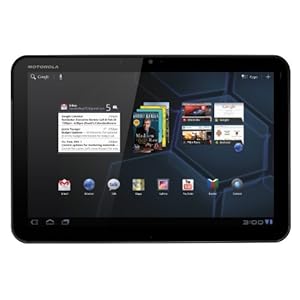
by Motorola

new

Price:
$599.00 & eligible for free shipping with Amazon Prime

This item has not yet been released.
You may pre-order it now and we will deliver it to you when it arrives.
Ships from and sold by Amazon.com.

I decided to place an order for a Motorola Xoom as many of my technical friends prefer Google Android vs. Apple iOS operating system.

Forbes has a blog entry on the iPad 2 vs. the Xoom which has a high 22,781 views

Apple iPad 2 vs. Motorola Xoom: Which Wins As A Business Tool?

Mar. 14 2011 - 1:31 pm | 22,781 views | 2 recommendations | 9 comments

The iPad 2 (left) is thinner than the Xoom (right) but has a slightly smaller screen than its rival.

If you are a Travelgeek you either have or are considering one of the latest tablet computers. A lot has been written on this topic, so my focus is on the utility and value of these devices for the pro business traveler. Is it worth the investment?

After reading the Forbes post, it became clearer what I am looking for in the Xoom vs. the iPad.

Why do I believe that Android will prevail? It is because almost all of our lives are now wrapped around Google and its incredible data search and access capabilities. Apple, in my view, cannot compete with what Google can offer to Smartphone and tablet users: an amazing array of instant information from anywhere in the world which has been integrated into the functionality of a tablet or Smartphone through its Android operating system.

I use Gmail and Google Search more than any other app.  For the same reason Microsoft shipped apps for the Mac, but eventually developed more for Windows given they owned the OS, they could do more.  Google can do more on Android than Apple’s iOS.

There are many out there who are happy being an Apple device family.  But, in my work Google is the dominant player with almost no need for Apple software.  I may need to apps running on my iPhone, but I don’t actually need the iPhone.

Google is a company who lives in the cloud.  If you want to leverage the cloud why wouldn’t you get their device.  The Motorola Xoom is the better device for working with the Google cloud than the iPad.  The iPad may be better for entertainment and media, but that is not my work. 

Part 2 of the Forbes blog on iPad 2vs. Xoom closes with.

As the Xoom takes its place as the serious business tablet, then I guarantee you will appreciate its attributes over the iPad, especially if you are computer-savvy and can appreciate the design differences between it and the iPad 2.

As to the utility of tablets in general, I found more and more uses for my iPad during the past year and have come to realize its value and versatility as a computing device. Having said that, it has only taken me two weeks to all but discarded it in favor of what I consider as the “Grown Up” new tablet for business: the Xoom.

Transitioning from assumption of Secrecy to public exposure snares top dogs, College football is an example

Data Center is an industry where most assume secrecy is a standard practice.  Secrecy makes life easier as many can do things that aren’t known to the public.  But, with Facebook, Twitter, and many other social sites documenting people’s actions, it is harder to keep things secret.  One of the latest examples in College Football’s Ohio St football coach Jim Tressel.

The WSJ article reviews the situation.

The Sport That Can't Keep a Secret

College Football's Sins Keep Getting Publicly Exposed—But Isn't Sunlight a Disinfectant?

By DARREN EVERSON

The public shaming of Ohio State football coach Jim Tressel is the latest in a series of revelations that have touched nearly all the top programs in college football and many of the sport's most prominent stars.

[tressel0310]Photo Illustration by The Wall Street Journal; Zuma Press

The recent suspension of Ohio State football coach Jim Tressel points to a complex truth.

The long trail of investigations, accusations, clarifications and statements of heartfelt contrition has cut from North Carolina to Oregon in recent months, scooping up national champions, famous coaches and Heisman Trophy winners.

Some see the openness as a good change.

The obvious conclusion to draw is that college football's moral center has been replaced with a delicious filling of creamy marzipan. (Good luck finding someone who would argue the other side). But the events of recent days also point to another, more complex truth: College football is becoming an impossible place to keep secrets.

"The more transparency, the more openness the better," said former Michigan athletic director Bill Martin. "I think this is all very healthy."

The NCAA has an impossible task to try and monitor football let alone all college athletics, but their life is much easier thanks to web properties like Facebook, Twitter, and TMZ.com.

In the last year, NCAA investigators have been drawn to ask questions about everything from a report on TMZ.com that a player was at a party sponsored by an agent to a Facebook post in which one heavily recruited high school player posted about his new iPhone.

There have been controversies generated by reports of players who've been spotted in fancy cars. And because most schools are public institutions supported by taxpayers, they're required to respond to requests for information made under the Freedom of Information Act.

The mood is changing to help the NCAA catch the illegal action.

Beyond enforcement, however, there's a growing consensus throughout college football that the NCAA is simply doing a better job of collecting information. "In the past, the NCAA was often criticized for not knowing what's going on in the real world," Baker said. "I think we've got a pretty good idea. Coaches and players are starting to realize that as well."

What's often forgotten is that the immense popularity of college football, the intensity of its rivalries and the increasing interconnections of its fans, have created another potent police force. The result: more messes are being exposed. But the sport is also seeing more than its share of sunlight. And as Justice Louis Brandeis said, "Sunlight is the best disinfectant."

"I don't know that things are a lot different—it's just that people are turning in schools now that weren't before," said Gary Barnett, the former Northwestern and Colorado coach. "It really comes down to all of the hype that's around this sport. The hype is involved, therefore the interest is involved, and people are willing to come forward."

In the future there is going to be a data center disaster that will break the code of secrecy in a location.  What type of event?  Imagine if there was a loss of life due to a data center going down or a data center is proven to be the center of criminal activity.  An investigation into the data center could bring out a bunch of people who were witnesses to illegal activities.  What kind?  Watch where the money flows.

Ironically what could snare some of the top dogs is how they are proven to know of the inappropriate activity, but as long as the data center was running it is not a priority.  Ethics in the data center should help transparency and openness which also makes it easier to green the data center.

Writing Process, an example of what I didn’t blog

I just spent the past week working on a newsworthy blog post.  After a week the person who I was working with and I agreed it was not appropriate to post.  Now some of you may find this extremely frustrating, spending all the time writing, editing, rewriting, obsessing, and repeating the process.  But, in the end I feel better we both agreed not to post. 

WSJ has an article by a creative writing teacher.

Novel Ideas: Write. Rewrite. Obsess. Repeat

By HELEN SCHULMAN

Part of my job as a teacher of creative writing is to curate a reading series for our students and the interested public. We often get great writers to come share their work and to talk about anything from the sources of their inspiration to the books on their bedside tables.

During the question-and-answer period, however, the discussion almost always turns to process: Our audience wants to know every detail of how an author actually sits down to write a book. In writing fiction, there is the mystical element that none of us ever quite understands—how we turn language and ideas into stories and then, hopefully, into art.

Helen discusses the different ways people write, making the point each comes up with their own personal rules of process.

And so, to gird themselves against the anxiety of this fraught endeavor, writers often come up with their own personal rules of process. Think of it as a means of self-discipline, with a dollop of magical thinking and even obsessive-compulsive disorder thrown in to keep the spirit afloat.

Which brings up one of the rules of why I write.  I write because it supports my learning by making me write why I think something is important, and think about the effects of what I post.  Another rule is I always require permission to post or the content is already publicly disclosed.

So going back to the effort I spent the past week on writing a post that I didn’t post.  I feel good, because I learned things about the person, how to write on a topic that would be picked up in news, and about myself.  And, as Helen mentions.

Think of it as a means of self-discipline, with a dollop of magical thinking and even obsessive-compulsive disorder thrown in to keep the spirit afloat.

My spirit does feel better sharing that I didn’t post. Smile

Speed is where margins increase in Data Center Solutions

Rich Miller at Data Center Knowledge has a good post on the value of a millisecond for competitive carriers.

More Speed, at $80,000 a Millisecond

January 24th, 2011 : Rich Miller

A panel at last week’s PTC ’11 conference in Honolulu provided a glimpse at the startling economics on the shifting frontier of low-latency trading. The difference in pricing between the fastest route and runners-up can be dramatic, according to Will Hughs, president and CEO of Telstra Americas.

“On the Chicago to New York route in the US, three milliseconds can mean the difference between US$2,000 a month and US$250,000 a month,” Hughs said. “The financial traders will pay a premium.”

This data fits well with what I have been telling some clients that speed is where margins increase.  Federal Express expanded its capacity by buying a bunch of 727 from United Airlines cargo operations.  In the conversation with a United executive and FedEx executive, the United person was so glad to get out of the cargo business.  FedEx was charging $3.60 a pound, United $0.20 a pound.  A big difference if you sell next day delivery (speed vs. capacity).

image

Note most are focusing on low latency financial trading.

That premium illustrates the value proposition for the network operators who can provide those extra milliseconds and microseconds. That’s why we’ve seen new fiber builds like Spread Networks’ recent trenching of a route connecting  key trading hubs in Carteret and Secaucus, which could also provide some customers in an Equinix data center in Secaucus with faster routes to exchanges in Chicago. Meanwhile, Hibernia Atlantic has announced plans to build a trans-Atlantic submarine fiber optic cable that will provide faster connections between New York and London than any available today. These illustrate how capacity isn’t the only metric driving fiber economics.

But, you know where else the money is?  Gaming.

However, online gaming demands low latency so as not to disadvantage players with low latencies due to highly varied ping times among fellow players - for this reason, game server applications generally favor players with lower latencies by determining the data relating to a player as known to the server, and allowing players to act on that, not the data as known by the fellow player's client.

Low latency is currently a hot topic in the capital markets, particularly where trading based on algorithms (Algorithmic Trading) is used to process market updates and turn around orders within milliseconds. Low latency trading refers to the network connections used by financial institutions to connect to stock exchanges and Electronic communication networks (ECNs) to execute financial transactions. With the spread of computerized trading, electronic trading now makes up 60% to 70% of the daily volume on the NYSE and algorithmic trading close to half of that. Trading using computers has developed to the point where millisecond improvements in network speeds offer a competitive advantage for financial institutions.

Low latency is also being discussed in the advertising community, as a form of advertising that responds rapidly to consumer inputs, often from tweets.

And as this wiki post mentions, advertising is a big area too.

Not a bad market group to go after – Securities trading, Gaming, and Advertising.

Thanks Rich for an informative post that helps me prove my point that speed is worth a bunch of money.

Read more