3 Degrees of Separation, Data Center Dynamics Seattle, High Density Energy Efficient Cooling Experts

While many others were at NGDC, I stay close at home and attended the arrival of Data Center Dynamics to Seattle where 243 people attended an event that expected 200, according to Stephen Worn, CTO. Many times I find a small event enables better networking as you see the same people many times during the conference and you start to build connections with others who have common interests.

One of the people I met at Uptime Institute's Symposium 2008, Green Enterprise Computing event is Digital Sense's Michael Tran.  I suggested he visit Data Center Dynamics Seattle as he was already planning a US trip and I can introduce him to some other people who are building Green Data Centers.

To handle power densities over 25 kW per rack, Digital Sense has chosen Emerson's Liebert XDO cooling as the primary cooling system. Michael said his installation will be the largest installation of XDO cooling in the world.

image

image

Being a little curious I searched for more information on cooling systems that can be repositioned and found some interesting patents.  I found one patent with Liebert's Lennart Stahl and Christian Belady.  I don't know Lennart, but I do know Christian.  Searching more I found 2 more patents with the same two people on them.

US Patent 6,564,858

Abstract

A method and system are disclosed for cooling a heat generating object. A coolant is passed through a heat exchanger so that heated air passing through the heat exchanger is cooled. A fan unit is selectively positioned adjacent to a first side of the heat exchanger. When activated, the fan unit draws the cooled air through the heat exchanger and directs the cooled air towards the heat generating object. The fan unit may be repositioned along a second side of the heat exchanger so as to redefine the flow of air drawn from and directed towards the heat generating object.

US Patent 6,705,389

Abstract

A method and system are disclosed for cooling a heat generating object. A coolant is passed through a heat exchanger so that heated air passing through a first portion of the heat exchanger is cooled. A fan unit is selectively positioned relative to the heat exchanger. When activated, the fan unit draws the cooled air through a second portion of the heat exchanger and directs the twice cooled air towards the heat generating object. The fan unit may be repositioned along a different portion of the heat exchanger so as to redefine the flow of air drawn from and directed towards the heat generating object.

US Patent 6,854,659

Abstract

A system for cooling heat generating objects arranged in a room. The system adapts in real time to changing cooling demands of the objects. Remote sensors mounted in proximity to the heat generating objects relay information to cooling units, which adjust their operation in response to the information.

After understanding more what Michael is doing, one guy I wanted to introduce him to is Christian Belady as he would be a good person to validate Digital Sense's use of Liebert XDO as it appears they have been influenced by some of Christian's cooling ideas.

We ended up chatting for over an hour on power and cooling techniques with power supply architect Shaun Harris, joining in the conversation.  Christian also pulled in Stephen Worn for a bit to discuss power and cooling ideas, and how customers like Michael Tran need to give more presentation at future events.

6 degrees of separation is an idea supported by Microsoft Researcher Eric Horvitz's recent article.  But what I find at Data Center Dynamics events there are many times the degree of separation is only 3 degrees or less.

Another recommendation for Data Center Dynamics is by Ken Oestrich.

Read more

Australia Green IT Summit, 23 July 2008

Thanks to Bianca Wirth for sending me the following information.

This week I'll probably be posting more Aussie content as I have 3 different people I am meeting with from Australia this week to discuss Green Data Centers.

ICT Environmental Sustainability Group

The ACS on behalf of the Queensland ICT Industry launched a National Green IT Industry Special Interest Group and Taskforce 23rd July 2008 at the Brisbane Town Hall. Slides and video from the event are available.

The Green IT Industry SIG aims to provide industry and consumers with reliable information on current strategies and practices for achieving environmentally sustainable IT.

Speakers from Industry and Government explained how the IT Industry and major users can understand and respond effectively to the changing business landscape created by climate change and carbon accounting.

Presenters:

Alison O’Flynn - Guest keynote speaker

Alison heads the Sustainability Consulting practice for Fujitsu Australia, assisting organisations in understanding the risks and identifying opportunities in response to climate change, developing the ‘Green Business Case’ and implementing strategic initiatives.

· GREEN IT Delivering Business Sustainability (Text)

· GREEN IT Delivering Business Sustainability (Slides)

· GREEN IT Delivering Business Sustainability (Video)

Dr Paul Campbell, Green IT Industry Taskforce Chair

How Queensland is leading the national Green IT agenda

· Green IT SIG - Qld leading the agenda (Slides)

· Green IT SIG - Qld leading the agenda (Video)

Phillip Nyssen, Green IT Special Interest Group Chair

How you and your organisation can adopt Green IT practices.

· Green IT SIG Awareness, Knowledge, Adoption (Slides)

· Green IT SIG Awareness, Knowledge, Adoption (Video)

Here is a little fact from the presentaiton by Fujitsu's Alison O'Flynn. 

image

Read more

Microsoft Internal Field Presentation on Green/Sustainability Architecture

Michael Manos, GM of Microsoft's Data Center Construction and Operation, and Lewis Curtis, Infrastructure Architect will be presenting for the 3rd time at Microsoft's TechReady event, an internal presentation for Technical Field staff.

TechReady is a bi-annual, 5-day internal technical conference for Microsoft employees. Microsoft employees from all of the international subsidiaries, as well as American employees are presented to by the product groups about all the upcoming releases for the year, and receive training on all of the currently released Microsoft products[1]. The senior executives will also often present at TechReady, outlining their visions for the future, and taking questions from employees.

TechReady is made up of many separate 'sessions' - from general briefings suitable for all audiences to in-depth 'breakout sessions' for a deep look at a specific product, or part thereof.

For those Microsoft people coming to town for the event, the session is ARC204, Thurs, July 31, 4:15-5:30, Environmental Sustainability Architecture Update.

    · Sustainable Intelligence:  example is SCRY

    · Sustainable Online Services: example is Live / GFS 

    · Sustainable Optimization: example is products like Windows 2008 power mgmt/.Net optimization as well as datacenter optimization best practices from GFS, etc…

    · Sustainable Consolidation: example is Windows Server 2008 Virtualization, IIS7, hardware design consolidation, SQL Server 2008, etc…

Maybe I'll be able to catch Lewis and Mike after the event for some comments.

Read more

A Look Inside Microsoft’s Green Data Center Efforts, Educating Enterprise Developers and Sys Admins

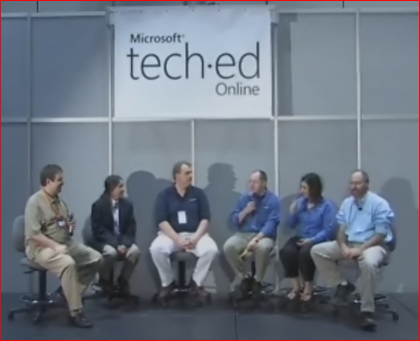
Microsoft hosted a panel discussion at TechEd 2008 in Orlando.  The panel was moderated by George Cerbone with Mike Manos, Lewis Curtis, Beth Humphreys from Microsoft. Additional panel members are Kathy Malone and David Platt.

The video is here. Don’t hesitate to just hit play, and listen to the audio while you are surfing the web.  It has some good perspectives.

image

Lewis Curtis presented first his past experiences over the last year working on Green IT at Microsoft.

Mike Manos presented why going Green is a business responsibility to save energy and has monetary savings.

Beth Humphreys shares her experiences in customer engagements discussing Green IT.

Kathy Malone talks about her efforts to build compliance systems and a green IT developer community.

David Platt, a recognized .NET developer expert, explains why developers are not creating green applications. His view is green should be an OS function, and developers don’t have enough time for this.

Mike Manos brings up a good rebuttal that once Microsoft changed to an energy based chargeback system, the business units started to understand the impact of their SW on their energy bill, and have chosen energy efficiency vs. a focus on only performance.

David Platt continues to make the point developer costs and power is negligible, repeating his point that the energy efficiency is the responsibility of the OS, and none of the effort should be taken on by the developer.

The good thing is the rest of the panel think David Platt is wrong.

Kathy Malone makes excellent points on compliance systems.

This video gives you an idea of some of the people in Microsoft who are driving the Green Data Center efforts to the software developer community. 

I am glad I caught Lewis’s post.

Read more

Ken Brill Champions Energy Czar as Path to Green Data Center at Uptime Institute Conference ,will it work?

In Ken Brill's opening keynote, after going through the background of energy studies in data centers, the path Ken Brill presents is the idea of an Energy Czar, an executive top down position to support a Green Data Center initiative.

This is nice in theory and is a method to sell a green data center program at the executive level. I question whether this is effective though. Part of my skepticism is raised by the fact that McKinsey is the sponsor of the study.

The problem with an Energy Czar is the job becomes a political job negotiating ownership and control of data center capital expenditures and operating expenditures while negotiating new SLAs and technical requirements. The term Czar is appropriate to describe the hierarchy and politics for the job.

I am trying to imagine how this would work.

One simple concept Mike Manos explained in his keynote is to use PUE to communicate the overhead to run data centers. Overhead costs are numbers executives understand. And, once execs understand how Green Data Center programs can affect overhead, projects are approved to improve efficiencies.

Is the PUE method a simpler way to put a Green Data Center initiative in place?

Can you get the executives all nodding their head when they understand how Green Data Center initiatives reduce overhead?

On Weds, there will be a presentation of the McKinsey report, and I'll be able to comment more on the idea of an energy czar to Green Data Centers.

Read more