Disrupting the Data Center, Uptime Institute focuses on Cloud, Cost, Capacity, and Carbon

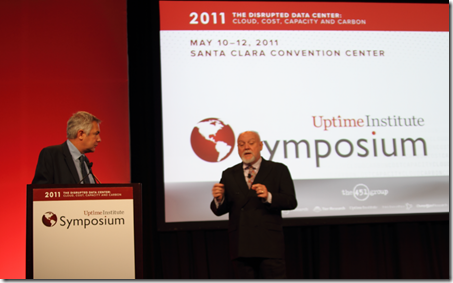
Watching the initial keynotes for Uptime Institute it is great to see the Green Data Center idea manifest in the tag line of Cloud, Cost, Capacity and Carbon.
image

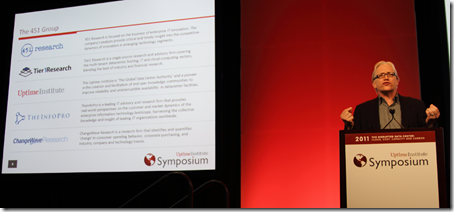
The keynote kicked off with the idea this the conference for the Disrupted Data Center which pulled together the groups of The 451 Group.

In the coming five years, a series of major technological innovations, coupled with significant, external legislative and market disruptions, will make an ever greater impression on the planning, design and operation of data centers. The economics, the operational practices and the underlying design principles of data centers, and of IT service provision, may be about to undergo some fundamental, disruptive shifts.
image

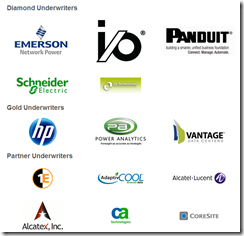
And, organizes the top underwriters of the conference.
image

But, then I ask the question is disruption of the data center come from the above list of companies.  Facebook is presenting part of its Open Compute project.

Open sourcing designs disruptive. 

As I spend the rest of my time at Uptime, I'll keep on thinking of what is disruptive in data centers.  Is Cloud, Cost, Capacity, and Carbon disruptive?  Or is it the companies who are not the underwriters list?
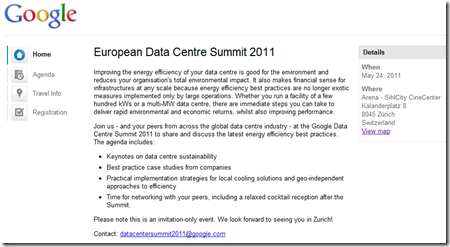
Hot Ticket where EU gets priority, Google’s Data Center Summit 2011 in Zurich May 24

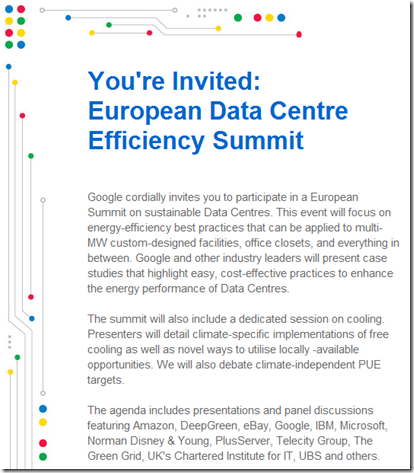
Google will officially announce its Data Center Summit 2011 next week for the world of Google data center followers.  Attendance is limited so not everyone can go.  What will get you to the top of the list of potential attendees is if you are based out of the EU and you have a passion for energy efficiency in the data center. 

Information about the Summit itself is straightforward - innovative thinkers and industry leaders are coming together to discuss energy efficiency best practices for data centres. For Google's part, we will share the total cost of ownership analysis of a computing and network room (CRN) retrofit and explain how seawater cooling makes sense for our facility in Finland. Other presenters will give similar accounts of the results from adhering to efficiency best practices as well as taking advantage of local cooling solutions. We are hoping to see the European data centre community continue to focus on improving operational efficiency.

If you don’t qualify pass this post on to a Green Data Center friend in the EU.

image

With Google’s permission I am sharing the event web site before they post the event on their blog next week.

image

Here is the event schedule with speakers.

Event Schedule

8:30
Keynotes on data centre sustainability and best practices
Zahl Limbuwala, Chartered Institute for IT; Harkeeret Singh, The Green Grid

10:00
Best practice implementation case studies
Joe Kava, Google; Dean Nelson, eBay

11:20
Panel discussion
James Hamilton, Amazon; Robert Coupland, Telecity Group; Brian Waddell, Norman Disney and Young; Mark Eichenberger, UBS

12:00
Lunch

13:30
Local cooling solutions and geo-independent approaches to efficiency
Joe Kava, Google; Dileep Bhandarkar, Microsoft; Jochen Berger, PlusServer; Chris Malone, Google

15:50
Panel discussion
Mark Monroe, The Green Grid; Andre Oppermann, DeepGreen; Bruno Michel, IBM Research Lab; Jeff Monroe, Verne Global

17:00
Reception

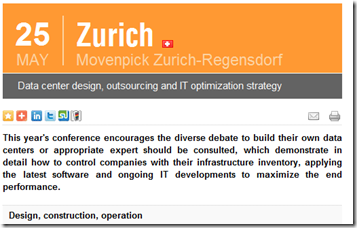
I’ll be at the event and most likely will attend DataCenterDynamics Zurich the day after and try to add some data center tours while I am there.

image

Attending Structure Cloud Conference June 22-23 2011

A friend asked me recently what Cloud Conference would I recommend he attend.  I suggested GigaOm’s Structure.

image

Making Sense of the Real Cloud

After years of questions about what cloud computing is and how it will affect IT, we’re finally starting to get answers. With major acquisitions having gone down, hybrid clouds now a reality and the federal government eyeing cloud-inspired legislation, it is becoming more clear how the cloud landscape will shape up. At Structure 2011, we’ll address these issues and more to help attendees make sense of where cloud services are headed and how they’ll affect everything from application development to data center design.

One of the main things that got my attention for the event is the list of speakers.  Here are some people I know, and it will be good to see their latest presentations and chat in person again.

Don Basile

CEO, Violin Memory

Don Basile joined Violin Memory in 2009 and grew the company from under $10m in funding and 15 employees to a $110 million backed entity with a staff of over 120. The company’s Memory Arrays are changing the datacenter for companies like AOL, Brand.net, Tagged.com, Oracle, Juniper, and HP through its patent-pending flash vxMemory and vRAID technology. Prior to his role at Violin Memory, Don was Chairman and CEO of Fusion-io. Earlier, during the rise of the Cable Industry, Don pioneered digital video insertion and Internet advertising as an executive of Lenfest. Don holds M.S. and Ph.D. degrees from Stanford University.

Barry Evans

CEO, Calxeda

Barry Evans is an experienced semiconductor executive, most recently as VP and GM of Marvell’s Application Processing BU in the Cellular and Handheld Group. He was responsible for the Xscale (ARM-based) product line, the world’s highest performance handheld processors with revenues exceeding $300 million. He served as Intel’s Director of Marketing for Application Processors for Xscale and Low Power x86 customer engagements and product strategies to address the wireless handheld market. Mr. Evans is an 18 year veteran of the semiconductor industry having held roles in field sales and marketing management across wireless handheld, telecommunications, embedded servers, and embedded computing applications. He holds a BSEE from University of Texas at Austin and an MBA from Boston University.

Luke Kanies

CEO, Puppet Labs

Luke is the founder and CEO of Puppet Labs and the founder of the Puppet project. He helped kickstart the devops movement by preaching Infrastructure as Code, and he believes that computers should be used, not managed.

Paul Maritz

CEO, VMware

Paul Maritz joined VMware in 2008 as President and CEO. He was previously President of Cloud Infrastructure and Services at EMC after the company's acquisition of Pi, where he was founder and CEO. Before that, he spent 14 years at Microsoft. He was a member of the five-person Executive Committee that managed the overall company and he oversaw the development and marketing of Windows 95, Windows NT, and Windows 2000, Visual Studio and SQL Server, and the complete Office and Exchange Product Lines. He also spent five years at Intel. Born and raised in Rhodesia (now Zimbabwe), Paul is a graduate in Mathematics and Computer Science of the Universities of Cape Town and Natal in South Africa. He is Chairman of the Grameen Foundation.

Satya Nadella

Microsoft

Sam Ramji

VP, Strategy, Apigee

Sam is Vice President of Strategy at Apigee, the leading API products and services company. He brings over 15 years of industry experience in enterprise software, product development, and open source strategy. Prior to Apigee, Ramji led open source strategy across Microsoft. He was a founding member of the AquaLogic product team and has built large-scale enterprise and Web-scale applications, leading the Ofoto engineering team through its acquisition by Kodak. Other experience includes hands-on development of client, client-server and distributed applications on Unix, Windows and Macintosh at companies ranging from Broderbund to Fair Isaac.

Google and Yahoo set pace of Greener Data Center discussion, Om Malik moderates #greennet session

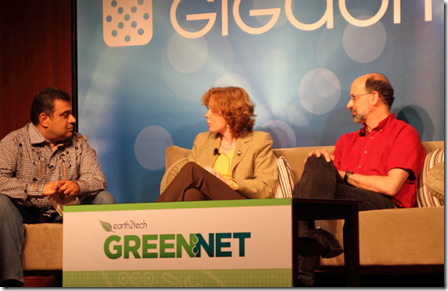
At Green:Net 2011 Om Malik hosted a discussion with Yahoo's Chris Page and Google's Bill Weihl on "Greener Data Center"

image

It was great to see that Om Malik chose the Green Data Center topic for GreenNet.  His choice for interviewing were Google and Yahoo.  Not Facebook.  Not Amazon.  Not Microsoft, who chose to speak about on how software, the web and cell phone are creating more efficient systems, but Microsoft was not on Om's panel.

Here are a few questions that I found were interesting to share with you.

Om Malik asks with Google's 100MW wind power purchase is this an indicator of Google's future site selection, making renewable energy as part of data center site?  Bill Weidl did  a good job of avoiding the questioning by making the point that he hopes more users  take into account energy composition in site selection.  The 100 MW wind power contract Google announced is 180 miles from Google's data center so the power doesn't go directly to a Google data center, but the wind power is on the same power grid as its data center.

Om says he has seen the media discuss the merits of building a big or small data center.  Is it better to build big or small?  Chris Page answers that Yahoo's approach is to build modular.  Bill answers Google builds what is most efficient.

One question I think Om asked for the audience is to have Chris and Bill decode PUE.  I hope you know the answer to this one.

Here is a live coverage page that you can go to see more.  http://gigaom.com/cleantech/greennet-2011-live-coverage/

Absorbing information at Green:Net 2011 - Greenpeace and Google make announcements

I walked in the door at 7:40a to Green:NET 2011.  The room was sparse, but within 2 minutes I saw a good friend who I didn't expect  to see. The last time we saw each other was Olivier Sanche's memorial service in Los Gatos.  We quickly had a great conversation on Greenpeace's announcement.

Greenpeace Unveils Who’s Behind the Internet’s Dirty Power

By Katie Fehrenbacher Apr. 21, 2011, 6:30am PT 1 Comment

A group of the Internet’s most recognized brands — from Facebook to Apple to Twitter to Amazon — have received failing grades when it comes to using clean power for their web services, according to a new report unveiled by Greenpeace on Thursday at our Green:Net 2011 event. Greenpeace found that while a few companies like Akamai, Google, Yahoo and IBM have been taking important steps towards clean power, overall, many web companies “are perpetuating our addiction to dirty energy technologies.”

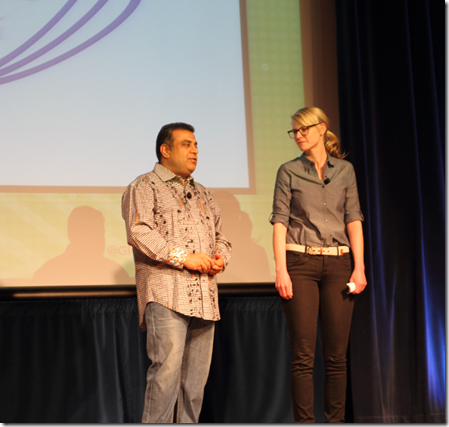
The day kicked off with Om Malik and Katie Fehrenbacher

image

Google  Energy announced their 100MW Wind Power purchase.

Google to Buy Another 100MW of Wind Power via Google Energy

By Katie Fehrenbacher Apr. 21, 2011, 8:00am PT No Comments

Google isn’t just continuing to investhundreds of millions of dollars into clean energy projects, but it’s also continuing to commit to buying up the clean power itself. On Thursday morning Google announced that it has made its second deal via its subsidiary Google Energy, and the search engine giant plans to buy 100 MW of power from a wind farm that’s under construction in Oklahoma.