Are you picking up the habits of the slowest player? Maybe you shouldn't follow the thought leaders

Many of you play Golf.   I don't.  i decided playing golf gave people (including in-laws) the right to grab 4 hours of my time was not something I had interest in.  Maybe if golf was 1 1/2 hrs I would play.

Watching Kevin Na play golf is painful, and few would follow his example.  Although all players have been frustrated by a slow group in front of them.  Almost all amateurs pick up some habit of the pros.

WSJ has a post on this problem.

But the Tour's pace of play is a problem for the rest of golf, since the pros serve as amateurs' primary role model for how the game should be played. We buy the clubs, balls and golf fashions that we do largely based on the pros' example, and the same goes for how everyday players line up putts, take practice swings, throw grass in the air and dither around the course like they're being paid by the hour. Survey after survey show that slow play is a major factor in creating ex-golfers.

Now, as much as you may think this is wrong.  Keep in mind who the tour serves.  The players.

The reasons why the Tour is unlikely to change its current pace-of-play system anytime soon are many and interconnected, but here's a good one to start with: meaningfully speeding up play would, in effect, penalize the Tour's slowest members where it hurts them the most, in their wallets. And the Tour, lest we forget, exists primarily for the benefit of its members.

Think about it.  Just because you are watching someone present at a data center conference should you follow their habits?  Many data center conferences, the #1 customer is the vendor and their needs.  A pro golf player's # 1 revenue is his sponsor money, not the winnings.

Consider Charles Barkley's controversial statement that he is not a role model.  Who is your role model for data centers?  The guys who have vendors sponsoring their performance should have you questioning whether it is best for you.

AOL's 3 steps to save $5mil in IT Operations

I met a bunch of Mike Manos's IT team from AOL in Santa Clara.  They were in town for Uptime Symposium and we invited the AOL team to meet some of the thought leaders in the bay area.  We gave Mike's team a bunch of Mike Manos's stories as there were a lot of people who used to work in Mike's group at Microsoft and Digital Realty Trust. Plus his brother Steve Manos was there as well.

I've gotten to know Mike as I used to help him on his presentations.  I met the presenters Chisty and Julie, so besides sharing the slides and writing a post, let me take a stab at telling the AOL story in a different way.

The opening slide is this.

NewImage

After going through the slides i would try "AOL's 3 steps to save $5mil in IT Operations"

Clearing the Cruft is not going to get people's attention.  Saving $5mil does.

The results are summarized here early on.  This is good.

NewImage

The order of the three steps presented are AOL Cloud, Power Absurdity, and Power Hog.

I would change the order. Put Power Hogs first.  Find those wasteful things.

NewImage

Some of these power hogs are not only wasteful, but also absurd.  Project Absurdity after Power Hogs

NewImage

What is left should try to go to AOL cloud.  The last step is the stuff left over gets moved to the cloud.

Although I bet you there are a bunch of VMware consultants who will gladly move the Power Hogs and Power Absurd to the cloud as well.  The more VMs the more they make.

NewImage

The list of steps taken are good, but I would reorder them and use it is a good chance to make fun of their absent leader Mike Manos.  Without an executive sponsor a project this is impossible.  I wonder if Mike calls his staff Donkeys for not taking up the challenge.

NewImage

Excellent slide with energy savings and carbon reduction.

NewImage

Overall this is a well thought out presentation.  I only suggest some changes in the order of the content, changing the title, and adding some humor.

Good job AOL team.  Hope to see you soon.


Pleasure: Great People attending Uptime Symposium, Part 1

i didn't attend Uptime Symposium, but I had a 11:30 meeting with Dell so I headed over to the hotel bar. 12 hrs later I was still at the bar.

One of the great things about the data center industry are the people.  Some of the companies I was able to chat with are the following. I am sure there others I missed someone, and my apologies for not listing your company. 

Compass Data Centers

RagingWire

Fieldview Solutions

Jones Lang LaSalle

Norland

RTKL

AOL

DELL

HP

Spencer Fane

Walsh Construction

Verizon

Data Foundry

Digital Realty Trust

Ramprate


Skipping the Vendor/Analyst Pay to Play Dance

Observation:

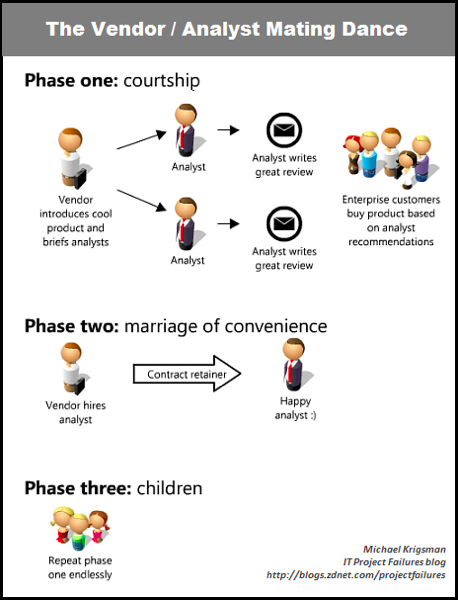
The data center industry is part of the pay to play dance that exists between vendor and analyst organization.  ZDNet does a pretty good job of describing the situation.

NewImage

One of the comments explains the dilemma of an analyst in the pay to play.

I was an analyst for many years at a pay-to-play analyst firm, and like many of my peers, I strove to maintain my personal integrity, despite the many, many pressures I felt to say the right thing. At the end of the day, I found it was impossible, and I quit doing that kind of work. 

It wasn't the overt stuff. Despite many, many suggestions, I never, ever wrote anything that I thought was untrue. But in this business, the nuances matter. You end up giving people the benefit of the doubt, when you shouldn't have.

You also found that it was impossible to call a spade a spade. If some poor guy plunked down $20,000 of his savings to get our firm to say that his nonsense software had some merit--this really happened, the company now long-gone--it was hard for me to look the guy in the eye and say, "No way," and as for my boss, well, he's the guy who negotiated the deal. So you try to thread your way through with phrases like "interesting" and "still some way to go." 

Many data center vendors feel compelled to be at all the trade shows as a lack of presence would indicate you are not commited to the market.  So, your marketing expenses grow as you "ante up" to play the game.  In addition to the trade shows, you pay the analysts to analyze your company.  You up your event sponsorship to get more leads.  Arghh!  This is so frustrating when it doesn't pay off.


It is so appealing to skip this dance.

Four reasons why a speaker is presenting at a conference

Now the following may sound obvious, but I don't think people lay this out as simply.  Why is this speaker presenting at this conference?

#1 The person is selling you their company, product, or service.

#2 The person is looking for a new job and getting their name out there and what they do gets them known in the industry.

#3 The person is passionate about the topic and wants to tell the world.

#4 The person has done a great job and as part of the reward gets to speak on the achievements made.

In general as most industry conferences, I would say 80% of the talks out there are category #1.  That leaves 20% for #2, 3, 4.  And out of the 20% maybe 25% are good talks.  So there are 5% of the talks worth seeing.  Huh, maybe that's why I get so bored attending most conferences, and spend most of my time in the hallways networking.