Facebook Prineville Data Center Design and Site Selection Video

Jay Park, Facebook's Director of Data Center Design presents at the Open Computer Project.

Jay explains three reasons why Prineville was chosen.

    1. Available power
    2. Network
    3. Climate for running with chillers

Highlights the 480V/277V power system and chiller-less cooling system.

In the above video is a 3D rendering of the data center showing airflow.  Note: these 3D renderings are not part of the Open Compute Project web site.

Three examples of what Facebook doesn't include in Open Compute, like the use of Fusion IO integration

There are many out there who believe Facebook's Open Compute Project published all the details on Facebook's new data center.  When I see the Open Compute website  I see what is missing more than what is there.  So, let's try and list a couple of areas where Facebook doesn't share its data center information.

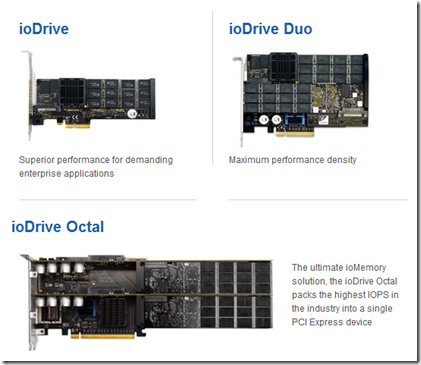
1)  ZDNET's Between the Lines reports on Fusion-IO plans for IPO and Facebook is its largest customer.  The Fusion IO products look like the following.

image

When you look at the Open Compute PCB, you don't see any Fusion IO products or mention of solid state memory or PCIe slots.  There is an external PCI Express connector, but no explanation of what connects to it.

Image of AMD motherboard

image

How are the Fusion IO product being used by Facebook?  I can't find any details on Open Compute regarding the use of Fusion IO, can you?

Why wouldn't this be share, because knowing how Facebook uses solid state memory in its servers is a competitive advantage.

2)  What is the % mix of server skus and from what vendors.  Dell DCS is part of the launch event and is a supplier of Facebook. HP is mentioned as well.  Supermicro and many others have sold servers to Facebook.  What % of the 150,000+ servers Facebook has are Open Compute Project versions? 

image

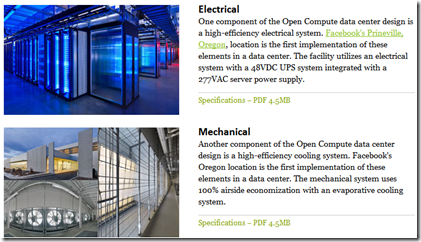
3) Where are the drawings for the Electrical and Mechanical systems?

image

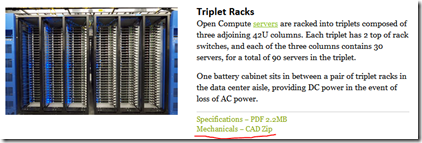
The Triplet Racks do have mechanical drawings.

image

Why wouldn't Facebook publish their mechanical drawings for the electrical and mechanical systems?  Either they are too valuable and give away too many secrets and/or they don't own the distribution rights from the data center engineering design companies.  We'll see if Facebook ever publishes its mechanical and power drawings.

Facebook's Open Compute has many believing Facebook released all the data center specs, but...what is reality?

I've been watching the Facebook Open Compute news and have had a bunch of people send me links.  From a PR perspective Facebook did extremely well.  What is funny is how some, well many, almost all media thinking that Open in Open Compute means Facebook shared everything in its Prineville data center.

The best trick: Facebook released all the specs for the data center

Note the word all.  When you go to http://opencompute.org/.  I sure don't see all the specs for a data center.  Do you?  There are pdf documents.  The Data Centers section has drawings for the racks, but not for the electrical, mechanical, battery cabinet.

One of my friends has been sending me various articles he finds, and one poppped out.  For a good analysis on Facebook's openness and what they share check out this marco.org's post.  Here are nuggets that Marco captures.

Nothing about Facebook’s design is particularly revolutionary to casual industry observers (except the impressive PSU efficiency). The much more interesting question is why they released this. It’s only going to be useful to a very small number of firms for the foreseeable future, and even then, it’s not as if anyone who wants these server or rack designs can just place an order — they’re just designs.

...

On a large scale like this — not a small open-source project by good-willed individuals — “opening” something is almost always an effort to commoditize it, leveling the playing field as much as possible and marginalizing competitive advantages that others might have had.

...

Nobody “opens” the parts of their business that make them money, maintain barriers to competitive entry, or otherwise provide significant competitive advantages.

...

We can reasonably conclude from the Open Compute Project that Facebook isn’t trying to maintain a top-secret competitive advantage in hardware and datacenter design, and they’re not expecting anyone else to gain a meaningful, exclusive advantage by copying ideas from theirs and keeping the results secret.

Marco comes to the following conclusion.

My best guess is that this is primarily for recruiting engineering talent. There’s no shortage of engineers, but there’s always a shortage of greatones, especially in Silicon Valley. Google has been a talent vacuum for a long time since it’s so appealing for most engineers to work there.

One point I think Marco misses is the effect of Greenpeace and its pressure for Facebook to use renewable energy.  Much of the Facebook's Open Compute effort talks about how it is energy efficient, and the Open Compute project is Facebook's way of saying we are contributing to lower power use by the IT industry.


Greenpeace's Unfriend Facebook TV ad targets the lack of a Green Data Center commitment

Greenpeace has a new Unfriend Coal ad. http://www.facebook.com/unfriendcoal

There at 18,801 views on Youtube.  There are 101,569 members on the unfriendcoal Facebook page.

When you look at the details of the Apr 7, 2011 Facebook Open Compute project there is no mention of green/renewable energy.

Starting the Dialogue

The ultimate goal of the Open Compute Project, however, is to spark a collaborative dialogue. We’re already talking with our peers about how we can work together on Open Compute Project technology. We want to recruit others to be part of this collaboration -- and we invite you to join us in this mission to collectively develop the most efficient computing infrastructure possible.

To get a behind-the-scenes look at the birth of the project, watch this video:

Jonathan is Vice President of Technical Operations at Facebook.

Africa's Mobile Internet is built on a spoken tradition, voice-activation opportunity

The Economist's Intellgient Life has an article on Digital Africa.  Think of about this.

digital Africa will become a spoken tradition. African cultures are among the most oral in the world. Storytelling under the tree is still commonplace. Speaking is still preferred to writing and Africa happens to have timed its digital age to coincide with new voice-activated technologies. The generation gap between those who were trained to guide a fountain pen with their fingers, those whose kinetic memory is dominated by their thumbs, and those even younger who are used to the sweeping movements of the touchscreen, will give way to the return of voice—Africa’s voice.

Most don't even think about Africa, but I would bet as a percentage growth Africa is the largest data center expansion than any other continent.

Ethan Zuckerman's blog on Africa has some interesting posts.

I’m also utterly fascinated by this graph:

It’s a visualization of round-trip ping times between a test server and servers around the world. Basically, it’s a way of testing actual speed, rather than promised speed, of internet connectivity in different corners of the world… and it’s a reminder that there are many countries (at least when this data was generated in 2009) that are connected primarily by satellite, where packets take more than half a second to make the round trip.

But the data set I’m most enjoying is this one: the number of Facebook Friends various African leaders can claim. Some leaders have official pages, some private, personal pages. A large number simply have fan pages, put together by a community of supporters. Nigeria’s President Goodluck Jonathan leads the pack – by a lot – with 341,759 friends in December 2010. He’s embraced Facebook rather aggressively, going as far as to announce his candidacy for the presidency on the site, probably to preempt the announcement of a rival.

A close look at African leaders with lots of Facebook friends might offer a caution for Jonathan. Here are the top leaders, in terms of followers, as of December 2010″

341,759 Goodluck Jonathan, Nigeria
232,424 Zine El Abidine Ben Ali, Tunisia
61,510 Mwai Kibaki, Kenya
59,744 King Mohamed VI, Morocco
57,072 Morgan Tsvangirai, Zimbabwe (Prime Minister to Robert Mugabe)
21,306 Jakaya Kikwete, Tanzania
15,723 Hosni Mubarak, Egypt
15,377 Laurent Gbagbo, Ivory Coast
14,714 Jacob Zuma, South Africa
12,658 Abdelaziz Bouteflika, Algeria

Back to the Digital Africa Article, three companies are highlighted in the article - Facebook, Google, and Nokia

The first is Facebook. This social network, born at Harvard and based in Palo Alto, California, is not just a skin on internet-enabled African mobiles, it is the skin. Pricing is driving its popularity. The site was zero-rated in 2010—that is, made almost free of data charges in several African markets (the bill is footed by Facebook, the network operators and the phone manufacturers). “The zero-rating of Facebook was the most significant tech story in Africa in 2010,” says Erik Hersman, who has two influential blogs, White African and Afrigadget. So while text messages are cheap, sitting on Facebook is even cheaper. Facebook’s own numbers show growth coming fastest in Egypt, Morocco, Nigeria, Kenya and South Africa.

Google is next, but note the mention that Google is adding data center capacity in Africa.

The second company is Google, the search and advertising colossus, also based in Palo Alto. In Africa, Google looks omniscient. It wants to make the internet a part of everyday life in Africa by eliminating entry barriers of price and language. Even with the drop in prices, Africans still pay many times more for broadband than Europeans do. Google hopes to bring the price down further by establishing data caches in Africa, greatly reducing the time taken to reach popular websites—particularly those with African content. Detractors say Google is buying up swathes of Africa’s digital real estate at bargain prices: it seeks transparency of others, but reveals little of itself. How much is it spending on the new infrastructure? “We don’t discuss numbers,” says a Google executive, “but we are committed to Africa.”

Nokia gets mentioned as the biggest cell phone provider.

The third big player in Africa’s digital revolution is Nokia, the mobile-phone maker from Tampere in Finland, which has history and substance in African eyes. It claims a 58% market share in Africa and vies with Coca-Cola as the continent’s most recognised brand. It was Nokia’s ability to distribute phones through subsidies in rich countries that allowed it to sell basic models at low prices in Africa. Nokia has lost ground at the high end in rich countries to Android and the iPhone. Nokia executives admit the company has “lost the thought leadership” in some markets, but not in Africa.

Apple and Nokia are mentioned.

Apple is nowhere in Africa and shows little interest in democratisation, but Nokia is facing stiff competition at the top of the market from BlackBerry, the smartphone made by Research in Motion, based in Waterloo, Canada. The head of BlackBerry’s Africa office, Deon Liebenberg, says his company’s sales defy logic. BlackBerry had seen itself as providing a secure platform for businessmen and government officials. Now it is selling models with consumer appeal: rounded phones in shades of tangerine and strawberry lipgloss. To the young African professional, the smartphone is highly aspirational: it is the house and car you can’t afford. In a culture where so much is shared, the smartphone is a space which is all yours—your music, your plans, your tomorrow.