Where's the News on Google Electricity efforts? Achieving Carbon Neutral in 2007. Google: jolly green giant?

I wrote about Google as an electric company back in Nov 2007.

I searched news.com's GreenTech and no real news on Google's green energy efforts since Nov 2007 posting Google: jolly green giant?

Google: Jolly green giant?

By CNET News.com Staff

Last modified:November 28, 2007, 11:26 AM PST

The search and advertising company is a force to be reckoned with across the Web. Now it's looking to do the same in alternative energy (along with many others, large and small).

Google's energy push: Distraction, PR, or good business?

People are wondering why Google's getting into renewable energy. The answer is simple: it believes in innovation.
November 28, 2007

Google in energy: Imitator or innovator?

In Google's renewable-energy initiative, there are new ideas, and some reruns. Is the eSolar investment more of a VC deal than a way to push the frontiers of science?

Compared to rapid pace of innovation in Web Technologies, electricity development moves at a glacial pace.

Where is the press release from Google on achieving Carbon - Neutral in 2007? I couldn't find it on their press release site.

Reducing our Carbon Footprint to Zero

Our business powers the platforms that drive the Internet. With hundreds of millions of Google users, it takes extensive computer infrastructure to keep our tools and services running. And that takes a lot of electricity. Generating that electricity requires energy, and as our business grows, we want to make sure we minimize our impact on the Earth's climate. So we’re taking every step we can to produce electricity using renewable energy resources that don't add to the production of greenhouse gas emissions.

As part of that responsibility, Google has committed to being carbon-neutral for 2007 and beyond. To honor our pledge, we’re taking a three-step approach. First, we’re increasing the energy efficiency of our own operations. Second, we’re actively pursuing the use and creation of clean and renewable sources of electricity. Third, for the emissions we can’t reduce directly at this time, we’re investing in projects that help offset carbon generated.

I did find one entry saying Google was going carbon-neutral in 2008, but the article was written in June 23, 2007, and the Google web site still says 2007.

Google's green PR images are date June 18, 2007.

Has Google's stock price decline caused the company to put the Green message on the back burner and focus on revenue?

Google does have a Green store though.


The Google Store is going green. We only have one Earth and we want to do our best to take care of her, so we've worked hard to make our store more eco-friendly. From organic cotton T-shirts to pencils made of recycled blue jeans, you'll find that most (though not all) Google products are now made of recycled material or other stuff that goes easy on our planet.  We are also using more environmentally sound, recycled polybags, to individually package your items and to protect your items during transit.


Thoughts, comments or suggestions? We'd love to hear from you. Click here and let us know what you think.

Back

Read more

35 employees per Data Center for Microsoft's latest construction vs. Google's 200

In eWeek's interview with Microsoft's Mike Manos, says 35 employees per data center.

The Chicago-area data center is expected to be completed later in the summer of 2008, as are the other three data centers. Each center will employ about 35 people on a 24/7 basis, Manos said.

What is up with Google's 200 employees per data center:

  1. Are they doing this to meet local employment commitments?
  2. Are their data centers higher maintenance than what Microsoft builds?
  3. Are they making up the #'s to fool the rest of us?

Most of us are stumped how and why Google needs so many employees in its data centers.

Read more

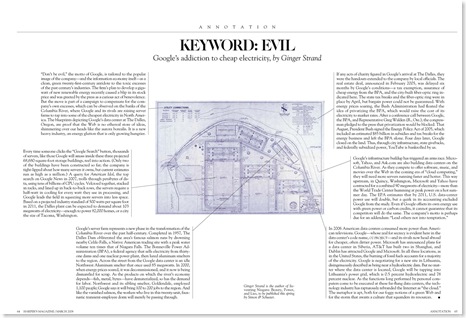
Harper's Magazine- Keyword: Evil, Google's addiction to cheap Electriticity

DataCenterKnowledge wrote a post that Harper's Magazine has published a copy of the site plan for Google's data center in The Dalles, OR.

The Dalles

Google The Dalles

In reading the Harper's article (which isn't totally accurate), I was curious what motivated the writer to write and use Keyword Evil Google in her title.  It turns out the Author Ginger Strand lists her obsession as Hydroinfrastructure.  And, she is about to publish a book Inventing Niagara: Beauty, Power, and Lies.

Most of us take infrastructure for granted but we shouldn't; it tells us a lot about ourselves. The massive investment in designing, building and maintaining infrastructure is one of a society's most utopian actions: through it we seek to remake the world. Hydroinfrastructure, for example, shows our conviction that the perfect world has easy access to cold drinks and hot showers. It also links country and city through the flow of one of earth's most elemental substances, demonstrating that the worlds of “nature" and “culture" are not as separate as we often believe.

A great book on infrastructure generally is Infrastructure: The Book of Everything for the Industrial Landscape by Brian Hayes.

I looked up the book she references and it looks like an interesting read.

Read more

Google Demolishes Presbyterian Church, do no evil?

InformationWeek has a picture gallery of Google's data center construction in Council Bluffs, Iowa.  One interesting picture for company with the motto of do no evil is below where a Presbyterian Church will be demolished as part of the construction.  A funny point made by one blogger is do no evil  is an anagram for o no devil seems to be appropriate.

Nearby Presbyterian Church will be demolished.

Photo Gallery: Google's Iowa Data Center Emerges

Nearby Presbyterian Church will be demolished.

Photograph by Joshua White/The Daily Nonpareil

For the curious, the reporter also has pictures of the Google The Dalles facility.

Read more

Cool It! Data Centres writes Economist.com

A good friend, Joe Ternasky sent me the link to this Economist article. This article should work well to get the attention of CxOs.

The data centres that power the internet demand a lot of power. Time, then, to make them more efficient

Google

AS ONE industry falls, another rises. The banks of the Columbia River in Oregon used to be lined with aluminium smelters. Now they are starting to house what might, for want of a better phrase, be called data smelters. The largest has been installed by Google in a city called The Dalles. Microsoft and Yahoo! are not far behind. Google's plant consumes as much power as a town of 200,000 people. And that is why it is there in the first place. The cheap hydroelectricity provided by the Columbia River, which once split apart aluminium oxide in order to supply the world with soft-drinks cans and milk-bottle tops, is now being used to shuffle and store masses of information. Computing is an energy-intensive industry. And the world's biggest internet companies are huge energy consumers—so big that they are contemplating some serious re-engineering in order to curb their demand.

The traditional way of building data centres such as Google's is to link clusters of off-the-shelf server computers together in racks. Hundreds, even thousands, of such servers can be combined to achieve the sort of arithmetical horsepower more usually associated with a supercomputer. But the servers all require energy, of course, and so do the electronic links that enable them to work together. On top of that, once the energy has been used it emerges as heat. The advanced cooling systems required to get rid of this heat demand the consumption of more power still.

All of which is expensive. Though the price of computer hardware continues to plunge, the price of energy has been increasing. The result is that the lifetime cost of running a server now greatly outstrips the cost of buying it. A number of researchers are therefore looking for ways to operate big computer centres like the one at The Dalles more efficiently.

The article continues and discusses energy efficient designs by Lawrence Berkeley National Labs, and IBM.

But, one of the main things this article draws attention to is the point,it is time to make these data centres more energy efficient (greener).  Do you hear the sound of gov't regulation coming?  And, the programs are going to be based on the amount of power you consume, not necessarily the price of your power.  So, even though companies have done like Google, Microsoft, and Yahoo move to cheap power, and economically they have side-stepped the issue of power costs, gov'ts could still require energy savings programs be put in place.  And once this starts you need a conformance system to validate your results, and now you are in EPA type of audit situation.

Read more