After Google Reorg, Data Centers are important to all three top execs

Google announced Larry Page is CEO, replacing Eric Schmidt.

But as Google has grown, managing the business has become more complicated. So Larry, Sergey and I have been talking for a long time about how best to simplify our management structure and speed up decision making—and over the holidays we decided now was the right moment to make some changes to the way we are structured.


For the last 10 years, we have all been equally involved in making decisions. This triumvirate approach has real benefits in terms of shared wisdom, and we will continue to discuss the big decisions among the three of us. But we have also agreed to clarify our individual roles so there’s clear responsibility and accountability at the top of the company.

When you read what Larry's role is leading product development and technology strategy it makes sense that Google's data center group would report to Larry.

Larry will now lead product development and technology strategy, his greatest strengths, and starting from April 4 he will take charge of our day-to-day operations as Google’s Chief Executive Officer. In this new role I know he will merge Google’s technology and business vision brilliantly. I am enormously proud of my last decade as CEO, and I am certain that the next 10 years under Larry will be even better! Larry, in my clear opinion, is ready to lead.

Sergey is working on strategic projects.  But, how can Google develop new products without data center resources.

Sergey has decided to devote his time and energy to strategic projects, in particular working on new products. His title will be Co-Founder. He’s an innovator and entrepreneur to the core, and this role suits him perfectly.

And Eric is working on external projects - deals, partnerships, ... technology thought leadership that are increasingly important.  You need Google's data centers for these deals.


As Executive Chairman, I will focus wherever I can add the greatest value: externally, on the deals, partnerships, customers and broader business relationships, government outreach and technology thought leadership that are increasingly important given Google’s global reach; and internally as an advisor to Larry and Sergey.
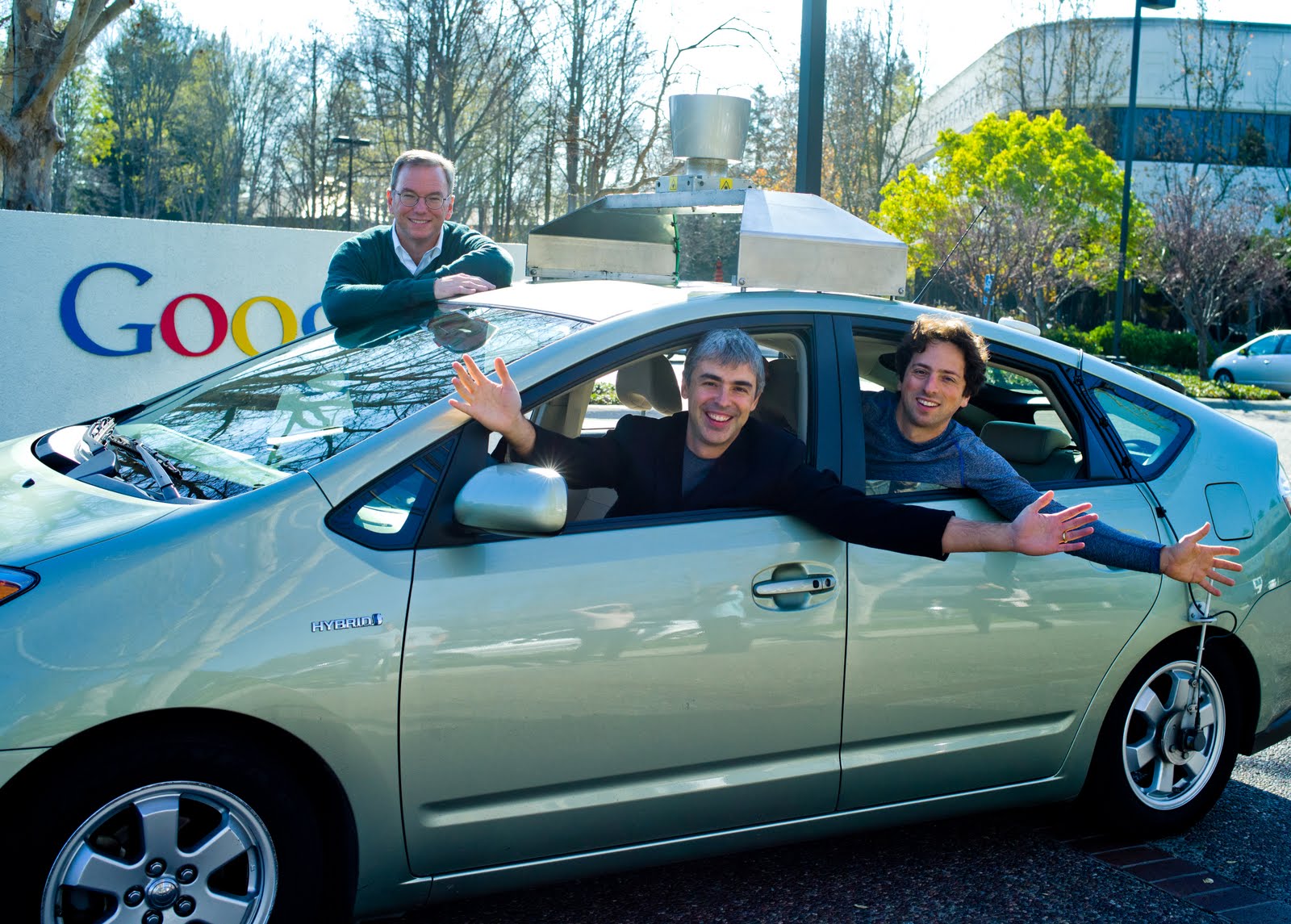
From left to right - Eric, Larry and Sergey in a self-driving car in a photo taken earlier today

So, even though Eric, Larry, and Sergey all have new roles.  They all need Google's data centers.

How many companies do you know need data centers for the three top billionaire executives to do their job?

Read more

Google Mail/Apps ups SLA, removes schedule downtime allowance

Data Centers and uptime is assumed.  Service Level Agreements (SLA) are made between groups.  But, many times there are exceptions for planned maintenance/downtime vs. unplanned downtime when calculating SLA.

InformationWeek reports on Google Apps/Gmail's change to this common practice.

Google Promises No Planned Downtime

A new service level agreement (SLA) for Google Apps customers strives to make Google's cloud as reliable as dial tone.

By Thomas ClaburnInformationWeek
January 14, 2011 02:42 PM

Google has changed its service level agreement for paid versions of Google Apps, its suite of online applications. The goal, says Google Enterprise product management director Matt Glotzbach, is to deliver service that's as reliable as telephone dial tone.

For today's mobile generation, who may lack experience with landlines, let it suffice to say that dial tone under Ma Bell was very, very reliable. Not sunrise reliable but chances were if you didn't hear a dial tone when you picked up a handset, the phone was disconnected from the wall.

Google is taking a leadership position.

But with millions of enterprise customers, Google aims to become more reliable. As a sign of its commitment, the company has disavowed planned downtime. "Unlike most providers, we don't plan for our users to be down, even when we're upgrading our services or maintaining our systems," wrote Glotzbach in a blog post. "For that reason, we're removing the SLA clause that allows for scheduled downtime."

Glotzbach says Google is the first major cloud service provider to make that pledge.

In Google's blog post they call out the competition.

Gmail: 99.984%
In 2010, Gmail was available 99.984 percent of the time, for both business and consumer users. 99.984 percent translates to seven minutes of downtime per month over the last year. That seven-minute average represents the accumulation of small delays of a few seconds, and most people experienced no issues at all. For those few who were disrupted for a longer period of time, we're very sorry, and Google Apps for Business customers received compensation where appropriate. We're particularly pleased with this level of reliability since it was accomplished without any planned downtime while launching 30 new features and adding tens of millions of active users.
Seven minutes of downtime compares very favorably with on-premises email, which is subject to much higher rates of interruption that hurt employee productivity. The latest research from the Radicati Group found that on-premises email averaged 3.8 hours of downtime per month. In comparison to Radicati's metrics for on-premises email, our calculations suggest that Gmail is 32 times more reliable than the average email system, and 46 times more available than Microsoft Exchange®.1

Fortunately Microsoft Exchange® customers can still benefit from the reliability of Gmail withGoogle Message Continuity. Comparable data for Microsoft BPOS® is unavailable, thoughtheir service notifications show 113 incidents in 2010: 74 unplanned outages, and 33 days with planned downtime.

You may be thinking I can't do this in my data center.  And you are right you can't.  This solution requires geo redundancy between data centers.  For a bit on some of Google's approach check out this Google presentation at Stanford University.

Google – A study in Scalability and A little systems horse sense

By ksankar

16 Votes

Google’s Jeff Dean did an excellent talk at Stanford as part of EE380 – it is worth one’s time to listen. Very informative, instructive and innovative. As I listened, I jotted a few quick notes.

  • Interesting comparison of the scale in search from 1999 to 2010
    • Docs and queries are up 1000X, while the query latency has decreased 5X
    • Interesting to hear that in 1999 they used to update a web page store in a month or two, but now it is reduced 50000X to seconds!
  • They have had 7 significant revisions in 11 years
  • Trivia : They encounter very expensive queries for example “circle of death” requires ~30GB of I/O
  • Trivia : In 2004, they did a rethink and refreshed the systems infrastructure from scratch
  • He discussed a little about encodings – informative discussion on Byte aligned variable length & group encoding schemes << I have to try it out …
  • Trivia : They have had long distance links failure by wild dogs, sharks, dead horses and (in Oregon) drunken hunters !

The presentation referenced is by Jeff Dean.

image

Read more

What could Google do with 111 Eight Ave building? Part 2, change what carrier hotels look like

I wrote last week on What could Google do with 111 Eighth Ave building? A new bargaining chip

Another idea that just popped into my head is Google could turn 111 Eight Ave building into a change agent for the carrier hotels, Internet Exchanges, Peering, and who knows what else they want to drive in the industry.

The current model of carrier hotels are run by private enterprises or a non-profit like AMS-IX.

Vision

AMS-IX: the trusted value creator in quality IP interconnection [1]

Mission

1. To realize the principal, neutral IP interconnection marketplace worldwide

2. To offer world-class quality performance and operate a future proof platform to secure the growth of IP traffic between connected parties

3. Support initiatives for the good of the Internet to ultimately improve end-user experience

Values

  • Neutral
  • Trusted
  • Pragmatic
  • Open
  • Innovative

Equinix is an example of private Internet Exchange site.

When our founders started Equinix, they envisioned a place where the information-driven world could grow and thrive.

As the company looks forward, we remain dedicated to the advancement of the information-driven world. This means that we will:

  • protect and connect our customers’ most valuable information assets;
  • constantly strive to evolve and share our industry insights with our customers;
  • continue to make necessary investments to expand and scale to our customer's needs;
  • act upon industry trends that will affect our business and the businesses of our customers;
  • cultivate a rich interconnected ecosystem of the top networks, carriers, ISPs, and business partners in the world.

What happens when Google takes their money, knowledge, and strategic vision and demonstrate to the rest of the industry the way they want carrier hotels to operate?

Don’t just think of Internet technology, think of different business models as well.  Many ideas have failed because of the business model, not the technology.

Google has 24 Public Peering Exchange Points in Equinix facilities.  The largest amount dedicated to any one company.  Don’t you think 111 Eighth Ave changes the conversations between Equinix and Google?

Google has sponsored projects like Google Fiber for Communities.

Google Fiber for Communities: Next steps

The deadline for responses to our request for information has passed. We will announce our target community or communities by the end of the year. In the meantime please visit fiberforcommunities.com to learn how to take action to improve broadband where you live.

Since we announced our plans to build experimental, ultra high-speed broadband networks, the response has been tremendous. Hundreds of communities and hundreds of thousands of individuals across the country have expressed their interest in the project. We're not going to be able to build in every interested community - our plan is to reach a total of at least 50,000 and potentially up to 500,000 people - but we hope to learn lessons from this experiment that will help improve Internet access everywhere.

We humbly thank each and every community and individual for taking the time to participate. If one message has come through loud and clear, it's this: people across the country are hungry for better and faster Internet access.

Map

This map displays where the responses were concentrated. Each small dot represents a government response, and each large dot represents locations where more than 1,000 residents submitted a nomination. A list of government responses is available here.

Seems natural Google would want to change the Internet Exchanges as well.

Read more

What could Google do with 111 Eighth Ave building? A new bargaining chip

It’s been two weeks since Google announced they bought 111 Eighth ave.

image


Investing in New York

12/22/2010 11:00:00 AM

Google New York started in a Starbucks on 86th Street with one person in 2000—a scrappy, highly-caffeinated sales “team.” After moving to a larger office in Times Square, in 2006 we relocated to our current home in Chelsea, at 111 Eighth Avenue—a former Port Authority building. In June of 2008, we took additional space in the Chelsea Market building at 75 Ninth Avenue. Now we have more than 2,000 Googlers working on a variety of projects in both sales and engineering—and we’re hiring across the board.
Today, we’re pleased to announce that we’ve closed a deal with the partnership of Taconic Investment Partners, Jamestown Properties and the New York State Common Retirement Fund to purchase 111 Eighth Avenue (also known as 76 Ninth Avenue). As part of the deal, we’ve retained Taconic Management Company to continue the leasing oversight services and management of the building on our behalf, providing the same level of customer service the building’s tenants have come to expect. We believe that this is a great real estate investment in a thriving neighborhood and a fantastic city.

Google could eventually grow to occupy the whole building, but is that worth $1.9 billion?  Is it to speculate on NY real estate, and sell at a gain?

How about this for an idea?

Google now owns a premium networking access point in NYC, the biggest concentration of money in the USA with the financials, stock exchanges, and other businesses.

As Google negotiates carrier access in various markets, it can offer a presence in 111 Eighth Ave.  This can change price points, and guarantees of service and access.

If Emerging Market Telecom sets up a relationship with Google, and agrees to a presence in 111 Eighth Ave, then the more the Emerging Market Telecom needs the location due to a variety of economic and technical reasons, the value works for Google.

Did Google just buy one the biggest bargaining chips it could have to negotiate access to WW Telcos?

Read more

James Cameron and Eric Schmidt discuss technology and the environment, “We’re the Comet”

Google’s Eric Schmidt moderated a two hour conversation with James Cameron

James Cameron on “Avatar 2″ and the Impending Environmental Crisis

James Cameron

On stage at a private event in Silicon Valley last night, legendary director James Cameron and Google CEO Eric Schmidt held a fascinating two hour conversation that touched on everything from the technology needs of the upcoming Avatar 2 film to the perils that face the environment if action isn’t taken.

Green was a dominant part of the conversation.

The vast majority of the conversation turned toward ecological issues when Eric Schmidt described Avatar as a narrative about the world’s ecology. “Why do you care so much about it?” Schmidt asked Cameron. “What is your responsibility and why are you using your significant perch?”

“Any movie can be a teaching moment, but it has to be wrapped in powerful entertainment,” Cameron stated in response. He says part of the reason Avatar succeeded was that it spoke to the human psyche and heart. Specifically, it spoke to something he believes we all know: that we’re becoming disconnected from nature and that we are on a precipice.

“If we don’t take control over our stewardship of our planet,” Cameron began, “the planet we bequeath to our children and our grandchildren will be in significant danger.”

The next part of the conversation focused around the statistics supporting Cameron and Schmidt’s positions on the environment. They said that 70% of species will be extinct by the end of this century if we do nothing to stop the rise of world temperatures. Both men pointed out that while an average temperature rise of a few degrees would be devastating, the temperature rise would be three times as great at the arctic and antarctic poles.

We’ll see how green the data center environment is for Avatar 2.

One closing quote stuck with the author.

While they covered a lot of ground (more than I can reasonably type up), there was one quote that really summed up Cameron and Schmidt’s thoughts on our treatment of the environment. It was in reference to the comet that killed the dinosaurs.

“We’re the comet this time,” Cameron said.

Read more