Google announces Dublin Green Data Center Project, uses proven perfected air-cooling technology

The media has been covering Google's New Dublin Green Data Center project.  A Google News search is here.  But I wanted to know the facts Google released, so below is the full press release.

Particular parts that I like and has the potential to set a new benchmark for PUE.  How low can Google's PUE go?

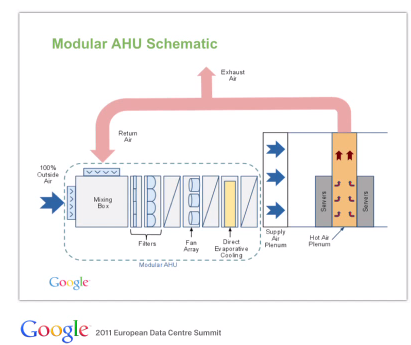
Once complete, the facility will rank amongst the most energy-efficient data centres in the world. Google will use advanced air-cooling technology that has been tested and perfected at Google’s existing rented datacenter facility in Dublin. This technology takes advantage of Ireland’s naturally cool climate and uses outside air to cool computers instead of costly and energy-hungry air-conditioning units.

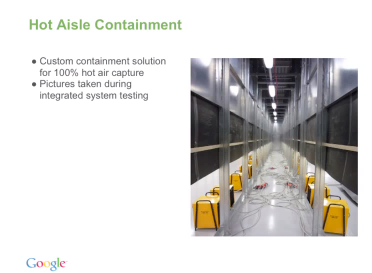
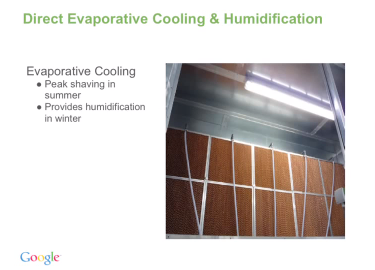
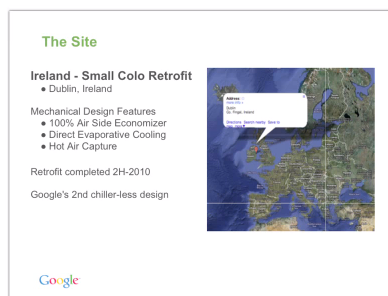
Here are a few pictures from the Google Data Centre Summit 2011 where the existing Dublin Data Center is mentioned.
NewImage

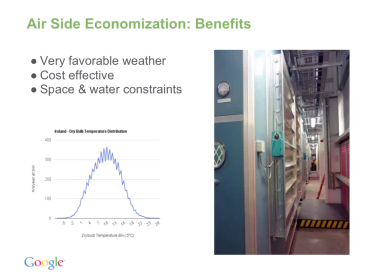
Here is information about Google's existing Dublin deployment.
NewImage

NewImage

NewImage

NewImage

Most likely you have not seen this video as it only has 265 views.

The following is the complete local press announcement Google made on its new Dublin Data Center project.

Minister Bruton announces new €75m investment by Google in energy-efficient, air-cooled data centre in Dublin

New project to provide more than 200 jobs for local and national construction firms, and up to 30 full-time and contractor jobs once operational.

Dublin – Mr Richard Bruton, TD, Minister for Jobs, Enterprise and Innovation, today announced that Google has acquired 11 acres of land and an existing building on Dublin’s Profile Park and will soon begin construction work on a highly energy-efficient data centre.  A data centre is a specialised building full of computers that run online services such as the Google search engine, Gmail and Google Maps.

Once complete, the facility will rank amongst the most energy-efficient data centres in the world. Google will use advanced air-cooling technology that has been tested and perfected at Google’s existing rented datacenter facility in Dublin. This technology takes advantage of Ireland’s naturally cool climate and uses outside air to cool computers instead of costly and energy-hungry air-conditioning units.


Google will invest up to 75 million Euros in the acquisition, build and fit out of its new facility, and will provide work for over 200 people from local and national firms at the peak of the construction phase. The contractors have already been selected after taking part in a competitive bid process.


Once operational, the centre will employ up to 30 people in a variety of full-time and contractor roles, including computer technicians, electrical and mechanical engineers, and catering and security staff. The new data centre will be in addition to Google’s existing rented datacenter facility in Dublin, which will continue to operate. Google already employs over 2,000 people in Dublin, and last year also bought three major office buildings in central Dublin, including Dublin’s tallest commercial office building, Montevetro.


Minister Bruton said: “As I have said repeatedly, the global cloud computing industry offers Ireland a massive opportunity for jobs and economic growth. I am determined that government will act decisively to seize that opportunity, and that is why I have established a cross-government implementation group to ensure that prompt action occurs.”

He continued: “The decision by Google, one of the most important multinational companies in Ireland, to locate a state-of-the-art data centre in Dublin is an endorsement of our policies in this area, and a sign of what is possible if we continue our focus”.

“We’re very happy to continue investing in Ireland and to build out our presence here even further,” said John Herlihy, head of Google Ireland. “The new data centre will be one of the most energy-efficient in Google’s global fleet. This investment further strengthens our presence here, and I’d like to thank IDA Ireland for the assistance they gave us in selecting this site.”
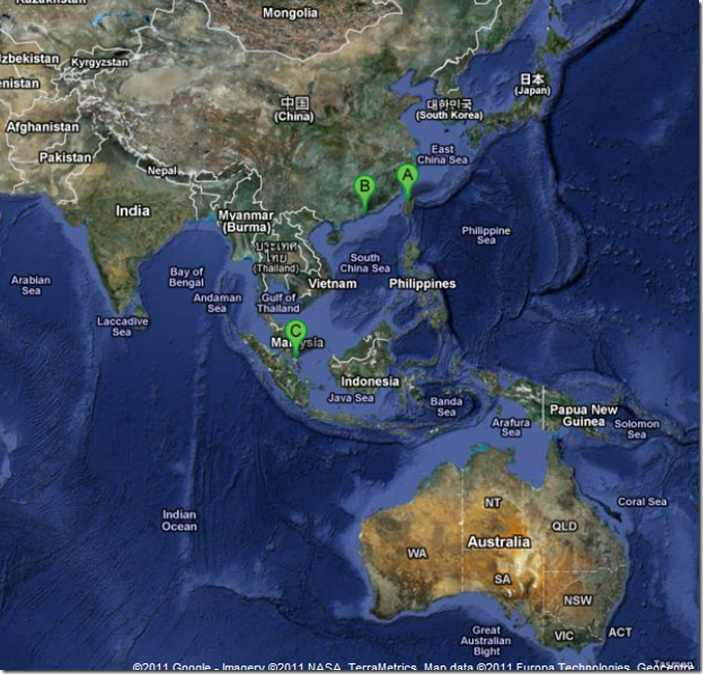
Google’s Three Asia Data Center Locations

Google announced its three data center locations in Asia - Taiwan, Hong Kong, and Singapore.

image

The logic of the three locations being in the center of the Asia Pacific region is hard to argue against. Which most likely disappointed governments in Australia, Korea, Japan, Vietnam, Phillipines, and India.  Here is Australia news.

Google will build three new data centres in Asia to service increased internet demand from the region, but Australia has missed out on being picked as a site location.

A Hong Kong-based spokesman, Taj Meadows, said Google used a stringent process to choose locations for the new facilities. The three cities met the criteria better than Australia, he said.

“We have a rigorous process in place around selecting sites for our data centres, taking many technical and other considerations into account. Some of the key things we look for in a site include closeness to our users, robust local infrastructure, reliable power, availability of skilled workers, reasonable business regulations and cost”, Meadows told IT Pro. He later added close proximity to existing underwater communications cables was also important.

Here is news about Singapore and Google’s Green Data Center plans.

“A data center here would be among the most efficient and environmentally friendly in Asia, subject to the same high technical and environmental standards we use worldwide,” Google said. It added that Singapore was chosen based on its proximity to users, access to robust infrastructure and reliable power, and reasonable business regulations, among others.

Hong Kong is a site to reach China.

Google faces stiff competition in Asia, particularly in the mainland market where homegrown search services such as Baidu are household names.

An Economist Intelligence Unit study released on Tuesday said Asian economies are closing the gap on the West in terms of IT competitiveness.

The United States is still the most competitive IT industry, but seven Asian economies made it to the top 20, including Singapore at No3 and Taiwan at 13.

And Taiwan makes the third.  

Three

The number 3 (三, Pinyin: sān, jyutping: saam1) sounds similar to the character for “birth” (生, Pinyin: shēng, jyutping: saang1), and is thus considered a lucky number.

Google to build US$100 million data center in Taiwan
2011/09/28 11:39:08


Taipei, Sept. 28 (CNA) Google Inc. will acquire 15 hectares of land in Changhua County to build a data center that will offer faster access to its services, the company announced Wednesday.
The world’s largest Internet search company said in a statement that it plans to invest over US$100 million (NT$3.04 billion) in the data center, which it expects to come on line in one or

.

Google opens Hamina Data center

WSJ reports on Google’s Hamina data center.

Google Inc.'s opening of a €200 million ($273 million) server hall in Hamina, Finland, over the weekend is boosting Scandinavian hopes that other big Internet companies will choose to build data centers in the region, attracted by its cold climate and low electricity prices.
SERVER

One interesting speculation in the WSJ article is Facebook is looking at a site in Sweden.

Mr. Engman has been active in promoting Luleå as a hot spot for data centers, and he has undoubtedly had some success. An undisclosed major U.S. Internet company, widely believed to be Facebook, is planning to build a giant data center outside the town center, in an investment estimated by local officials at between three billion and five billion Swedish kronor ($459 million to $764 million). Facebook has declined to comment on the matter.

The plan has been delayed by legal action brought by a private individual on concerns the data center may harm wildlife, but should the latest appeal fail, the center will represent the single largest corporate investment—more than three times the size of the nearest contender—ever made in the city.

Mr. Engman, who takes pride in having attracted the U.S. company to Sweden, says there are several reasons other than climate that contributed to its interest in Luleå.

"We've got a unique electricity infrastructure up here. The electricity network is built for [energy intensive users such as] paper mills and the metals industry, and our supply of hydroelectricity means electricity prices here are among the lowest in Europe," Mr. Engman says.

And the folks in Lulea claim they haven’t had a power outage since 1979.

"You can't have a blast furnace shutting down because of electricity shortages. Luleå hasn't had a power outage since 1979. When we informed executives at U.S. software firms about this, they had a hard time believing it," Mr. Engman says.

One of the reasons Sweden and Finland are interesting is proximity to Russia.

But it is not just the cool climate that makes the Nordic countries attractive, supporters say. "There are several factors," says Tomas Sokolnicki, a senior investment adviser at Invest Sweden. "We have political stability, excellent fiber-optic infrastructure, minimal risk for natural disasters and a favourable climate.

"Also the fact that we are geographically close to Russia is important. Many players want to establish data centers close to the growing Russian market, but few dare establish data centers in Russia itself."

Greenpeace updates Google’s Environmental Grade from F to B

Greenpeace has posted its view of Google’s environmental disclosures.

Good news: Google comes clean on energy use

Blogpost by Tom Dowdall - September 8, 2011 at 20:31Add comment

Today Google has finally released information on exactly how much energy it takes to provide searches, email, youtube videos and all other Google services. For years Google has claimed this information was a “trade secret”, despite many competitors having already disclosed the same information. Such a lack of transparency led to much speculation about Google’s energy use from Blackle (remember that?), via much disputed kettle boiling comparisons, to our own recent dirty data report.

Previously Google has “a big fat F” from Greenpeace.

Since 2009 we’ve been pushing Google and all IT companies to be more transparent as part of ourCool IT leaderboard, and in our analysis of the power consumption and energy-source choices of data centers, as part of our Dirty Data report where Google scored a big fat F for transparency.

With Google’s latest extra credit work, Greenpeace would Google a “B”.

If we were giving out new grades based on today’s release, Google would likely earn a low to middle “B”.

Until today, silence from the Googleplex on producing meaningful environmental footprint data seriously undermined its standing as a corporate leader on clean energy, and put it out of step with many other IT companies. Publishing this data helps back up Google’s impressive track record on renewable investment (US$700m in the last year) and policy work in support of strong climate targets.

There is a lot of good info that Google has put out today, including more detail on how it can claim to be “carbon neutral”, which we’ll have more to say on that later, but as a customer of Google and other “Cloud” computing companies, we need to see others put their numbers and plans for clean energy on the table, both to help customers make more informed decision about the carbon impact of different online services, and hopefully to spur greater transparency and competition for improved performance that the IT sector is so known for.

Why not an “A”?  Greenpeace objects to site location in areas where coal is the dominant energy generation composition.

Of course a central part of the take home message from Google is that they want you to feel good about using their products, and should maybe be more thinking more about the footprint of the bottle of wine you are drinking than your Gmail account.  However, Google’s data centers in South and North Carolina certainly don’t run on wine yet (78% and 62% coal powered respectively), and going forward we will be taking a deeper look at how Google and other companies are increasing the demand for dirty energy and the pollution that comes with it in many communities in their race to build the cloud, a task that is made slightly easier today with Google’s new commitment to transparency.

Greenpeace goes on to call out for the rest of the data center industry to match Google’s performance.

Google is now disclosing more information than other big IT companies and is one of the first companies after Akamia to release information on how much energy and emissions are generated by its Gmail and Youtube services which are based on distributed servers, known as cloud computing.

And calls out one of those it would like to see join the transparency.

Google’s big step forward leaves Facebook kinda lonesome at the back of the green IT class, failing to say anything about how much energy is consumed and emissions are created by all our millions of Facebook posts, photos and online friendships generate. Its high time Facebook took a step forward by ditching dirty coal power and following Google’s lead by increasing its use of renewable energy.

Ask Facebook to unfriend coal by joining the Unfriend Coal fan-page


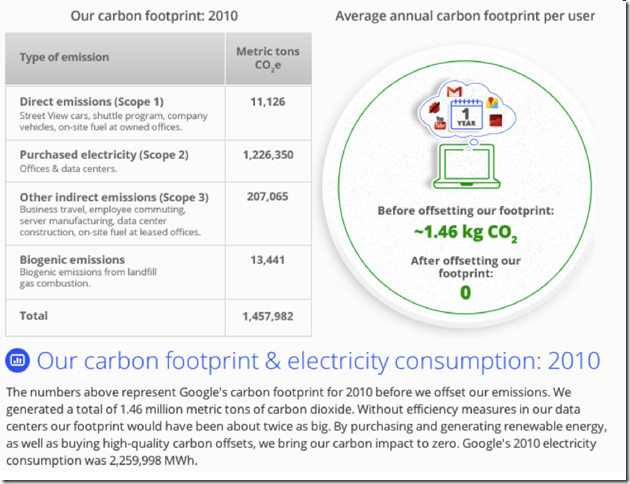
Google sets a High Bar for Tech Industry, discloses 2010 2,259,998 MWh energy use and 1,457,982 tons CO2e carbon emissions

The data center industry is not known for its openness and transparency of its data center’s environmental impact.  Greenpeace and other environmentalist group have made the point that just because a service is in the clouds people need to think about the environmental impact.

Google has taken a leadership position that is going to make others scramble for a response.  What are the equivalent numbers from Microsoft, Amazon, Apple, Yahoo, AOL?  Is this a tipping point where it will be expected that technology companies disclose their energy use and carbon impact?

image

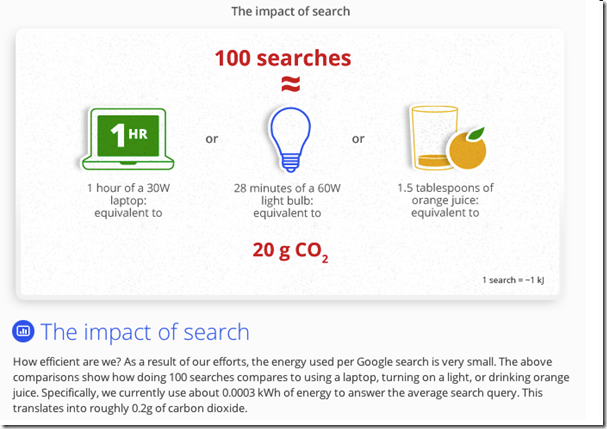
These numbers can be hard to grasp, so Google has created a set of numbers that an individual can relate to on the environmental impact of 100 searches.

image

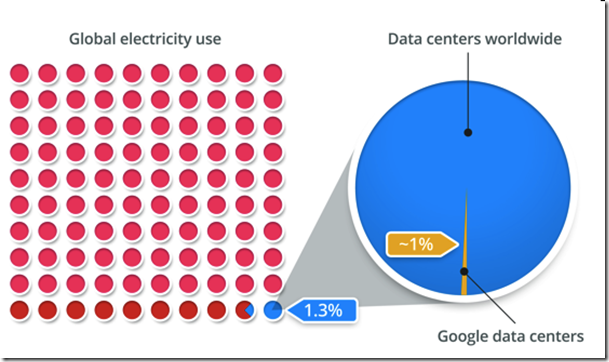
Google is showing even though it is a big user of data center energy it is a small target when you look at the big picture.

image