If Yahoo, Bing, Yandex, and Baidu fail as search providers, does Google get defined as a monopoly?

The future of Yahoo is not good.

Yandex is having its problems.

Yandex Sinks on Profit Concern as Google Grows: Russia Overnight

Yandex NV (YNDX) tumbled the most this year on speculation the owner of Russia’s most popular Internet search engine will report net income faltered last quarter as competitors such as Google Inc. (GOOG) encroached on its market share.

Baidu is down on weak forecasts.

Baidu shares decline on a weaker than expected forecast

Baidu's chairman introduces the company's search engine Baidu has seen a robust growth in advertising revenue in recent years

Related Stories

Shares in Chinese biggest search engine Baidu fell more than 10% in after hours trading after the firm issued a weaker-than-expected revenue forecast.

Bing is speculated to be sold to Facebook.

The rumor, which started as a prediction in an e-book written by an "anonymous" marketing executive trying to cash in on Facebook's IPO, turns out to be truer than anyone could have guessed.

According to a nugget buried in a New York Times report on Facebook's patent strategyMicrosoft executives approached Mark Zuckerberg to see if he'd like Facebook to acquire Bing.


If no one but Google can make money on search and competitors fold shop, is it possible in the future that Google becomes the monopoly of search?
If Microsoft, Baidu, and Yandex can't beat Google, it seems like governments around the world would think they need to regulate Google Search.

Google's Future Growth is Mobile and Social, are you focusing on this too?

Forbes has an article on how much Mobile and Social are fueling Google's growth.

Google's Earnings Show That Mobile And Social Are The Future

Image representing Google as depicted in Crunc...

Image via CrunchBase

Google reported its earnings for Q1 2012 on April 12, with gross revenue of $10.65 billion, up 24% year-on-year. [1] It also reported a significant jump in operating and net income, and the same ratio of traffic acquisition costs as a percentage of advertising revenues as in 2011 – 25%.

As a result of its push into mobile advertising, the cost-per-click dropped nearly 12% over last year, but there was a 39% growth in aggregate paid clicks, which led to a healthy increase in advertising revenues. We expect this trend to continue as mobile search advertising drives the next phase of earnings growth for Google while traditional online search advertising takes a backseat.


Note how traditional online advertising has taken a backseat.  This is like Microsoft having Windows and Office take a backseat to Mobile and Facebook-type products.

An interesting way to look at Google is how it's stock is valued.

NewImage

Here is Microsoft for contrast.

NewImage

Interesting that this same system shows Amazon's company value to have Kindle and AWS equal.

NewImage

Google expands in Oklahoma, instead of launching a new site, Why?

It is interesting how much news Google gets by expanding its data center capacity at a site.

Print story only Print story with comments Email Facebook
Google to double capacity in Oklahoma
Justin Hobbs, a facilities technician for Google, works on his computer in January at the company's data center in Pryor. Google announced Wednesday plans to expand the Pryor facility, adding about 50 jobs. MATT BARNARD/Tulsa World file

By ROBERT EVATT World Staff Writer


OKLAHOMA CITY –Mike Wooten, Google Data Center Operations Manager, had previously said the company was looking into building a much smaller auxiliary building to support its Pryor data center.

But that’s not what he announced during a press conference at the state capital building Wednesday.

“We’re going to construct a new building that will house twice as much server capacity,” Wooten said.

The new building slated for Google’s 800-acre campus at Mid-America Industrial Park will be roughly the same size as the 130,000 square-foot data center that opened just six months ago, and enable Google to add 50 jobs to its current 100-employee Pryor workforce.


There are many like the so called Nebraska Edge project that are hoping to land a big data center from Google in their area.  Site selection is complex and has a long list of factors.

Jones Lang LaSalle’s data center services include:

  • Location and site selection strategy
  • Site due diligence
  • Project management
  • Purchase, lease and build-to-suit negotiations
  • Financing strategies
  • Business and economic incentives negotiations
  • Critical environment management
  • Project and development services

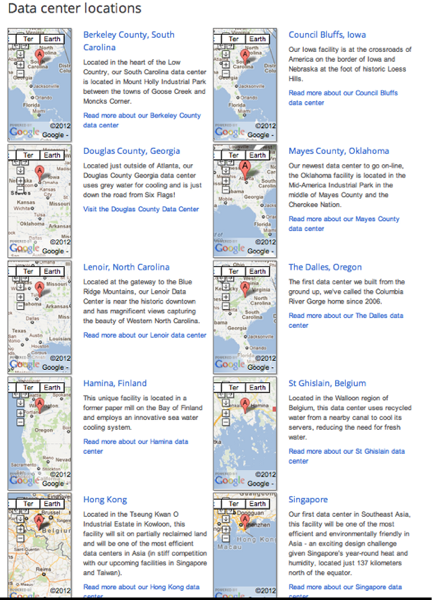
With Google's 12 data center sites you may say why not add another site in my area.  (Note the list has only 11 sites, and I included Dublin where Google has announced expansion.)

NewImage

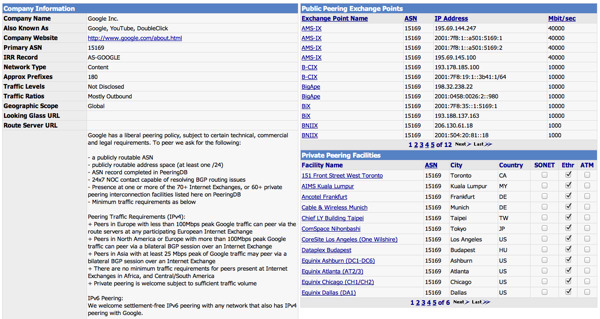
But, the one answer a site selection consultant has difficulty answering is what is the right number of data center sites and how does a new site affect your operations.  Google has 12 main data centers that are bigger than 5MW.  I would assume there are another 120 sites (10X the main data centers) to support lower latency.  Here is a list of the public and private peering sites which gives you an idea of the other Google locations.

NewImage

How a data center site interacts with this system is a question that only Google can answer.  it is useful to have consultants take fresh looks at where data center sites can be.  Given Google has 800 acres in Pryor, OK and hundreds of acres in other sites in the US, you shouldn't hold your breath for a new Google data center site in the US.

In the same way FedEx has a strategy for its site locations, Google has their own.

Why is it news that Google announces a data center expansion?  Because Google articles drive traffic.  The way the news is written it seems like many are not aware that there is a new Google data center project announced every 3-6 months.


Google updates data center locations info with Hong Kong, Singapore, and Taiwan

Google has updated its data center locations with its newest construction in Asia Pacific.

The Taiwan site is the only that looks big enough for the thermal storage units given it is 5-6 times bigger than Hong Kong and Singapore.

Hello Taiwan!

In September 2011, we announced that we had acquired 15 hectares of land in Changhua County, Taiwan, with plans to build a data center. We’re now busy building, and we plan to start limited testing and bringing the facility online by the second half of 2013.

Building this data center in Taiwan is an exciting step for us. More new Internet users are coming online everyday here in Asia than anywhere else in the world. They are looking for information and entertainment, new business opportunities and better ways to connect with friends and family near and far. We’re building this data center to make sure that our users in Taiwan and across Asia can do just that, with the fastest and most reliable access possible to all of Google’s services.

Here is more information about the other sites.

Hong Kong

Located in the Tseung Kwan O Industrial Estate in Kowloon, this facility will sit on partially reclaimed land and will be one of the most efficient data centers in Asia (in stiff competition with our upcoming facilities in Singapore and Taiwan).

Read more about our Hong Kong data center

Singapore

Our first data center in Southeast Asia, this facility will be one of the most efficient and environmentally friendly in Asia - an exciting design challenge given Singapore’s year-round heat and humidity, located just 137 kilometers north of the equator.

Read more about our Singapore data center

Changhua County, Taiwan

Located about three hours down the coast from Taipei, in the shadow of some of the 100 meter wind turbines that dot the Changhua Coastal Industrial Park, this facility will be our first to save energy through a nighttime cooling and thermal energy storage system.

Read more about our Taiwan data center

Google plans use of thermal storage for Taiwan Data Center

Google's Asia Pacific president, Daniel Alegre says that Google plans on using thermal storage to reduce cooling costs.

Google center to adopt green solution amid energy price hike concerns
2012/04/03 22:01:37
Taipei, April 3 (CNA) Google Inc. said Tuesday it will incorporate energy-saving solutions into the design of its new data center in Taiwan, amid local concerns over a possible increase in electricity rates. 

"We've taken that into account, into our investment in this data center, which is actually one of the reasons why we are very committed to a green solution to minimize our energy consumption," Daniel Alegre, president of Google's Asia-Pacific division, said at the groundbreakin

A bit more details are shared.


One way that Google will increase energy efficiency at its new facility is to adopt a nighttime cooling and thermal energy storage system, according to the company.

The world's largest Internet search engine explained that the data center will cool large quantities of water at night while temperatures are low and power is more plentiful, storing it in insulated tanks where it will retain its temperature.

During the day, especially in the summers when Taiwan heats up and power is more expensive to produce, Google will circulate that cold water throughout the facility to keep it cool.

Google Taiwan Managing Director Chien Lee-feng said the nighttime cooling system, the first of its kind to be used at any Google data center, will enable the Taiwan center to use 50 percent less energy than typical facilities.

The new facility in Changhua will be one of the most energy efficient and environmentally friendly data centers in Asia, with each element

If you are not familiar with thermal storage here is an Intel paper.

NewImage