Google doubles its presence in Kirkland (Seattle), Seattle is a cloud development hub with Amazon and Microsoft

I moved to Seattle 20 years ago.  Part of Seattle are clouds.  And it makes you wonder if all those clouds are influencing software developers. :-)  As Google invests more in cloud development like Amazon and Microsoft cloud development teams in Seattle.

NYTimes posts on the Google expansion in Kirkland, WA.  Kirkland is probably more known as the Costco branded items.  Kirkland city is near Costco HQ. And Kirkland is where Google has its hub of offices in the Seattle area.

In a battle for dominance in cloud computing, Google is taking onMicrosoft and Amazon in their own back yard.

Google said Tuesday that it was doubling its office space near Seattle, just miles from the campuses of Amazon and Microsoft, and stepping up the hiring of engineers and others who work on cloud technology.

It is part of Google’s dive into a business known as cloud services — renting to other businesses access to its enormous data storage and computing power, accessible by the Internet.

Here is a video by local Komonews with a tour inside the Google Kirkland facility.

Wow, PUE of 1.26 for 120v Nissan Leaf charging system vs. 1.08 for 240v

I have one friend who just bought a Tesla S and he mentioned something that doesn't get widely publicized for the Tesla's that typical charging is 85% of battery capacity.  So keep in mind the typical range of a Tesla is 85% of the stated range.  I asked him what kind of charging system he had and he had the 240V that is similar to an electric dryer circuit.  I told him I had another friend with a Nissan Leaf who was a bit more on the cheap side so he charging his leaf on 120V.  It takes 20 hours for a complete charge and is also recommended to not exceed the 80% battery charge.

What I found interesting in a Nissan Leaf Forum is there is 300 watts of overhead for the 120 Volt and 240 Volt charging. 

The question starts.

7 hours for 240V and 20 hours for 120V. I thought it would be exactly half for the lower voltage?

The answers posted are.

The 120v charging is limited to 12amps (1.44kW). 240v charging is done at 16a (3.84kW). That comes to 2.67 times slower, plus 120v charging is less efficient...there's a fixed overhead for the cooling system that brings the practical difference close to 3 times slower.

2). There is a parasitic load of about 300W that runs during charging. These pumps draw the same power regardless whether the charging is done with 120VAC or 240VAC. This power takes a larger fraction of the available power away from charging when using 120VAC, This further slowing charging. Interestingly, this causes 240VAC charging to be more efficient.

The last comment on 240VAC being more efficient got me curious to calculate the PUE of 1.44kW (120V) vs. 3.84 kW(240V) with a  0.3 kW overhead for the cooling and electrical distribution.

120V had a PUE of 1.26.

240V had a PUE of 1.08.

When you do the math on an individual basis this is not big deal, but add up all the 120V charging of electric vehicles and the numbers add up fast.

Google has a PUE of 1.08 for its Hamina Data Center.  Would it ever want to go back to a PUE of 1.26?

It is painful to think about charging at 120V vs. 240V both from a time perspective and waste of energy.

SW = HW Google's Jeff Dean, employee #20

Google has some really smart people and there is an inner circle of smart rich people who keep Google infrastructure going.  Silicon Valley has an article on Google's Jeff Dean.

How Google's Jeff Dean became the Chuck Norris of the Internet

By Will Oremus, Slate


"The speed of light in a vacuum used to be about 35 mph. Then Jeff Dean spent a weekend optimizing physics." — Jeff Dean Facts

Jeff Dean facts aren't, well, true. But the fact that someone went to the trouble to make up Chuck Norris-esque exploits about Dean is remarkable. That's because Jeff Dean is a software engineer, and software engineers are not like Chuck Norris. For one thing, they're not lone rangers - software development is an inherently collaborative enterprise. For another, they rarely shoot cowboys with an Uzi.

Jeff is a low level guy who gets to the bits running on the HW.  What really smart people like this get is it is all about processing bits.  Processing bits is done in SW and HW, and sometimes SW changes the HW. 

Nevertheless, on April Fool's Day 2007, some admiring young Google engineers saw fit to bestow upon Jeff Dean the honor of a website extolling his programming achievements. For instance:

Jeff Dean (Courtesy: Google)

Compilers don't warn Jeff Dean. Jeff Dean warns compilers.

Jeff Dean writes directly in binary. He then writes the source code as documentation for other developers.

When Jeff Dean has an ergonomic evaluation, it is for the protection of his keyboard. Jeff Dean was forced to invent asynchronous APIs one day when he optimized a function so that it returned before it was invoked.


Here is a bit of a peak into the inner circle fueled by cappuccinos

Almost every morning, he comes into work at the GooglePlex in Mountain View, Calif., and sits down for coffee with the same core group of people. "We've made 20,000 cappuccinos together" over the years, he estimates. These people don't all work together. In fact, as Google has grown, some have moved to different buildings on opposite sides of the campus. But when they get together to dish about what they're doing, their problems spark ideas in one another, Dean says. These coffee talks are what has enabled Dean to put his expertise in optimization, parallelization and software infrastructure to work on such a wide array of projects. That and healthy doses of ambition and confidence. "He's always very enthusiastic and optimistic about how much we can get done," says Ghemawat, his longtime collaborator. "It's hard to discourage him."

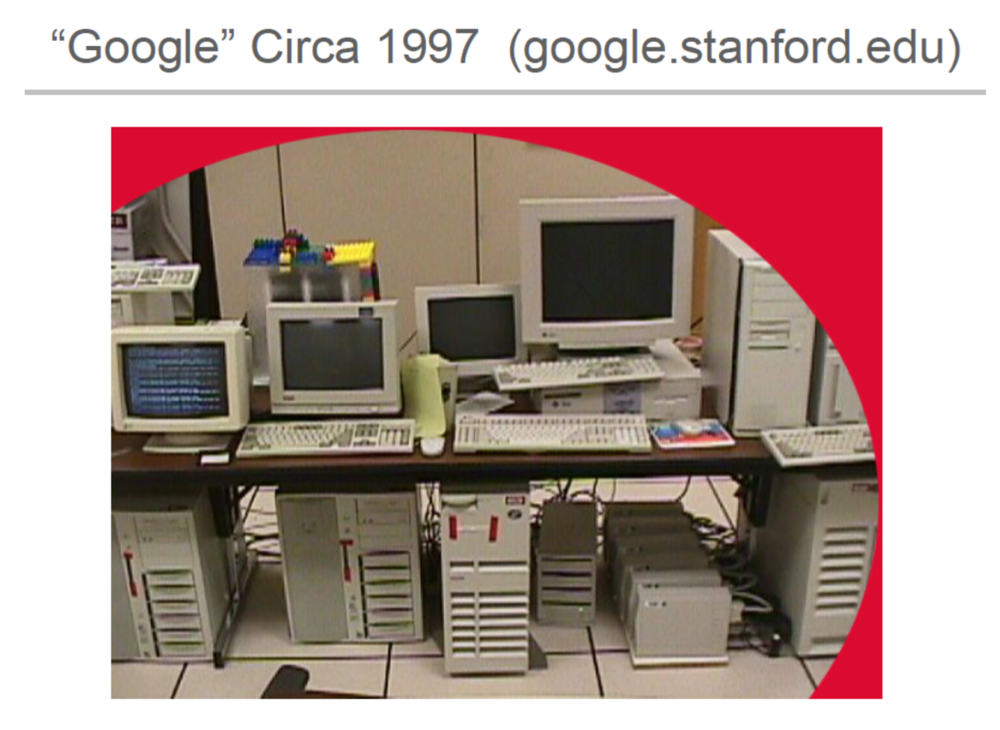
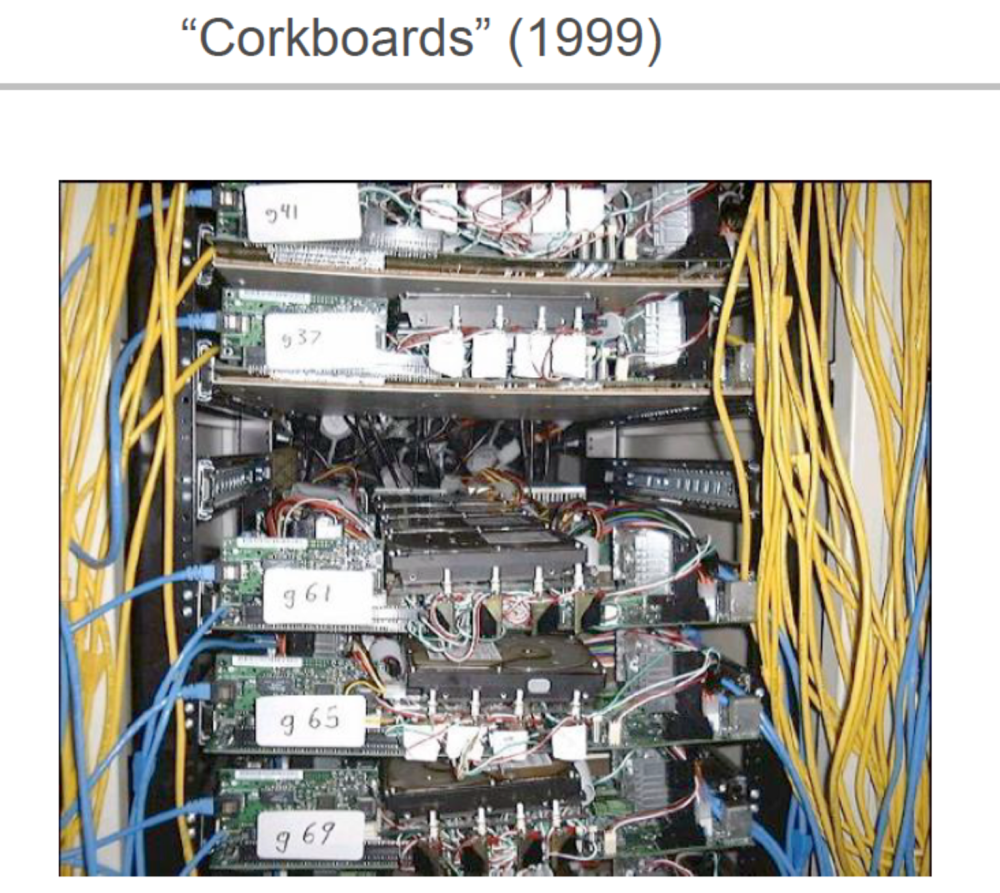
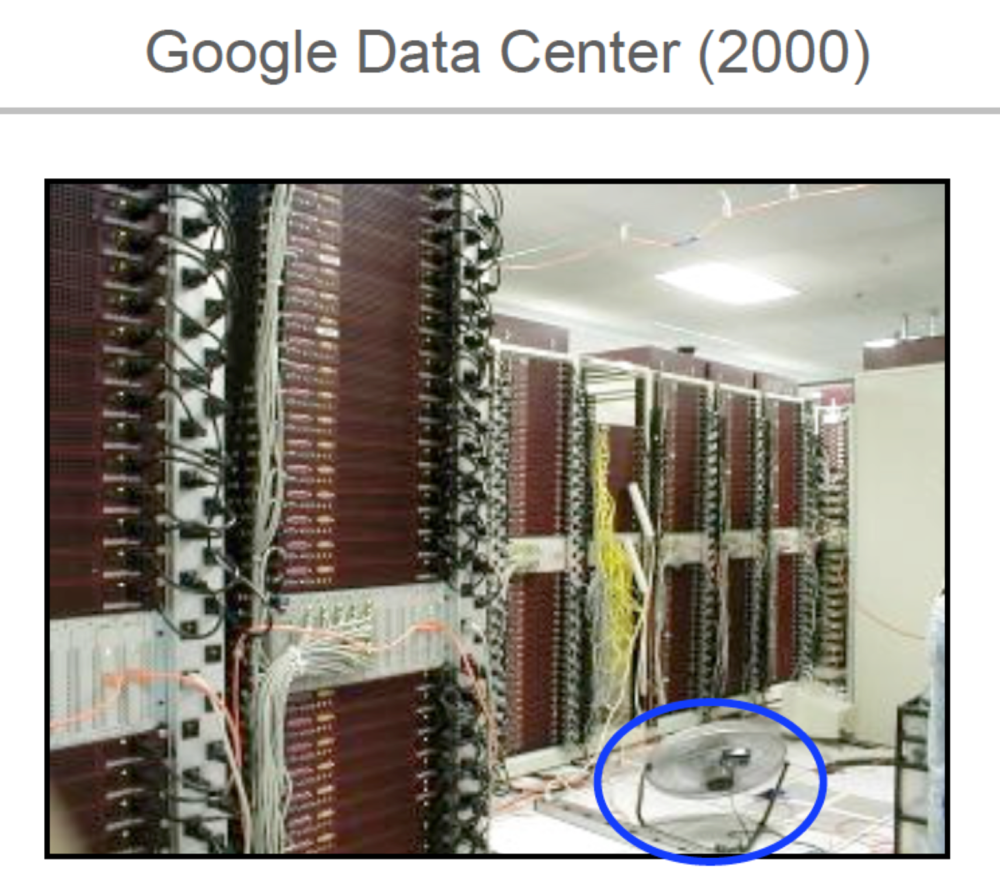
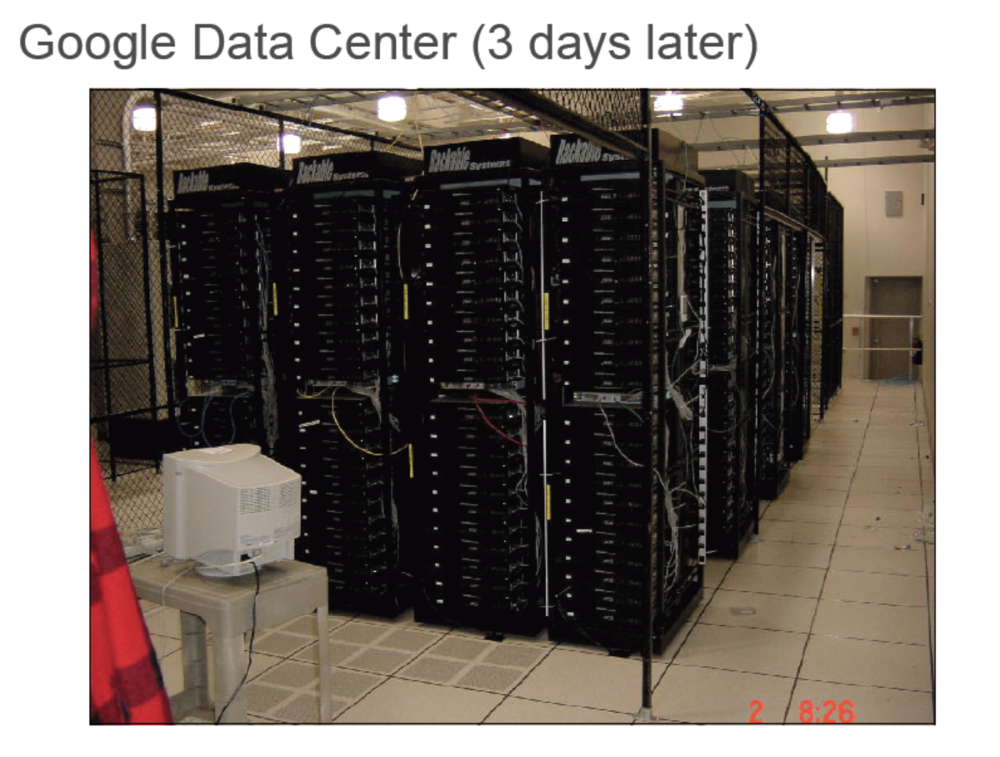
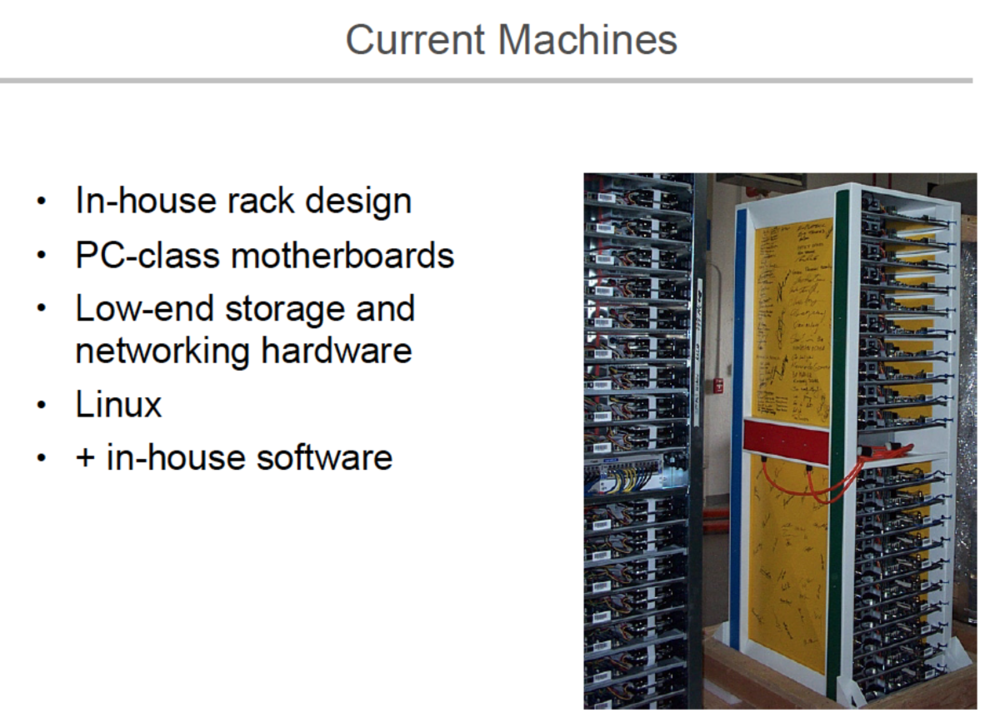
Here is a presentation that Jeff did on Google in 2009, it gives you some history and pictures of what Google Data Centers used to look like.


NewImage
NewImage
NewImage
NewImage
NewImage

The First Data Center where all knowledge was a goal, where anyone could access the information - Ancient Alexandria

What is a Data Center?  A place to house IT equipment.  What is IT equipment for?  To support the receiving, organizing, processing, analysis, and distribution of information.  Before the Internet the most common way to get information was to go to the library.  Libraries were also places to meet others to discuss topics which support the development of knowledge to be shared.  The library seems so ancient.  But, long long ago there was a library that attempted to have all knowledge accessible to all people just like a data center service like Google Search.

One of the more interesting conversations I've enjoyed discussing with a friend, Fred Gainer who is a retired teacher is the role of museums and libraries in society.  This gets into the subject of Epistemology.

Epistemology (Listeni/ɨˌpɪstɨˈmɒləi/ from Greek ἐπιστήμη - epistēmē, meaning "knowledge, understanding", and λόγος logos, meaning "study of") is the branch ofphilosophy concerned with the nature and scope of knowledge.[1][2] It questions what knowledge is, how it is acquired, and the possible extent a given subject or entity can be known.

I wrote previously posted on epistemology.

I saw a talk by John Leslie King Titled - Knowledge Infrastructure: Mechanism and Transformation in the Information.  One of the slides that got my attention was this one.

NewImage

The role of the Academy in a systematic collecting of information for a crowd-sourced knowledge.

A great point was the knowledge in a perspective of reason for existence, and how what's obvious leads to thinking what's hidden.

NewImage

One of the books that Fred suggested to read is 

The Rise and Fall of Alexandria: Birthplace of the Modern World

NewImage

Warning this book is not a fast read and many of you may not be interested in the idea of how knowledge/information was developed to rival Athens and Rome as centers in the Ancient World.

I just finished the book this morning and the thing that hit me, thinking like a data center person is. The choices made by Ptolemy to make Alexandria a center of knowledge and a repository for books across a wide range of cultures is exactly what has made Google a source of information.

Many of the concepts to build Alexandria, its libraries and its open culture is what is being repeated now in the huge data centers whether they are Google, Facebook, Twitter, or Microsoft.

Reading the history of Alexandria gave me a bunch of ideas on how to approach a knowledge system.  The politics and people issues were huge in Alexandria's history.  

Alexandria became a center of learning and knowledge development.  Companies like Google are focused on developing better knowledge systems that allow them to learn things faster.

It was in Alexandria, during the six hundred years beginning around 300 B.C., that human beings, in an important sense, began the intellectual adventure that has led us to the shores of the cosmic ocean. The city was founded by Alexander the Great who encouraged respect for alien cultures and the open-minded pursuit of knowledge. He encouraged his generals and soldiers to marry Persian and Indian women. He respected the gods of other nations. He collected exotic lifeforms, including an elephant for Aristotle, his teacher. His city was constructed on a lavish scale, to be the world center of commerce, culture, and learning. It was graced with broad avenues thirty meters wide, elegant architecture and statuary, Alexander's monumental tomb, and an enormous lighthouse, the Pharos, one of the seven wonders of the ancient world.

But the greatest marvel of Alexandria was the Library and the associated Museum (literally, an institution devoted to the specialties of the Nine Muses). It was the citadel of a brilliant scientific tradition. The Library was constructed and supported by the Ptolemys, the Greek kings who inherited the Egyptian portion of the empire of Alexander the Great. From the time of its creation until its destruction seven centuries later, it was the brain and heart of the ancient world.

Think Different, Infrastructure as an executive position, example Google's SVP Urs Hoelzle

3 years ago I was introduced to how differently Google thinks of the word infrastructure when a Google guy I met said he worked on Google Infrastructure.  My context was from thinking of the definition.

Definition of INFRASTRUCTURE

1
: the underlying foundation or basic framework (as of a system or organization)
2
: the permanent installations required for military purposes
3
: the system of public works of a country, state, or region;also : the resources (as personnel, buildings, or equipment) required for an activity

So, he worked in the data center group.   No, he worked on Google Infrastructure.  Search - the underlying foundation or basic framework of the company.  Cities are built on infrastructure which is where we commonly get the use of the word.

The term typically refers to the technical structures that support a society, such as roads,bridges, water supplysewerselectrical gridstelecommunications, and so forth, and can be defined as "the physical components of interrelated systems providing commodities and services essential to enable, sustain, or enhance societal living conditions."[3]

Google goes far in its use of Infrastructure to the point where Urs Hoelzle says he is an Infrastructure Czar.

Urs Hölzle, Google’s infrastructure czar tells us what the Cloud really is and what it is supposed to do.

It was nearly five years ago when I last spent time with Urs Hölzle, Google’s infrastructure czar. (His official title is SVP of operations.) It was around that time he introduced me (and several others) to many of the concepts (such as cloud and big data) that are now part of the technology sector’s vernacular. Hölzle was company’s first VP of engineering, and he has led the development of Google’s technical infrastructure.

Hölzle’s current responsibilities include the design and operation of the servers, networks and data centers that power Google. It would be an understatement to say that he is amongst the folks who have shaped the modern web-infrastructure and cloud-related standards. When I had a chance to chat with him recently, my question was, “How do you define the cloud?”

...

Others might disagree, but Hölzle believes Google’s common infrastructure gives it a technological and financial edge over on-premise solutions. “We’re able to avoid some of that fragmentation and build on a common infrastructure,” says Hölzle. “That’s actually one of the big advantages of the cloud.”

Do you have an infrastructure czar or VP at your Web2.0, cloud company?  If not, you may have a hard time competing against those who have figured out how important infrastructure is.