Google Floating Data Center makes the news, what are some facts?

Run a Google News Search on “google floating” and you get a range of articles.  Here are a few

Is Google building a hulking floating data center in SF Bay?

CNET - ‎4 hours ago‎
SAN FRANCISCO -- Something big and mysterious is rising from a floating barge at the end of Treasure Island, a former Navy base in the middle of San Francisco Bay. And Google's fingerprints are all over it. It's unclear what's inside the structure, which ...
 

Google May Be Launching Floating Data Centers Off US Coasts

Mashable - ‎16 hours ago‎
Google, one of the world's largest users of data, may finally be making good on a five year-old patent to build offshore data centers — cooled and powered by the ocean, and potentially beyond reach of the government. An investigative report by CNET Friday ...
 

Google could have a floating data center in Maine, too

CNET (blog) - ‎17 hours ago‎
As CNET reported Friday, it looks very much like Google has been building a floating data center made from shipping containers on a barge in the middle of San Francisco Bay. But it may not be the only one of its kind. Google has not responded to multiple ...
 

Google it? Search-engine giant may be behind secret structures

TheDay.com - ‎5 hours ago‎
The lack of windows and egress stairs on the exterior of the buildings rule out the possibility that they are floating hotels, said Joel Egan, the principal at Cargotecture, which designs buildings using shipping containers. "If it's Google, it's probably a data center ...
 

Google's Latest Data Center May Be Floating In San Francisco Bay

ReadWrite - ‎17 hours ago‎
Google may be building a secret data center on a barge currently floating in San Francisco Bay, CNET's Daniel Terdiman reports in a convincing, though still circumstantial, article. If true, it would represent the Internet giant's latest attempt to translate some of ...
 

Google data center, floating in the ocean?

Android Community - ‎18 hours ago‎
If you like speculation, try this on for size. A giant, floating something has been spotted in the San Francisco Bay Area. Some are speculating that it's Google in nature, and could be afloating data center. While no clear ties to Google are present, speculation ...

So what are a few facts to think about.

Google running its Hamina data center has been gaining experience running  sea water cooling system.  No one else has this.

So where would Google put a floating data center?  Not in the path of hurricane.  Although if it was with advance notice you could disconnect it and move it.

Putting a floating data center in the US off the coast of NYC one of the highest density areas could work, but why?

How about this where it could make sense is to float it in for a deployment like  portable cell tower.

My suggestion is that the search and rescue team simply deploy portable cell phone towers and continually ping/call their cell phone numbers or listen for their calls, in addition to the traditional S&R.

The basic technology already exists. There are portable towers (http://en.wikipedia.org/wiki/Cell_on_wheels) that could be driven along the suspected route the missing folks took. If the search area is large, the tower could even be designed to be suspended from a helicopter to increase the range. There are portable towers that appear to be small enough for this (http://www.survivalistboards.com/showthread.php?t=166036).

Moving a barge is not quick, so you would normally want weeks of advance notice, not hours or days.

With the World Cup Soccer and Olympic games in Brazil there is going to be a local requirement for Google Services.  But, anyone who has worked in Brazil knows it can be some of the most expensive data center space when you add up the TCO.  Google is extremely good at looking at TCO.  And it would seem possible when you look at the costs and issues to ramp up enough capacity for Brazil it is cheaper to deploy a floating data center.  Anchor it far enough offshore and you are in International waters.  Put it close to the fiber access coming in from Int’l carriers and you can bypass the local Telecom.

BTW, part of the reason I think these are facts is I have gone through this thinking exercise years ago and it does make sense.  Especially when you only need the capacity for burst and not long term.  
A peak into Google Corporate IT, restricted use of Windows

AllthingsD has a post with an interview of Google CIO, Ben Fried.  For those of you who are curious how Google corporate IT is different from yours you can read this post.  

Google CIO Ben Fried on How Google Works


Warning if you are a Windows user, you need to have business justification for why you need to use Windows to do your job.

Google also restricts the machines it lets employees use. For example: Windows computers.

Dating back to early 2010, when Google disclosed that its corporate infrastructure had been subject to attacks originating in China, the company began cracking down on use of Windows machines.

That’s not to say PCs are banned — Fried said that Google employees today use “many thousands of Windows laptops and desktops.” But now, Googlers must apply to a manager to get permission to use Windows, and explain why it is important and necessary for their job. “There’s somewhat a difference between using it because it’s the only thing you know, and using it because it’s the best tool for your job,” Fried said.

The point, Fried said, was to get a better balance of types of computers used within Google, because heterogeneity would make the company less susceptible to attacks. Then, it was a mix of Windows, Mac and Linux; today, Chromebooks have been added to the mix.

Google tours media in its Council Bluffs DC expansion

Here is a local media article on Google's open house on Oct 3, 2013.

Google shows off new Council Bluffs data center at grand opening

Print
Font Size:
Default font size
Larger font size
 

Posted: Thursday, October 3, 2013 5:07 pm | Updated: 8:29 pm, Thu Oct 3, 2013.

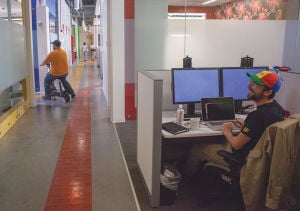
Employees on motorized scooters, paintings of Stormtroopers in a field of poppies, scale-model rockets. A recreation room with a pool table, two TVs and gaming systems. Bright colors.

The new Council Bluffs Google data center on Bunge Avenue was everything you’d expect from the iconic corporate behemoth. And it was pretty cool.

About 40 members of the community stopped by the Google campus Thursday afternoon for an open house at the data center on the southern edge of the city.

Apr 4, 2011, Google shifted from analytical data driven to an emotional customer driven design focus

When I left Apple in 1992 for Microsoft I was one of the few Apple employees to move to Microsoft.  Over the years many more Apple employees joined Microsoft, and now many more Microsoft employees have gone to Apple.  

One of the questions many asked when I first joined Microsoft was what is the difference between Apple and Microsoft.  After months of explaining I finally hit upon the following.

Microsoft is an analytical company, doing things that there is data to support the decisions.  What makes people feel good inside the company is having data to support a decision.  Apple is an emotional company where you do things that feel good for the customers.  Usability testing rarely taps into the emotional element of do people like the new service.

This split is a religious one.  Designers on one side.  Developers on the other.  Until April 4, 2011 Google had a shift in the balance and afterwards designers got more votes on what Google shipped.

Here is a post on Fast Company.

How Google Taught Itself Good Design

LONG DOMINANT IN ONLINE SEARCH, ADVERTISING, AND MAPS, GOOGLE HAS SHIFTED GEARS FROM UTILITY TO BEAUTY--AND IS NOW MORE FEARSOME THAN EVER.

...

If you ask a Google designer to mark the shift between Google's old approach to design and its new one, you're likely to get a precise date: April 4, 2011. That's the day Page became CEO. It's also the day Google designers were set free. Within a week of taking over, Page called together the company's top designers, product chiefs, and executives to outline his vision for Google's aesthetic future. Page's ideas meshed with a plan that designers had long thought Google should embrace.

Leading up to 2011 was the reality of 2010 user feedback.

 In 2010, Google conducted a series of user tests to find out how people felt about Android. The results were stark: "A lot of people felt that Android was essential to their lives, but they didn't like Android," Duarte says. The robust abilities of the OS "made them feel small. It wasn't empowering, but daunting." The same could be said for other Google products. When you loaded up something made by Google, you were more likely to feel overwhelmed than welcomed.

How much voice do you give your users?

Do you design for your users or your developers and internal views?

On site power generation changing the Utilities

WSJ reports on companies adding on site power generation is changing the Utilities behaviors.


Companies Unplug From the Electric Grid, Delivering a Jolt to Utilities


[image]Michal Czerwonka for The Wall Street Journal

At Kroger’s food-distribution center in Compton, Calif., a tank system converts organic waste into biogas to produce electricity used by the facility


On a hill overlooking the Susquehanna River, two big wind turbines crank out electricity for Kroger Co.’s KR +2.19% Turkey Hill Dairy in rural Lancaster County, Pa., allowing it to save 25% on its power bill for the past two years.


Google and Apple are mentioned in the article and their servers in data centers.

Almost overnight, that niche market has gone decidedly mainstream. Six years ago,Google Inc. GOOG -0.19% attracted attention by installing big solar arrays atop its Silicon Valley complex in California. Other tech companies followed suit, worried about ensuring power supplies for energy-hungry server farms and achieving sustainability objectives.

Apple Inc. AAPL +1.14% now gets 16% of its electricity from solar panels and fuel cells that run on biogas. Apple’s data center in Maiden, N.C., makes all the power it consumes, a company spokeswoman said.