Green Your Data Center with a Low Power Server, Intel Atom Powered – 25 watts

As power costs increase more people are looking at performance per watt. Virtualization of high power servers has been done by many. Another new approach gaining momentum is low power servers.  The Register reports on a 25 watt server for UK hosting company Bytemark.

Intel UMPC chip enters service as server CPU

Madness or genius?

By Tony Smith More by this author

Published Monday 21st July 2008 12:32 GMT

UK hosting company Bytemark has seen the future of servers and it's... er... a processor designed for tiny laptops and desktops.

Yes, we're talking Intel's Atom, specifically the 1.6GHz 230, which Bytemark's now using as the basis for what it claimed were its lowest-cost dedicated Linux-running servers yet.

An Atom-based box with 2GB of memory and a pair of 100GB SATA drives costs £45 a month to rent, compared to £60 for a unit built around an AMD Athlon LE-1620, 1GB of Ram and a 100GB hard drive.

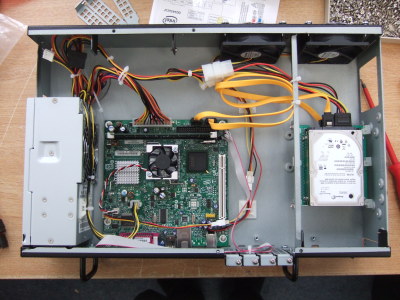
Bytemark Atom-based server

Bytemark's Atom-based box: lots of empty space

Bytemark charges less to set the system up, too: £50 for the Atom box, £100 for the Athlon. Both CPUs are single-core jobs.

Part of the reason for the lower cost is the power saving: the Atom system consumes 25W in total - a lot less than the Athlon rig does, Bytemark's Matthew Bloch claimed.
Intel is going to do everything it can to protect its high margin server business, so you’ll find these Intel Atom based servers coming from non-traditional markets.

I’ve been looking at building my own home server using http://www.newegg.com/Product/Product.aspx?Item=N82E16813121342.  But, thanks to a friend who reminded Intel’s IDF is coming up in August, I am going to wait and see what he reports on at IDF.
Read more

Microsoft's James Hamilton Presents "Where Does Power go in Data Centers and How to get it Back?"

James Hamilton has a blog post about his attending O'Reilly's Foo Camp and his presentation on "Where does Power go in Data Centers and How to get it Back?"

The title for my session was Where Does the Power go in Data Centers and How to get it Back?  I didn’t show slides but much of what we covered is posted at: http://mvdirona.com/jrh/TalksAndPapers/JamesRH_DCPowerSavingsFooCamp08.ppt.  In the session, we talked through how contemporary large data centers work first looking at power distribution. We tracked the power from the feed to the substation at 115,000 volts through numerous conversions before arriving at the CPU at 1.2 volts. We then talked about power saving server design techniques.  And then the mechanical systems used to get the heat back out.  In each section we discussed what could be done to improve the design and how much could be saved.

Our conclusion from the session was that power savings of nearly 4x where both possible and affordable using only current technology.  For those participated in the session, thanks for your contribution and  for your help. It was fun.

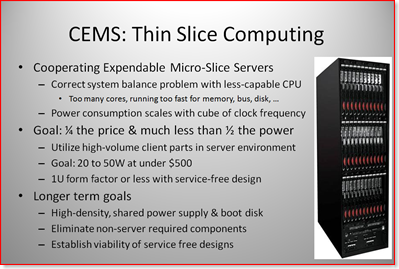
James comes to the conclusion there is a power savings of 4x. If  you are curious as to how he comes to this look at his slides.  One of his ideas that flies in the face of high density computing is Thin Slice Computing.

image

Read more

Nortel’s Energy Efficiency Calculator

Greenmonk has a post about Nortel’s Energy Efficiency Calculator.

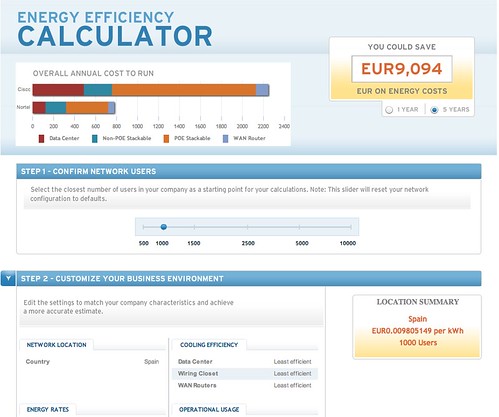
Nortel Energy Efficiency Calculator

Nortel announced the release their Energy Efficiency Calculator online last week.

The tool is available for anyone to use after a quick registration (name, email and country) and uses best guestimates to give figures for energy spend.

The data are highly customisable, you can vary country, energy costs, company setup (network, no. of employees, etc.). It outputs costs to run the network infrastructure, kWh consumed, MBTUs generated and CO2 emissions.

This is an extension of the “Cisco Energy Tax” campaign which Nortel have been running very successfully now for some time.

And, they close throwing out a challenge to Cisco

Having said that, this is a neat tool and reinforces the connection for companies between saving costs and lowering CO2 emissions.

Now Cisco, where is your rebuttal? ;-)

[Disclosure: Nortel are a GreenMonk client]

Nortel must be pleased with its Green Data Center efforts it announced at Interop.

Read more

Microsoft Research Paper on SSD Performance and Design Tradeoffs

StorageMojo has a post about Microsoft Research’s paper on Design TradeOffs of SSD.

Design Tradeoffs for SSD Performance

July 15th, 2008 by Robin Harris in Architecture, Future Tech, SSD/Flash Disk

A new Usenix paper looks at NAND flash SSD performance. From a team at Microsoft Research and the University of Wisconsin, including Ted Wobber who worked on last year’s A Design for High-Performance Flash Disks [see Flash chance for the StorageMojo take on that excellent paper - a post Ted was kind enough to review and comment on].

Design Tradeoffs for SSD Performance (by Nitin Agrawal, Vijayan Prabhakaran, Ted Wobber, John D. Davis, Mark Manasse and Rina Panigrahy) makes a deep dive in flash translation layer (FTL) issues. As the authors note, flash vendors keep their FTL designs secret, so the team developed a NAND flash simulator to look at how design choices affected performance.

What they found
They ran several workloads on their trace-based simulator, including TPC-C, Exchange and some file system benchmarks. They found several critical issues in SSD design.

  • Data placement Needed for wear leveling and load balancing.
  • Parallelism Single flash chips aren’t very fast so they need to work together.
  • Write ordering Small random writes are a killer.
  • Workload management You can optimize for sequential or random workloads, but managing both well is hard.

and as StorageMojo closes you need to read the Microsoft Research paper to get a full understanding.

The StorageMojo take
This paper is too rich in detail to summarize well. If understanding SSD controller design is important there is no substitute for a careful read.

The net is that engineers have many options in configuring and managing flash devices inside a solid state disk. The interaction of these design choices with applications is likely to remain a fruitful area of study for years to come.

Expect to see many performance oddities as new solid state disk designs are released. This is a different world than disk drives. There is much innovation and much to learn.

A macro longer-term trade-off is the extent to which SSD vendors should attempt to alter operating system behavior to better match SSDs. In the short term designers must conform to today’s disk I/O oriented operating systems. In the long term however, there must be major opportunities to tweak operating systems to enhance solid-state disk performance.

For this reason SSDs is may find their best short term market to be inside storage arrays where array vendors have complete control over the interface to the array software. This will be no small advantage as array vendors struggle to remain relevant in a world where high performance solid state disks have the potential to replace midsize arrays.

James Hamilton also has a post referring to Spansion’s Flash Memory announcement.

Read more

Western Digital Pitches Greener HD to UN

PCMag reports on Western Digital presenting at a UN conference.

Western Digital to UN: Buy More Green Hard Drives
ARTICLE DATE:  07.11.08

By  Jeremy A. Kaplan

Runaway power consumption in data centers is a well-known phenomenon, but Western Digital has a new solution: replacing the thousands of hard drives in today's data centers with new, green models. In a keynote address at the United Nations on Friday morning, Tom McDorman, vice president and general manager of Western Digital's enterprise storage solutions division, will argue that the power savings, reduced temperatures, and added capacity of the company's low-power drives is a key first step towards fixing what is clearly a broken system. The speech is part of AIT Global's ICT for Sustainable Economic, Social, and Business Development Conference (aitglobal.com), taking place yesterday and today at the UN in New York City.

Data centers consumed 1.5 percent of our nation's energy costs in 2006, according to the EPA's Data Center Report to Congress from last August, and with the increased popularity of video sharing sites like YouTube and Revver, the overall capacity of data centers is exploding. As the need for storage space grows, so does the cost of running these centers. IDC estimates that between power and cooling, 48 watts are consumed in a data center for each hard drive. Drives themselves consume a mere 12 watts. Addressing that disparity is one way to control rising costs.

Groups like The Green Grid and the Green Storage Initiative are busy developing blueprints for building new eco-friendly data centers, but McDorman has an alternate solution: retrofitting current data centers with energy-efficient hard drives. By reducing the speed of Western Digital's GreenPower disks from 7,500 or even 10,000 revolutions per minute down to 5,000, and increasing the number of sectors per track (called the linear density of the hard drive), overall power consumption is reduced—yet data is pulled off a drive at the same rate.

Western Digital has also optimized "seek times," a traditional measure of a hard drive's performance; It turns out, faster isn't always better. McDorman points out that getting to a specific point on the hard drive too early merely wastes power. By seeking more intelligently, and arriving at a point on the disk at the right time, the company is able to minimize vibration, heat, and power consumption.

Read more