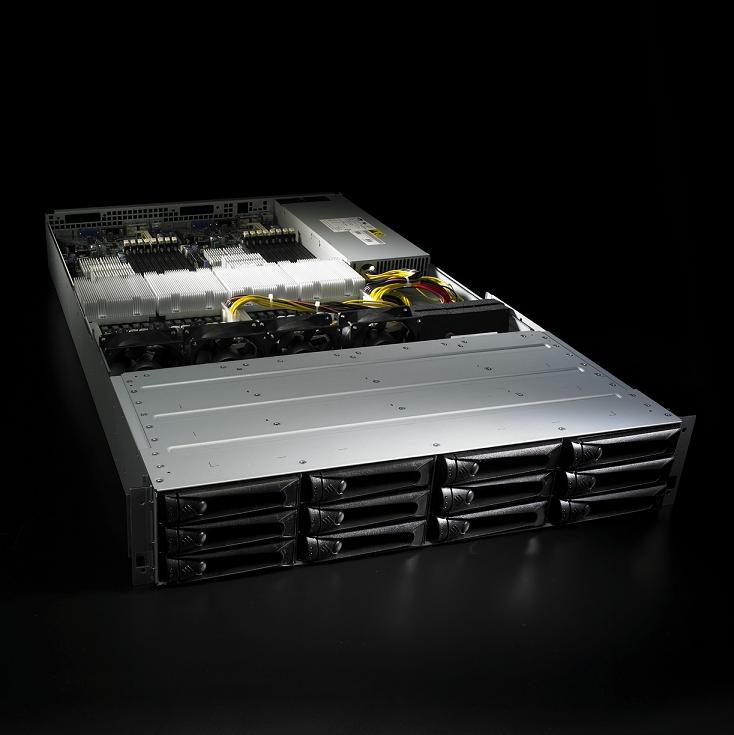
Little and Large, Extremes of Nehalem-EX vs. Via Nano, the Struggle for Power Efficiency

Just posted this blog entry with Adam Bogobowicz.

Little and Large

When you hear the phrase “green IT”, you know that the word virtualization will usually appear shortly afterwards. Virtualization provides the ability to consolidate your IT infrastructure from several physical computers (each of which has a basic power overhead) onto virtual computers running on significantly fewer host computers. The increase in power consumption for each virtual computer you run on the host is considerably less than the power overhead for each replaced physical computer.

http://www.intel.com/pressroom/archive/releases/20090526comp.htmAt this point, you can usually hear the sounds of hardware manufacturers rubbing their hands with glee. This enthusiasm results from the prevalent association that virtualization (and especially consolidation) requires multi-core processing capacity with associated power consumption rates. A good example of this type of hardware would be the recently announced Nehalem-EX processor from Intel. Everything is larger and more numerous on this chip when compared to the previous generation:

  • 8 cores
  • 9 times the memory bandwidth
  • 16 simultaneous threads
  • 24MB of cache
  • 2,300,000,000 transistors

If consolidation is the route you want to take and you have multiple physical computers to consolidate, then this processor would certainly be a good choice. But what if you see virtualization as an aid to manageability rather than consolidation and you want to conserve power?

O Fortuna

clip_image002[5]At the opposite end of the spectrum from Nehalem-EX systems is the diminutive Dell XS11-VX8, better known by its codename of “Fortuna.” If you are having trouble with the scale of this devices, that silvery part with the white label on the back of the server is the 3.5” hard disk. Yet this pocket-sized computer is no toy, but a true, enterprise-ready, 64-bit, hardware virtualization enabled, self-contained server with dual NICs and 2GB RAM that supports IPMI and iSCSI. The processor is the Via Nano, one of the most economical processors on the market with full hardware virtualization support for Hyper-V.

The post is a bit longer at http://blogs.msdn.com/the_power_of_software/archive/2009/06/08/little-and-large.aspx

Read more

Oracle and Google Netbooks Coming?

The Netbook market is one of the fastest growing IT segments.  All of these lightweight connected devices will push cloud computing use as these devices are developed for the always connected market segment.  The cel carriers are all scrambling to bundle 3G services with these devices as well.

The latest news is Larry Ellison discussing Netbooks coming from Oracle/Sun.

Ellison Mulls Foray Into Netbook Market

By BEN WORTHEN

Oracle Corp. Chief Executive Larry Ellison floated the idea that the software company might target mobile devices after its planned acquisition of Sun Microsystems Inc., including the small, low-priced computers called netbooks.

The possible focus on the netbook market was touched on in passing during a brief appearance by Mr. Ellison at Sun's annual JavaOne conference in San Francisco Tuesday. Netbooks are the fastest growing part of the personal computer business at the moment.

[oracle ellision and netbooks] Associated Press

un Chairman Scott McNealy, left, and Oracle CEO Larry Ellison at the JavaOne conference in San Francisco on Tuesday. Mr. Ellison floated the idea of targeting netbook computers after Oracle buys Sun.

"I don't see why some of those devices shouldn't come from Sun-Oracle," Mr. Ellison said.

Acer announced Q3 availability of an Google Android laptop. Part of the differentiator is the energy efficiency from the ARM chip.

"Google really does have the brand name and the financial resources to be able to be a rival to Microsoft," said Warren East, chief executive officer of chip designer ARM Holdings. "The whole Linux community is a bit fragmented when you compare it with Microsoft."

ARM, based in Cambridge, England, is a potential beneficiary of Android's success because Microsoft's Windows XP, Vista and Windows 7 don't run on ARM-based computers.

"Microsoft going forward may have to work on an ARM-based solution," said Daiwa's Huang. "If Microsoft doesn't want to see Google Android get into the PC market, they will have to support ARM; otherwise, ARM will go perfectly with Android."

Qualcomm and Freescale Semiconductor, which make chips based on ARM's technology, said they expect to release products this year for netbooks that run Google's operating system.

Google's cachet will help get the computers into retailers such as Best Buy or France's Fnac electronics chain, said Henri Richard, chief sales and marketing officer for Freescale.

"It's important to be able to convince Fnac or Best Buy to put a product on their shelf, and that's where I think Android is going to be more helpful," Richard said in an interview.

Read more

SuperMicro 6016T-GF, Dual Nehalem and Nvidia GPUs, produce 2 Teraflop Performance

SuperMicro announced their Fastest 1U Server.

Supermicro Unveils Fastest 1U Server on the Planet at
Computex Taipei 2009

2-Teraflop SuperServer 6016T-GF Series with Dual Nehalem CPUs and
Two Non-Blocking PCI-E x16 Gen 2 slots for Two Double-Width GPUs

TAIPEI, Taiwan, June 1, 2009 - Super Micro Computer, Inc. (NASDAQ: SMCI), a leader in application-optimized, high performance server solutions, is introducing the fastest 1U server on the planet this week at Computex (booth N806, Nangang Upper Exhibition Hall). As the first 1U multi-GPU (graphics processing unit) system with a fully non-blocking architecture, Supermicro’s new 2-Teraflop SuperServer 6016T-GF Series features dual Nehalem processors and two Gen2 PCI-Express x16 interfaces to support two double-width GPUs.

"Our 6016T-GF SuperServers are by far the fastest 1U servers in the world," said Charles Liang, CEO and President of Supermicro. "Featuring advancements such as multiple x16 non-blocking native Gen2 PCI-Express connectivity, highly reliable thermal optimization, and industry-leading power efficiency, Supermicro has developed the world’s first truly optimized GPU-based servers."

It is interesting to think that the Nehalem chips are support chips for the GPU computing performance.

Who is using the Nviida cuda chip? pcmag has a bit of info.

Meanwhile, the new capabilities Nvidia's CUDA offers have attracted OEM partners. In November, for example, Dell, Penguin Computing, and Nvidiateamed up to launch a "personal supercomputer" that used the Tesla architecture that also drives the SuperServer 6016. Nvidia now has Tesla solutions for the data center, the departmental cluster, and for what the company calls the "scientific desktop" or the traditional workstation.

Meanwhile, over 1.2 million users now run CUDA-accelerated high-performance-computing applications, including oil and gas giants BNP-Paribas and Petrobas, as well as scientific research sites such as the Oak Ridge National Laboratory, Cambridge University, and the Max Planck Institute.

I discussed the idea of megacomputer in this post.

Read more

XS23 II, Dell’s Opposite of XS11-VX8

I missed the post on XS23 II, the Intel Nehalem based server, the opposite end of the spectrum, a XS11-VX8 VIA based server.

Early last year, we developed a revolutionary design for the folks building hyper-scaled-out platforms. We’ve evolved that design and recently began shipping a new iteration of this system – the XS-23 II.   One of the first customers to receive this new system is Lawrence Livermore National Labs who is utilizing XS-23 II for their Hyperion project.  Ashlee Vance of the New York Times got one of the first glimpses of the system during a visit this week. 

Back to the XS-23 II, this system will support Intel’s Nehalem family of processors and we’ll also continue to offer other flavors (San Clemente, Seaburg) for specific applications. One of the other interesting things we’ve done recently in the XS-series was a two-server design where we replace two of the four system boards in the chassis with two monster graphics cards which are employed as co-processors. More on that later.

and here is the NY Times post.

Hardware peepers – my term for the iron-obsessed, geeky version of bird watchers – may take note of some of the new Dell systems used to build the machine. The computers code-named Xanadu II are the first servers Dell has shipped to a customer with Intel’s soon-to-be-released Nehalem chip.

And I’m pretty sure this marks the first sighting of a Nehalem-based server in the wild.

Nehalem, which is the code name for the chip design, is a big deal in the semiconductor world because it makes Intel even stronger against Advanced Micro Devices. The Nehalem chips bring a number of features that get Intel caught up with A.M.D. and contemporary chip designs in general.

Intel is expected to officially announce a fleet of Nehalem server chips any day now, but it looks like Dell has been moving early with the product.

Read more

XS11-VX8 Google Search, greenm3 back to #2

I’ve written 3 blog entries on the XS11-VX8.

/2009/05/xs11-vx8-dells-via-nano-server-anti-vmware-and-intel.html

/2009/05/dells-xs11-vx8-shows-momentum-for-little-green-server.html

/2009/05/dell-xs11-vx8-video-blog.html

I was disappointed when at first I went from #2 to #40, but figured oh well, the rest of the news/blogger community started putting “xs11-vx8” in their titles, so they got the traffic.

But, a few days later I am back to #2 right behind the Dell Blog.  I couldn’t exactly say why Google Search likes me, but it is pretty cool to be #2 out 11,000 search results.

clip_image002


There are now 11,000 results for a search on “xs11-vx8” in less than a week, and buzz that rivals Intel Xeon servers.

Dell and Via have got to be jumping for joy, slapping high five.

"A one-size fits all approach simply does not work for hyper-scale computing customers. The unique architecture of environments like Web hosting render unnecessary many of the system features required by mainstream IT.  By working with VIA to design a high density, lower power system, Dell is designing for these customer's specific needs, driving down costs and improving efficiency." -Forrest Norrod, vice president and general manager of Dell's Data Center Solutions division.


The XS11-VX8 server addresses the need in hyperscale environments like Web hosting, Web farms and light load infrastructures for a high density, low power and 'Ultra-Light' server product. In these applications general-purpose servers are under-utilized and inefficient, requiring expensive cooling infrastructures and using more energy than the applications require.


The VIA Nano-powered XS11-VX8 is the densest server on the market with 12 systems housed in a 2U chassis. Promising up to 34% lower TCO compared to the use of white box client systems, the XS11-VX8 is designed for single server workloads where overall power consumption needs to be less than 30 watts per system.


Read more