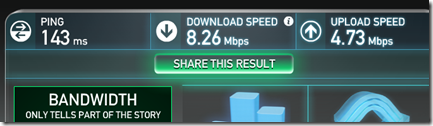
On the road with my new Verizon 4G wifi modem, on the bus 8 Mb down, 5Mb up

On April 18, Verizon finally shipped the Verzion 4G Novatel 4510L modem, and I upgraded right away from my 3G modem.  I am on a bus now riding to Seattle, then taking the light rail to the airport.  How fast is my 4G modem on a bus on the freeway?  Speedtest results.

image

Many of my travelling friends use the Verizon mifi 3G modem, so I expect them to upgrade soon. 

I don't know about you, but I am totally frustrated with free internet in hotels and conferences.  The bandwidth sucks too many times.  I've gotten as high as 12Mb down and 8 Mb up on my 4G modem.  For the monthly subscription fee, this is a no brainer.

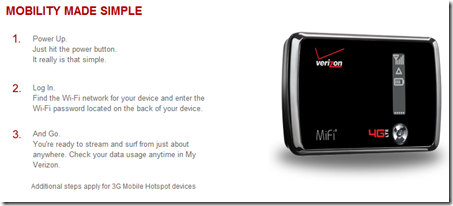
Here is the Verizon web page.  I held out for the Novatel modem, passing on the Samsung.

image

5 points amongst many others to think about if you buy from an ODM server vs. OEM

With Facebook sharing its server design and use of Quanta for its server supply.

Join Us

We worked with Alfa Tech, AMD, Delta, Intel,Power-One, Quanta and Synnex to develop of the first generation of technologies.

There are now bunches of IT purchasing departments looking to save money by buying direct and cutting out the middle man.  I’ve been laughing with my friends who have managed outsourced manufacturing projects on how naïve people are to how complex and difficult it is to buy direct from a manufacturer.  I got most of my hardware sourcing experience taking dozens and dozens trips to Japan, Korea, Taiwan, and China while I worked for Apple Computer, managing various peripheral projects for the Macintosh.  There is a huge reason why many companies have dual suppliers to manage price and quality, keeping the supplier constantly competing and knowing they will lose business if they can’t keep up.

To give you an idea of what few will hear about the Quanta Servers going to Facebook, check out this rumor of Quanta getting 20% margin on servers when their typical OEM server margin is 4%.

Order by the Facebook server Quanta: gross margin over 20%

April 18, 2011

Beijing the morning of April 18, according to informed sources, Taiwan’s contract manufacturers Quanta Facebook server to obtain orders, gross profit margin as high as 20% or more.

Reportedly, these servers will start shipping this fall, the order is Quanta gross margin is 5 times the daily orders, up to 20%.

Quanta declined to comment on.

Facebook server orders usually get HP and Dell. The Quanta favor, marking the influence of Taiwan’s contract manufacturers is growing.

At Apple we had teams who knew component cost, quality and performance issues.  They managed Bill of Materials (BOM) had HW engineering, Quality engineering, and purchasing expertise.  This is a big part of Apple’s IP that rarely gets out, and they’ve been working on outsourced manufacturing for decades.  Who would leave Apple’s HW team to go work on Amazon Kindle, HP, Barnes & Noble, etc.   I worked in the Apple purchasing group 25 years ago, and it was a blast in the Mac days. Smile

Even the Wal-mart purchasing staff don’t know how to do things at Apple’s level.  Have you ever seen a retail hit coming with a Wal-mart brand that was designed and developed by Wal-mart? 

Dell has attempted to educate some people with 5 points to consider in when choosing a server vendor.

Whitepaper: 5 points to consider when choosing a Server Vendor for Hyperscale Data Centers

Rate This

A whitepaper came out a little while ago from the management consulting firm, PRTM, that gives a perspective on the server industry.  The paper, which Dell was one of the contributors to, specifically focuses on something near and dear to our hearts, hyperscale data centers.

The paper, entitled Hyperscale Data Centers: Value of a Server Brand, talks about what organizations who are looking to build out these ginormous data centers should consider when selecting a system vendor.

But, there will be many who will dismiss this advice coming from a server OEM.

Want to know if I am right?  Watch the Server ODMs profit margins increase as many more people buy direct.

What most people don’t know is the ODMs are very clever in making it appear like they are supplying high quality just as good as the OEMs.  Cut out the middle man drop the price a bit.  But, there are many ways to cut costs which gives the ODM a 20% margin vs. 4% going through HP and Dell.  So, you think you have the game figured out and want a lower price.  And, the ODM looks for more ways to cut costs. 

Can you outsmart a huge team of Chinese engineers and business people with your one, two, maybe three people spec’ing a server?

Do you Trust your server supplier?

We’ve all seen disastrous product recalls on technology products.  Imagine 100s or 1,000s of servers being recalled.

For example, the unsexy capacitor has caused millions of dollars of damage.

Faulty capacitors have been discovered in motherboards as old as Socket 7 and have affected equipment manufactured up to at least 2007. The motherboard companies assembled and sold boards with faulty caps sourced from other manufacturers (see below). Major vendors such as Intel, Dell and HP were affected.[2] Circa 2005 Dell spent some US $150 million replacing motherboards entirely and another $150 million on the logistics of determining whether a system is in need of replacement. HP reportedly purged its product line in 2004. The motherboards and power supplies in Apple iMac G5s[3] and some eMacs[4] were also affected.

Welcome to the world of managing a ODM.  Late night regular phone calls to Asia, last minute war room meetings to address quality or supply issues.  Making the decision after weeks of phone calls, faxe’s, and e-mails, you need to get on a plane to China to resolve the issues.

Oh one other thing, at Apple it was worthwhile to do all this because the volumes were in 100,000s per month.  Only the server OEMs buy in this quantity.  As soon as you drop to 10,000 per month or less, you lose a lot of leverage with the ODM and you don’t have the benefit of large volumes to spread out your support costs.
HP targets large data center workloads with future server design, think Google, Facebook, Microsoft, Yahoo, Amazon

This is month old news, but I missed it so I figured many of you did too.

HP's corporate blog has a post on future server design for where data centers are going for the big guys.

HP nanotechnology research looks to sustain HP server market leadership for the long run

by ETHAN BAULEY (Ethan_Bauley) a month ago - last edited a month ago

(Update: read the 2/28/11 The New York Times story "Remapping Computer Circuitry to Avert Impending Bottlenecks" for more on this subject)

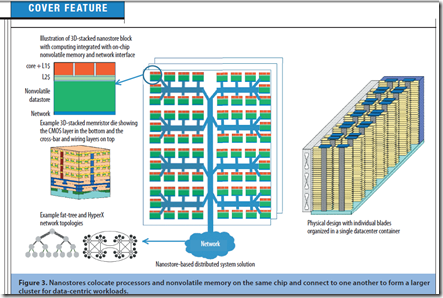
“What will future computer systems look like?” asks HP Labs distinguished technologistParthasarathy Ranganathan in a cover story for Computer magazine, the flagship publication of the IEEE Computer Society.

In his article [PDF], Ranganathan suggests computer science is at what he calls an ‘inflection point,’ one that will provoke a radical rethink of traditional computer system design.

In the PDF, there are mentions of the big guys in data centers  - Google, Microsoft, Facebook, Yahoo, and Amazon.

image

Recent data-centric workloads have been characterized by
numerous commercially deployed innovations in the software
stack—for example, Google’s BigTable and MapReduce, Amazon’s
Dynamo, Yahoo’s PNUTS, Microsoft’s Dryad, Facebook’s Memcached,
and LinkedIn’s Voldemort. Indeed, according to a recent
presentation, the software stack behind the very successful Google
search engine was significantly rearchitected four times in the past
seven years to achieve better performance at increased
scale.
The growing importance of this class of workloads,
their focus on large-scale distributed systems with
ever-increasing memory use, the potential inadequacy
of existing architectural approaches, and the
relative openness to software-level innovations in the
emerging workloads offer an opportunity for a corresponding
clean-slate architecture design targeted at
data-centric computing.

The HP server designed was covered in the NYTimes.

Remapping Computer Circuitry to Avert Impending Bottlenecks

By JOHN MARKOFF

PALO ALTO, Calif. — Hewlett-Packard researchers have proposed a fundamental rethinking of the modern computer for the coming era of nanoelectronics — a marriage of memory and computing power that could drastically limit the energy used by computers.

Enlarge This Image

Noah Berger for The New York Times

BIG NEW IDEA Parthasarathy Ranganathan and his prototype of a data center.

Today the microprocessor is in the center of the computing universe, and information is moved, at heavy energy cost, first to be used in computation and then stored. The new approach would be to marry processing to memory to cut down transportation of data and reduce energy use.

Note the last mention of "reduce energy use."  Green data center ideas are no longer as rare as they used to be.

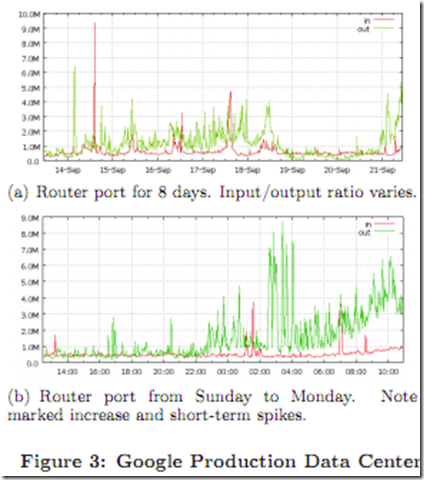
Green The Data Center Network with OpenFlow, ElastricTree Demonstration using Google data

OpenFlow is going to change data centers as it redefines the network.  Look at the company Nicira that was started by the professors who defined OpenFlow.

image

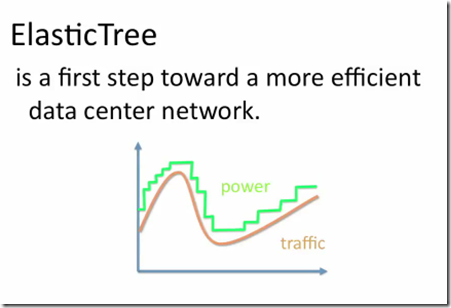
One of the demonstrations of OpenFlow is ElasticTree which can be used for lower energy use in the data center.

image

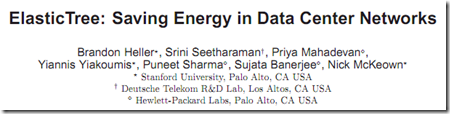
The ElasticTree paper is here.

image

The authors had access to data from Google.

image

It looks like this team had access to Google data centers back in 2008.

Traffic in a Realistic Data Center
In order to evaluate energy savings with a real
data center workload, we collected system and network
traces from a production data center hosting an
e-commerce application (Trace 1, §1). The servers
in the data center are organized in a tiered model as
application servers, file servers and database servers.
The System Activity Reporter (sar) toolkit available
on Linux obtains CPU, memory and network statistics,
including the number of bytes transmitted and
received from 292 servers. Our traces contain statistics
averaged over a 10-minute interval and span 5
days in April 2008.

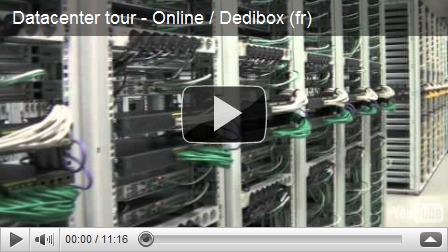
French Data Center Tour with Dell Servers, 14,000 views

I was reading Barton George’s blog and he pointed to a YouTube video tour of online.net.

DCS Microserver allows French hoster to enter new market (and grab big market share)

Rate This

Online.net, owned by the Iliad group, is the second largest hoster in the French market.  The company had traditionally been focused on the higher end of the dedicated hosting market with services starting at 29.99 euro/month and predominantly based on Dell’s rack mounted servers.  About three years ago they began exploring the possibility of providing a lighter weight entry-level offering targeted at SMBs.

Online engaged Dell’s Data Center Solutions (DCS) group and the two teams began brainstorming around system designs to meet the needs of this new segment.  The design that DCS came up with was the Via processor-based microserver the Dell X511-VX8, code name“Fortuna” (please note I had nothing to do with the official naming of this product:) ). The system handles one OS and app per server, has one 1 CPU per server and features 12 servers per chassis.
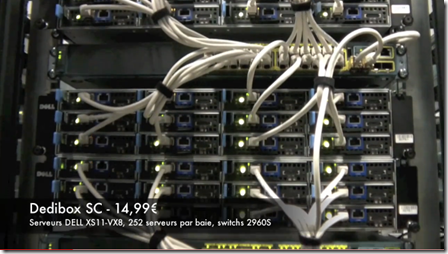
Online.net's "START" line of offerings, beginning with the microserver enabled, Dedibox SC.

The video has 14,0000 views in a month.

Here is one of the money shot for Dell and there a bunch others in the video.

image

The text is all in French, but it still is one of the more interesting data center videos as it shows the whole data center including servers(Dell), networking (Cisco), and storage (NetApp).