Michael Dell has fun commenting on HP's decision to abandon PC business

HP's decision to get out of the PC business has Wall Street voting with a 20% reduction in stock value.

Which leaves an opening for Michael Dell to make some comments on Twitter.


Michael Dell
Michael Dell
Michael Dell


HP discusses PC spinoff

WSJ reports on HP’s reported spinoff of the PC division.

Associated Press

As if that weren’t enough, the world’s biggest computer maker also announced fiscal third-quarter earnings and lowered its financial targets for the rest of the year. H-P reported preliminary earnings of 93 cents a share on revenue of $31.2 billion, compared with a profit of 75 cents a share and $30.7 billion in revenue a year earlier.

In a release, the company said it was exploring a spinoff of its PC business as part of a plan to put an “emphasis on enterprise, commercial and government markets.” Expect plenty of questions from Wall Street analysts on that issue in H-P’s earnings conference call, which is set to begin at 5 p.m. Eastern. Digits will be there to live blog.

Bloomberg also reports.

HP Said to Plan Autonomy Purchase, PC Spinoff

Aug. 18 (Bloomberg) -- Hewlett-Packard Co., the world’s largest computer maker, is in talks to buy Autonomy Corp. for about $10 billion and plans to spin off its personal-computer business, people with direct knowledge of the matter said. Autonomy confirmed it is in talks with Hewlett-Packard in a statement. Cory Johnson reports on Bloomberg Television's "Fast Forward." (Source: Bloomberg)

Is Foxconn using Robotics as its manufacturing push out of China?

Reuters has an article on Foxconn's plans for the use of robotics.

Foxconn to rely more on robots; could use 1 million in 3 years

Employees work inside a Foxconn factory in the township of Longhua in the southern Guangdong province in this May 26, 2010 file photo. REUTERS/Bobby Yip/Files

By Lee Chyen Yee and Clare Jim

HONG KONG/TAIPEI | Mon Aug 1, 2011 8:48am EDT

(Reuters) - Taiwan's Foxconn Technology Group, known for assembling Apple's iPhones and iPads inChina, plans to use more robots, with one report saying the company will use one million of them in the next three years, to cope with rising labor costs.

Foxconn's move highlights an increasing trend toward automation among Chinese companies as labor issues such as high-profile strikes and workers' suicides plague firms in sectors from autos to technology.

The one thing that caught my eye is Foxconn buying plants overseas.

Foxconn plans to buy a set-top plant in Mexico from Cisco Systems and is looking into investing more in Brazil, where it is already making mobile phone handsets.

It has bought LCD TV plants from Japan's Sony Corp in Mexico in 2009 and Slovakia in 2010 and is in cooperation talks with a number of top Japanese hi-tech firms, including Sharp, Canon and Hitachi.

Could server manufacturing be moving out of China as well in the future?

That's one way to solve the 100%+ tax for importing servers into Brazil.

Server Secret is getting out, on-chip Networking is more efficient, Facebook publishes Tilera 3X performance per watt vs. Xeon

There is a bunch of news on Facebook publishing results on the Tilera Server.

Facebook study shows Tilera processors are four times more energy efficient

Facebook sides with Tilera in the server architecture debate

Facebook: Tilera chips more energy efficient than x86

What I found as most useful is the PDF of the paper that Facebook published.

Many-Core Key-Value Store
Mateusz Berezecki
Facebook
mateuszb@fb.com
Eitan Frachtenberg
Facebook
etc@fb.com
Mike Paleczny
Facebook
mpal@fb.com
Kenneth Steele
Tilera
ken@tilera.com

We show that the throughput, response time, and power
consumption of a high-core-count processor operating at a low
clock rate and very low power consumption can perform well
when compared to a platform using faster but fewer commodity
cores. Specific measurements are made for a key-value store,
Memcached, using a variety of systems based on three different
processors: the 4-core Intel Xeon L5520, 8-core AMD Opteron
6128 HE, and 64-core Tilera TILEPro64.

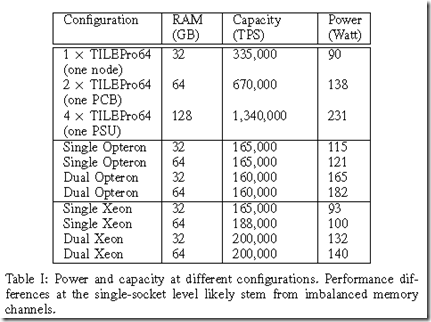
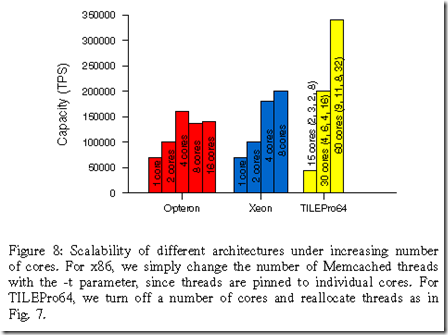
Here is the comparison of the Tilera, AMD, and Intel.
image

image

Here is a good tip and reason to think about more than 64 GB of RAM per server for memcache services.

As a comparison basis, we could populate the x86-based
servers with many more DIMMs (up to a theoretical 384GB
in the Opteron’s case, or twice that if using 16GB DIMMs).
But there are two operational limitations that render this
choice impractical. First, the throughput requirement of the
server grows with the amount of data and can easily exceed
the processor or network interface capacity in a single
commodity server. Second, placing this much data in a single
server is risky: all servers fail eventually, and rebuilding the
KV store for so much data, key by key, is prohibitively
slow. So in practice, we rarely place much more than 64GB
of table data in a single failure domain. (In the S2Q case,
CPUs, RAM, BMC, and NICs are independent at the 32GB
level; motherboard are independent and hot-swappable at the
64GB level; and only the PSU is shared among 128GB worth
of data.)

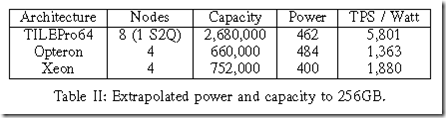
But, if you want to go beyond 64 GB, here are some numbers for a 256 GB RAM configuration.
image

And Conclusions.

Our experiments show that a tuned version of
Memcached on the 64-core Tilera TILEPro64 can yield at
least 67% higher throughput than low-power x86 servers at
comparable latency. When taking power and node integration
into account as well, a TILEPro64-based S2Q server
with 8 processors handles at least three times as many
transactions per second per Watt as the x86-based servers
with the same memory footprint.

With the server secret of on-chip networking discussed.

The main reasons for this performance are the elimination
or parallelization of serializing bottlenecks using the on-chip
network; and the allocation of different cores to different
functions such as kernel networking stack and application
modules. This technique can be very useful across architectures,
particularly as the number of cores increases. In
our study, the TILEPro64 exhibits near-linear throughput
scaling with the number of cores, up to 48 UDP cores.

Intel joins the Networking Industry, buys Fulcrum Microsystems for 10/40 Gbe chips

Intel has a press release announcing its acquisition of Fulcrum Microsystems.

FocalPointFulcrum Microsystems

“Intel is transforming from a leading server technology company to a comprehensive data center provider that offers computing, storage and networking building blocks,” said Kirk Skaugen, Intel vice president and general manager, Data Center Group. “Fulcrum Microsystems’ switch silicon, already recognized for high performance and low latency, complements Intel’s leading processors and Ethernet controllers, and will deliver our customers new levels of performance and energy efficiency while improving their economics of cloud service delivery.”

10 Gigabit Ethernet (10GbE) networks are one of the fastest-growing market segments in the data center today. As demand for data continues to increase, there is a growing need for high-performance, low-latency network switches to support evolving cloud architectures and the growth of converged networks in the enterprise. Fulcrum Microsystems designs integrated, standards-based 10GbE and 40 Gigabit Ethernet (40GbE) switch silicon that have low latency and workload balancing capabilities while helping provide superior network speeds.

What is part of Intel's motivation?

Cloud computing is driving the convergence of server, storage and network technologies and solutions based around Intel® Xeon® processor solutions.

A future with Intel Xeon's at the center, and Intel setting the performance standard for the converged infrastructure - server, storage and network.

Here is a post by Rob Enderle on what he observed.

A few years ago, I attended an Intel Labs presentation and one of the more interesting segments was on a technology it was quietly developing for large network switches. Intel argued that it could do to the very expensive and high-margin switch business what it did to UNIX servers over the last two decades to cut costs dramatically.

Apparently, Intel has now started executing on that strategy with the acquisition of Fulcrum Microsystems, a fabless semiconductor and related software vendor, targeting low-cost, high-performance, high-end switches.

This will be good news for HP, but bad news for Cisco. Let me explain.