Here is an interview Lewis Curtis conducted of Mike Manos at TechEd on Microsoft’s data center efforts.

Your Custom Text Here
There is tons of news out there on Micosoft’s Kevin Johnson failed leadership to acquire Yahoo. http://news.google.com/news?hl=en&ned=us&q=kevin+johnson
The Mini Microsoft guys provide an insider view.
I'm really surprised. There was Mr. Johnson up on stage this morning during the Town Hall causing me to roll my eyes with his fake enthusiasm and now he's leaving Dodge. On the horse he rode in on 16 years back. I know he did a lot to pick up the pieces after the Vista-debacle and is probably due a good amount of praise for letting Win7 align itself to be on the winning trajectory, but I just never bonded with Mr. Johnson's leadership. And some of the projects he's interested in and driving just leave me cold (e.g., the upcoming MSN UI revamp. It puts the F in WTF).
Is he taking the opportunity to be CEO of Juniper? Is he the fall guy for Yahoo! being such a bumbling mess? Is his departure meant to make way for a big acquisition / merger?
As we consider the long race to succeed Ballmer, I was certainly worried that Mr. Johnson was at the top of the stack rank. No reason to worry anymore! And three of my favorite technical leaders, Mr. Sinofsky, Mr. DeVaan, and Mr. Veghte, all move up a notch. Hey, one less layer in the company. Throw all three of them in the running, eh?
Bottom Line: Kevin Johnson was given a task to grow the Microsoft Search business. He led the Yahoo efforts. The whole Yahoo efforts are an embarrassment to Microsoft. Kevin you failed the test, let somebody else give it a try. Next are Sinofsky, DeVann, and Veghte. Who will succeed Ballmer?
ComputerWorld covers VMware’s new president, Paul Maritz, conference call to financial analysts.
VMware's new CEO says he knows Microsoft and can defeat it
Paul Maritz, a former top MS exec, says he is ready to take the big dog on
July 22, 2008 (Computerworld) VMware Inc.'s new CEO and president, Paul Maritz, took aim at his chief rival today -- Microsoft Corp. -- and told financial analysts that he knows how to beat that company, and that includes giving products away.
"The key when it comes to Microsoft is to neither rest on your laurels, nor get mesmerized," Maritz said.
Another key strategy in beating Microsoft, apparently, is to play offense. And that's what Maritz did on Tuesday, announcing during a conference call with financial analysts his intention to start giving away VMware's ESXi server. That software is roughly equivalent to Microsoft's just released Hyper-V virtualization server, which lists for $28 per server.
VMware will "take the price on that product to zero" in its next update, said Maritz. ESXi had listed for $495 but is offered for much lower prices by third-party server vendors that include the product in their own wares. VMware officials said after the call that the new release would be out in about a week.
As I mentioned in my own post on July 8, Paul Maritz is a force Microsoft will reckon with and he knows how to compete.
Paul was one of the best Microsoft VPs I enjoyed working with, and I believe he'll be able to take VMware to a new possibility of cloud computing and virtualization.
The ComputerWorld article continues.
The contrast between Maritz and recently ousted VMware co-founder and CEO Diane Greene was interesting, and it quite possibly gives a sense of the company's strategy going forward.
Greene rarely said anything publicly that could be interpreted as confrontational with Microsoft, even though she knew that the software giant was taking direct aim at her company. VMware, particularly in its earlier years, wanted a strong relationship with Microsoft as it built its x86 virtualization platform, and so Greene would often position her company as a partner of sorts.
That era of niceness may be ending with Maritz.
Maritz today made a point of telling analysts on the call something they no doubt already knew -- that he is a former Microsoft employee. "I know that Microsoft is a formidable but not invincible competitor," he said.
And Maritz knows firsthand just how powerful Microsoft can be. Microsoft, thanks to its free browser and operating system market strength, crushed Netscape; Maritz was one of the leading Microsoft executives to testify for the company in that antitrust battle with the U.S. government 10 years ago. The question is whether that deep knowledge will give Maritz the competitive edge he will likely need to keep Microsoft from repeating history.
"I know that Microsoft can afford to play a long waiting game, but I also know from firsthand experience that where a competitor has a lead and that a competitor invests and innovates to stay ahead ... they can be very hard to catch, even for Microsoft," said Maritz.
One of the things that Microsoft made the biggest mistake was not coming up with the money to buy VMware. Microsoft went cheap and bought Connectix, the #2 player in virtualization, instead of VMware which was a lot more expensive. Microsoft has given the opportunity to EMC, and EMC’s management was smart pushing out co-founder Diane Greene.
I wonder if EMC bought Paul Maritz’s company with the full intention to put him in charge of VMware. What do you think?
Michael Manos, GM of Microsoft's Data Center Construction and Operation, and Lewis Curtis, Infrastructure Architect will be presenting for the 3rd time at Microsoft's TechReady event, an internal presentation for Technical Field staff.
TechReady is a bi-annual, 5-day internal technical conference for Microsoft employees. Microsoft employees from all of the international subsidiaries, as well as American employees are presented to by the product groups about all the upcoming releases for the year, and receive training on all of the currently released Microsoft products[1]. The senior executives will also often present at TechReady, outlining their visions for the future, and taking questions from employees.
TechReady is made up of many separate 'sessions' - from general briefings suitable for all audiences to in-depth 'breakout sessions' for a deep look at a specific product, or part thereof.
For those Microsoft people coming to town for the event, the session is ARC204, Thurs, July 31, 4:15-5:30, Environmental Sustainability Architecture Update.
· Sustainable Intelligence: example is SCRY
· Sustainable Online Services: example is Live / GFS
· Sustainable Optimization: example is products like Windows 2008 power mgmt/.Net optimization as well as datacenter optimization best practices from GFS, etc…
· Sustainable Consolidation: example is Windows Server 2008 Virtualization, IIS7, hardware design consolidation, SQL Server 2008, etc…
Maybe I'll be able to catch Lewis and Mike after the event for some comments.
Microsoft hosted a panel discussion at TechEd 2008 in Orlando. The panel was moderated by George Cerbone with Mike Manos, Lewis Curtis, Beth Humphreys from Microsoft. Additional panel members are Kathy Malone and David Platt.
The video is here. Don’t hesitate to just hit play, and listen to the audio while you are surfing the web. It has some good perspectives.
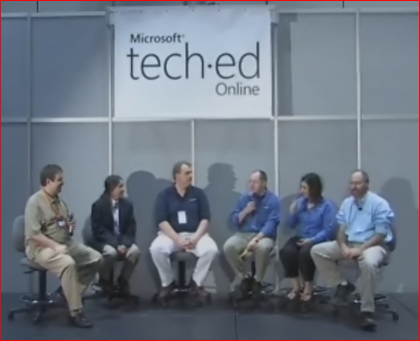
Lewis Curtis presented first his past experiences over the last year working on Green IT at Microsoft.
Mike Manos presented why going Green is a business responsibility to save energy and has monetary savings.
Beth Humphreys shares her experiences in customer engagements discussing Green IT.
Kathy Malone talks about her efforts to build compliance systems and a green IT developer community.
David Platt, a recognized .NET developer expert, explains why developers are not creating green applications. His view is green should be an OS function, and developers don’t have enough time for this.
Mike Manos brings up a good rebuttal that once Microsoft changed to an energy based chargeback system, the business units started to understand the impact of their SW on their energy bill, and have chosen energy efficiency vs. a focus on only performance.
David Platt continues to make the point developer costs and power is negligible, repeating his point that the energy efficiency is the responsibility of the OS, and none of the effort should be taken on by the developer.
The good thing is the rest of the panel think David Platt is wrong.
Kathy Malone makes excellent points on compliance systems.
This video gives you an idea of some of the people in Microsoft who are driving the Green Data Center efforts to the software developer community.
I am glad I caught Lewis’s post.