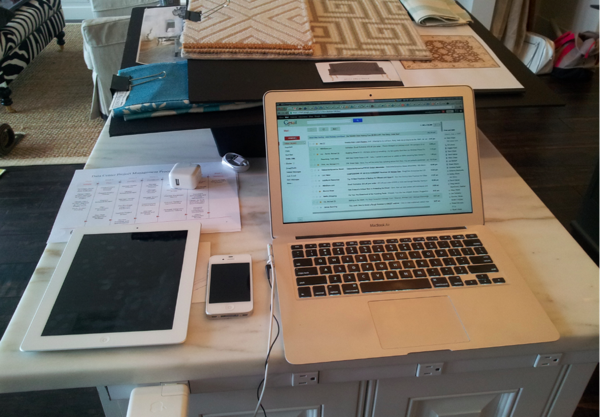
Below to the left is my new 64GB wifi iPad next to my iPhone 4S and MacBook Air. It's been about 6 years since I left Microsoft and it is now 20 years since I left Apple. I use Parallels and Windows 7 on the Mac when i need to run Quickbooks or other Windows apps. But, I am amazed at how much I just stay on OSX.
When I was in Austin with other data center people attending SXSW, we all had Macs.
I am getting back into Apple thinking, not to use Apple products, but it reminds me of how we did things at Apple. Microsoft was great too, but many things were based on iterating on past products. Not creating something brand new.
After 5+ yrs blogging on green data centers, I've figured out a lot of things, and it is time to help some of my friend do things differently. A lot of what I have been studying lately are checklists, habits, workflow, and bouncing lots of ideas off of my friends. There is no market data that supports the ideas, but that's OK. One of the things we learned at Apple is marketing data is useful for looking at the past, but not useful for creating the future.
Off to LV for a day to see more friends. I think I'll use my new iPad to review some of the drawings and diagrams, and leave the MacBook Air at home.
One of the best presentations at SXSW Interactive was Geoloqi's Amber Case.
Cybernetic anthropologist Amber Case spoke to a full house at SXSW this week, in one of the more thought-provoking sessions that I attended. She started off by declaring, "Every time you use that mobile phone of yours, you have a symbiotic relationship with it: you are a cyborg." Perhaps one of the most interesting points that she made was that current mobility interfaces take way too much of our time.
How cutting edge geolocation can change everything
Q&A At South by Southwest, Geoloqi CEO Amber Case spoke to CNET about the state of the art in geolocation, augmented reality, and heads-up displays.
Geoloqi CEO Amber Case speaking during her keynote address today at SXSW.
(Credit: CNET,James Martin)
AUSTIN, Texas--These days, smartphones seem like they're everywhere. And with their wide array of built-in sensors, those devices--iPhone, Androids, Windows Phones, and others--can provide us with more and more data about where we are and what's around us than ever before.
Amber's presentation was on Sunday afternoon which is when we were hosting a BBQ for a data center crowd, but luckily I had started interacting with Amber last year and visiting Geoloqi is on my list of 5 companies to touch base when I am next in Portland.
Geoloqi Extends its Reach to 350 Million Mobile Devices, 1.6 Million Mobile Developers, and a Database of 60 Million Places Globally, Giving Carriers and OEMs a Location-Based Platform Like Never Before
Austin, TX (SXSW Interactive) – March 11, 2012 – Geoloqi, a powerful platform for next-generation location-based services, today announced strategic new partnerships with Appcelerator, a leading cross-platform mobile development platform; Factual, a large-scale data aggregation platform with a Global Places API; and Locaid, the world’s largest carrier location platform. Through these partnerships, Geoloqi is significantly enhancing its location data and analytics offering while expanding its reach to millions of new developers and end users through Locaid and Appcelerators’ customer bases.
Geoloqi has a press release corresponding to Amber's keynote.
Why spend so much time thinking about location services? Because there is a huge opportunity to revolutionize industries when you think the way Amber presents. One of Amber's concepts in geofencing which could be viewed as a different way to do what an RFID solution would.
Let's use that example of a supermarket. With the accuracy of an iPhone's GPS, how far outside the boundaries of the store would you have to set the geofence? Case: You could set it and encompass the parking lot and you'd be able to trigger it quite well. We've taken the native, significant location updates and how iPhone and Android handled that, and amped it up and said, well, if you had your GPS running and sending up data to the server every five seconds, your phone would run out of battery. But if you figure out how to intelligently handle it, like if I get to a new area and there are geofences here, then turn on the GPS, or just slowly monitor in the background. Then it's able to converse battery plus get the resolution when it's necessary. We saw that this was a big pain in the industry. When we released a sample app, carriers and enterprises and governments and developers started showing up and saying, This has been a big pain for us, what a relief that somebody else is trying to solve this problem.
Can you explain a little more about geotriggers? Case: They're called geotriggers or geonotes. Geonotes are just text you leave inside a geofence, but a geotriger can trigger anything in life, so lights to turn on in your house, or you can do a lot of machine to machine communication.
Part of what Amber and I had discussed is the opportunities to apply some of her concepts in enterprise scenarios. I missed out being in standing room only keynote of 3200 people, but sitting down in a conference room in Portland is much more useful.
BTW, I did find Amber Case when I was looking up last year who was presenting at SXSW. When I saw her company is in Portland, I reached out to one of my friends who pretty much knows all the start-ups there and asked for an introduction. Why wait to talk to a though leader when you can connect other ways. Conferences are useful, but it can hard to connect with the popular people.
Ericsson has launched a Data Center Service leveraging its mobile network.
Ericsson launches Data Center Build and Optimization offering
February 26, 2012, 14:09 (CET) Download:
Ericsson enters the market for data centers, enables telecom operators to offer cloud services for their enterprise customers
Operators ideally positioned to offer high quality, high security and high availability cloud services to enterprises
With an optimized cloud strategy, a telco enterprise customer can lower its IT operating expenditure
Ericsson is reaching out its installed base.
Paolo Colella, Head of Consulting and Systems Integration at Ericsson, says: "Operators are ideally positioned to offer high quality, high security and high availability cloud services to enterprises. We bring telecom-grade thinking to the cloud space, focusing both on availability and security of the services, as well as cost and efficiency gains for enterprise customers. And, in addition, cloud services bring new business opportunities for the telecom operators.
Ericsson joins OpenStack, demonstrates unique virtual data center manager
February 28, 2012, 10:00 (CET) Download:
Ericsson to demonstrate cloud-management solution based on OpenStack's open-source components
Virtual data center manager supports multi-tenant distributed clouds and integrates elastic networking over wide area networks
Automated deployment driven by a service-level agreement drastically reduces costs and time to market
As part of the recently announced Network-enabled Cloud concept, Ericsson (NASDAQ: ERIC) has joined the OpenStack project, an open-source community dedicated to creating cloud software that has achieved strong industrial momentum. Ericsson will contribute to further developing OpenStack to support carrier-grade services and applications. OpenStack provides a flexible alternative cloud management solution that is based on open-source components.
If you didn't think Mobile and the Cloud had much to do with each other, Ericsson may change your mind.
A customer who filed a complaint against AT&T after having his wireless data speeds throttled has come out the victor.
One of the points made is ATT is looking to appeal
The victory could be short-lived for Spaccarelli, the AP said. AT&T spokesman Marty Richter told the outlet the company was "evaluating" the possibility of an appeal.
Some have said ATT has a case because no where in the contract does it say it cannot throttle the unlimited data plan.
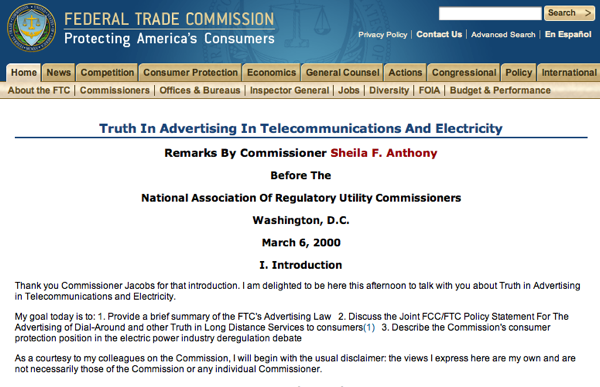
But, maybe the FCC and FTC can come to the rescue of consumers. How? Remember those overhyped long distance plans, that had restrictions in contracts that were not mentioned in the ads? The FTC and FCC did something about that and created the "Truth in Advertising in Telecommunications and Electricity" dated Mar 2000.
Here are some parts that should get you and ATT thinking. Maybe the rest of the mobile carriers and even Comcast's Internet throttling over 250 GB should consider this as well.
The FTC's of truth-in-advertising law that has been developed through Section 5 of the FTC Act, which prohibits "unfair or deceptive acts or practices," provides helpful guidance to long distance carriers.
...
A. General Concepts of Advertising Law
Today, I will describe how the concepts of advertising law apply to the advertising of telecommunications services and electricity. In general, Commission law requires that advertising be truthful, fair, and substantiated.
Each of these concepts is detailed in formal policy statements adopted by the Commission or addressed by statute. A deceptive act is one that contains a misrepresentation or omission that is likely to mislead and be detrimental to consumers who are acting reasonably under the circumstances.(2) An unfair act or practice is one which causes or is likely to cause substantial consumer injury, not reasonably avoidable by consumers themselves, and not outweighed by countervailing benefits.(3) Although the Commission challenges conduct that is unfair, the majority of our actions in the advertising area target deceptive ads.
ATT claimed unlimited data plan.
In all advertising cases, the Commission must determine exactly what claims are made, and whether there is substantiation to support those claims. We look at both express and implied claims. Express claims are claims that unequivocally state the representations. For example, an ad which says: "long distance services to 100 countries" makes an express claim. Implied claims are anything else and range on a continuum from language that is virtually express to language that literally says one thing but strongly suggests something else. For example, an ad which says: " 7 cents a minute" may make an implied claim that there is no minimum charge for each call. In determining the claims that an ad conveys, the Commission examines "the entire mosaic, rather than each tile separately."(5)
Advertisers must make truthful claims and substantiate all objective claims. These rules of the road, of course, apply both to advertisers using traditional media and those who market their products and services on the Internet, telephone, e-mail or through any other media.
Was throttling omitted from ads and should have been disclosed in advertisement?
B. Deception by Omission
Ads can be deceptive because of what they do not say. Let me give you a few examples. If an ad omits material information, an ad can be deceptive even if everything else in the ad is truthful. This is called deception by omission. An ad will be deceptive if it fails to disclose qualifying information that, in light of the representations made, would be necessary to prevent consumers from being misled. We determine whether material information has been omitted by examining a typical buyer's expectation and understanding of the advertiser's claims.
In the Dial Around context, if an ad represents that all calls are 10 cents a minute, but fails to disclose that all calls are subject to a 50 cent minimum charge, the ad would likely be deceptive. A reasonable consumer would likely conclude that a one minute call would be 10 cents, not 50 cents. The same would be true if an ad made specific per minute price claims but failed to disclose that there was a mandatory monthly fee.
C. Material Limitations on Service should be disclosed
Advertisers for Dial-Around and other long distance services must take special care to make certain that material limitations on services are disclosed in the ads. Given the importance of price information, any significant conditions or limitations on the availability of the advertised rates should also be disclosed clearly and conspicuously. I will talk more in a moment about what makes a disclosure clear and conspicuous. But, clear and conspicuous disclosures are important in advertising law generally, and they have special meaning in the Dial-Around context because ads are the primary source of price information for consumers.
Let me give you some examples of situations where disclosures should be used to avoid deception. If an ad features the phrase "10 cents a minute" and that rate is available only during certain times of the day, the failure to clearly and conspicuously disclose the restriction would be deceptive. Likewise, if there are significant geographic restrictions, that fact should also be disclosed. Additionally, terms such as "Basic Rate" should be used only if the meaning of that term is clear to consumers.
An ad cannot refer to a toll-free number or a website to make disclosures that should be made in an ad. While advertisers are encouraged to use customer service numbers and websites to offer consumers more information, these sources cannot cure misleading claims in the ad itself.
When you signed up for ATT's unlimited data plan did you feel like you knew 1.5 - 2GB was the cut off?
In simple terms, disclosures should be presented so that consumers actually see them and understand them. That means disclosures should be clear, prominent, and in close proximity to the claim being modified. There should be no distracting visual or audio elements surrounding the disclosures. Also, legalistic disclosures or those buried in fine print will not be effective. The FTC has a lot of experience with disclosures in a variety of contexts. We enforce certain statutes and regulations that are very specific as to how and when disclosures should be made.
You would think that some of the same people who worked on this FCC/FTC truth in advertising act are still around and they are watching ATT. Remember those old Bell System commercials?
I spent much of my career working at HP on computers, Apple on computers and OS, and Windows on OS with Windows XP the last OS. Now I spend more time thinking about data centers, cloud, and mobile.
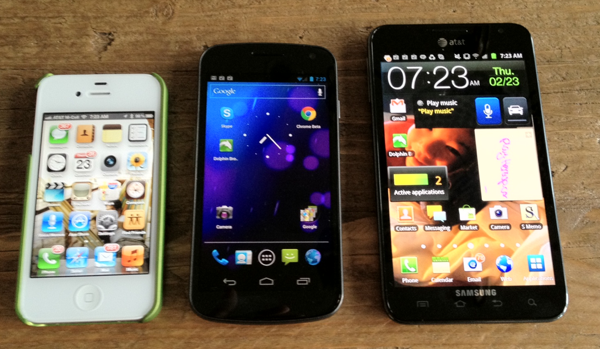
How much am I working on Mobile? I have three phones - AT&T iPhone 4S, Verizon Galaxy Nexus, AT&T Galaxy Note
As much as the PC is powerful, it is interesting what you develop when you make a mobile device your primary device with cloud infrastructure.
The above smartphones have dual core ARM processors, 32 GB of storage, 5-8 megapixel back, and 2-3megapixel front cameras. Each of the above have some advantages over the other. This is not about arguing what is best for an individual, but what works best for a usage scenario.
It is amazing how the kids want to play on these devices, and never ask to use my laptop.

Quisque iaculis facilisis lacinia. Mauris euismod pellentesque tellus sit amet mollis.