An example of what is behind the belief High Speed Rail is good for the world

Yesterday I wrote a post on the topic of whether Obama's High Speed Rail was on the ropes and it would be better to put the money into high speed internet connectivity.

With Obama's train initiative on the rope, why don't they take the money and build Internet Infrastructure instead of rail lines

MSNBC.com has an article on the dire straights of Obama's high speed rail line.

Is Obama's rail initiative a 'train to nowhere'?

High-speed train plan draws little enthusiasm as California costs soar

One the points I made was the reason high speed rail was popular is because of lobbyists.  An example of the response due to the negative PR is this Research ;-) from Worldwatch Institute.

Global Expansion of High-Speed Rail Gains Steam

Washington, D.C.----As interest in high-speed rail (HSR) surges around the world, the number of countries running these trains is expected to nearly double over the next few years, according to new research by the Worldwatch Institute for Vital Signs Online. By 2014, high-speed trains will be operating in nearly 24 countries, including China, France, Italy, Japan, Spain, and the United States, up from only 14 countries today. The increase in HSR is due largely to its reliability and ability to cover vast geographic distances in a short time, to investments aimed at connecting once-isolated regions, and to the diminishing appeal of air travel, which is becoming more cumbersome because of security concerns.

"The rise in HSR has been very rapid," said Worldwatch Senior Researcher Michael Renner, who conducted the research. "In just three years, between January 2008 and January 2011, the operational fleet grew from 1,737 high-speed trainsets worldwide to 2,517. Two-thirds of this fleet is found in just five countries: France, China, Japan, Germany, and Spain. By 2014, the global fleet is expected to total more than 3,700 units."

Is the alternative to cars and planes a train?  Or traveling through a virtual presence?  What is the carbon footprint for grams of carbon dioxide per passenger-kilometer for a WebEX on Skype meeting?

Not only is HSR reliable, but it also can be more friendly than cars or airplanes. A 2006 comparison of greenhouse gas emissions by travel mode, released by the Center for Neighborhood Technologies, found that HSR lines in Europe and Japan released 30-70 grams of carbon dioxide per passenger-kilometer, versus 150 grams for automobiles and 170 grams for airplanes.

China has even cut its budget.

China considers shrinking railway investment goal -report

Nov 8 (Reuters) - China's annual investment on railway construction could fall to about 500 billion yuan ($78.7 billion) a year, retreating from ambitious heights mapped out in a plan for the sector that has struggled with high debts, an official Chinese newspaper said on Tuesday.

The China Securities Journal cited an unnamed source who said yearly spending on rail construction for the remainder of the current five-year plan (2011-15) could shrink from the 800 billion yuan a year proposed in a long-term plan.

My vote is to stay home and have a virtual presence in real-time anywhere in the data center world when they need you there.

In fact, that is part of what I am working on with some data center experts.

High speed presence means minutes if not seconds.  As products like Skype get integrated into Microsoft will be the biggest threat to travel be video and audio communications?  (Disclosure: I have good friends who work at Skype and use the product regularly)
 

Quincy Data Center Diesel Generator Count is up to 132 with Dell and Sabey most recent addition

Wenatchee World has an article on the diesel generators permitted by the Washington Dept of Ecology.

Ecology issues more generator permits

Wednesday, August 31, 2011

QUINCY — The state Department of Ecology on Friday issued an air quality permit to Sabey Corp., allowing the company to install 44 backup generators for a 520,000-square-foot Intergate-Quincy Data Center in case of a power outage.

On Aug. 5, Ecology approved 28 backup generators for the Dell Data Center in Quincy. Last year, Microsoft won approval to expand its diesel generators to 37, and early this year, Yahoo! was granted permission to increase its generators to 23.

This brings the total diesel generators permitted to 132.

That brings the total number of approved backup generators in Quincy to 132.

The state agency evaluated the potential health risks from that much diesel exhaust, which has several toxic pollutants.


Is data center infrastructure a battle ground for terrorist vs. governments?

MSNBC has news about a hacker attack on al-Qaida’s web com sites.

NBC News: Hacker attack cripples al-Qaida web communications

Digital assault is similar to one last year linked to UK government

WASHINGTON — Computer hackers shut down al-Qaida's ability to communicate its messages to the world through the Internet, interrupting the group's flow of videos and communiqués, according to a terrorism expert.

"Al-Qaida's online communications have been temporarily crippled, and it does not have a single trusted distribution channel available on the Internet," said Evan Kohlmann, of Flashpoint Global Partners, which monitors the group's communications.

This could be the action of government-sponsored hackers.

Kohlmann said the latest incident "once again appears to bear the telltale fingerprints of government-sponsored hackers."

Think about this.  Would you want to be the persons trying to repair the al-Qaida outage?  Don’t you think the hackers and others are watching who is repairing the outage.  It is hard to hide when you are repairing something that has lots of visibility.

This is like flushing out the enemy and setting a trap.  If you scare the IT staff too much they don’t repair the site which is a win as well.

Can you imagine the guys trying to figure out how to repair the sites and constantly worried a predator UAV is targeting them?

If California targets Amazon.com Subsidiaries for Sales Taxes, can AWS continue to have locations in CA?

CNET has an article about Amazon.com distancing itself from its development groups in California.

California targets Kindle lab in Amazon tax spat

by Declan McCullagh

Amazon.com said today that it's reluctantly severing ties with affiliates in California, a move that it hopes will let it continue shipping products to state residents without collecting sales taxes.

The specific subsidiaries Amazon.com is severing ties with are A9 and Lab126.

The measure says that any retailer who "through a subsidiary" has any "place of business" in California must collect sales taxes. And--surprise!--Amazon has two subsidiaries in California: A9, in Palo Alto, which works on search technology, and Cupertino-based Lab126, which designed the Kindle and is rumored to be working onmuch more.

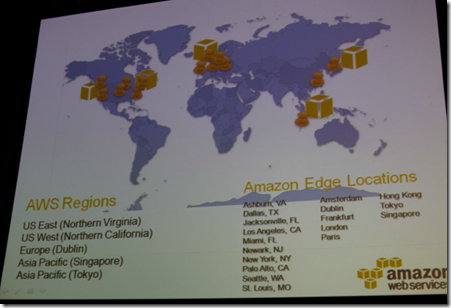
But, what about AWS's locations in CA?  Does AWS need to severe ties with those sites as well?

image

Amazon's Retail business model with customers avoiding sales taxes is an issue that affects Amazon's data center locations which then affects the AWS users as the operation of AWS cannot jeopardize Amazon.com's business model.

Is AWS's Northern California data centers next on will be spun off?  Ever wonder why Reno is a big distribution center for California?  Because, it is in Nevada along with a bunch of others who don't want to be in California's tax base.

Policy Makers have bad aim, not focusing on the real problem

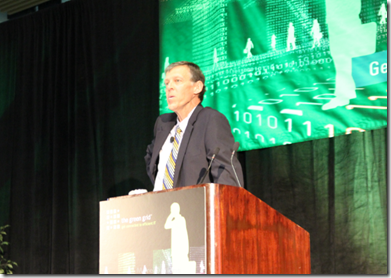
I am at The Green Grid Technical forum event, and I had the pleasure of chatting with the keynote speaker Robert D. Atkinson, Ph.D.  His company is Information Technology and Innovation Foundation.  Robert's keynote  is titled.

Policy Makers are Focused on You, Not the Real Problem

Regulators around the world are taking aim at IT in general, and data centers in particular, in their efforts to regulate reduced energy use and carbon emissions. But at the end of the day, we need more IT and innovation, not less. Rob Atkinson will discuss why policy makers should be concentrating on spurring digital transformation – incentivizing conversion of energy intensive atoms to energy savings bits. And why spurring fundamental clean energy R&D, rather than regulating IT efficiency, is the surer path to the needed low carbon global economy.

image

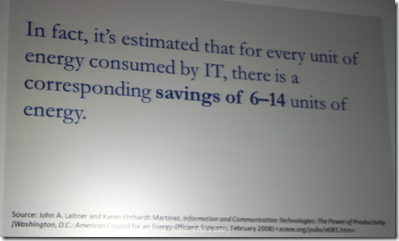
Robert is pro ICT

image

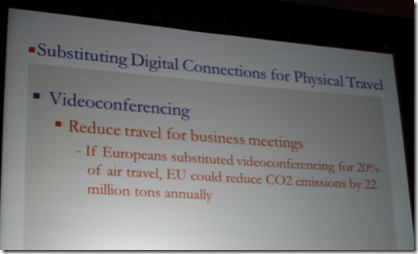
Points out of the irony of travelling to the conference on a plane and how video conference.

image

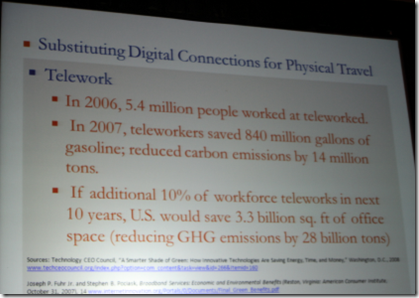
Teleworking is the fastest growing travel segment with the a positive environmental impact.

image

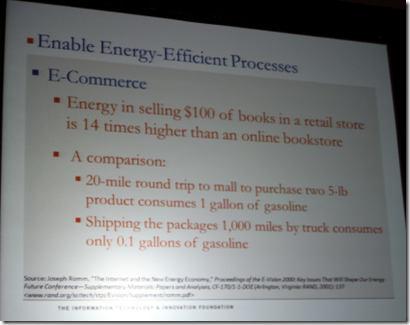
And a case for ecommerce for eBay and Amazon.

image

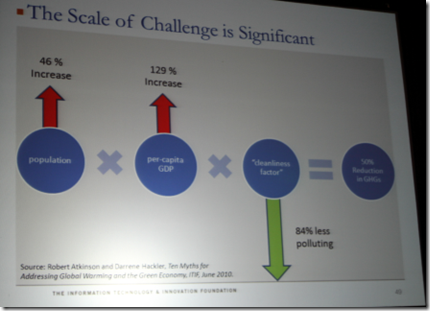
So what we should be doing given ICT has a reduction in energy overall.  What is needed is 84% less carbon energy.  And Robert says the focus on energy efficiency is a short term focus.  We need low carbon energy.

image

Which reminds me what I renamed the Green Data Center Blog to Green (low carbon) Data Center Blog.  When I hear guys like Robert talk I can easily see 5 years more of writing on the Green (low carbon) Data Center topic.

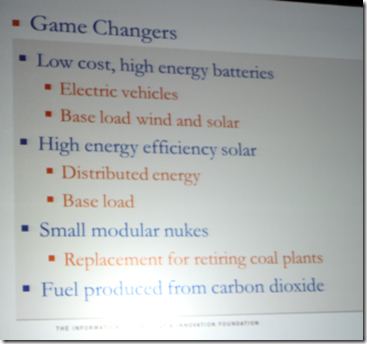
What are the low carbon technologies?

image

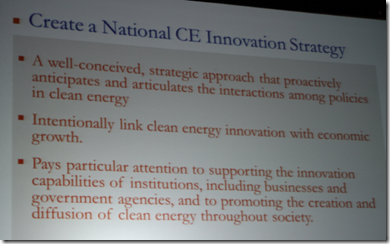
What should be done?  A clean energy strategy is Robert's closing recommendation.

image