Google takes the Lead in Greenpeace's Cool IT Climate Leaderboard

Greenpeace's Gary Cook posts on Greenpeace's latest Green IT Scorecard with Google in the leadership position.

Google wrests control of Cool IT climate Leaderboard

Blogpost by Gary Cook - February 8, 2012 at 9:00

Cool IT Leaderboard 5th edition

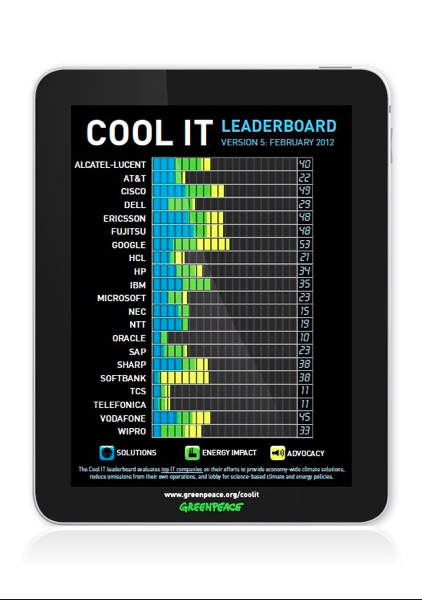
The tussle for the top of our Cool IT Leaderboard has taken its latest twist, with Google grabbing the top spot ahead of 20 other tech companies, including Cisco and Ericsson.

Google is singled out as the leader.

Google is way ahead on climate solutions and energy impacts, thanks to its disclosure of its energy footprint, and for providing its impressively detailed mitigation plan for achieving emissions reductions. On top of this, Google continues to speak up on important climate change policies, and make its voice heard on the immediate need for both US and EU governments to aggressively cut emissions.

Last is Oracle with a score of 10 vs Google's 53.  The full report is here.

NewImage

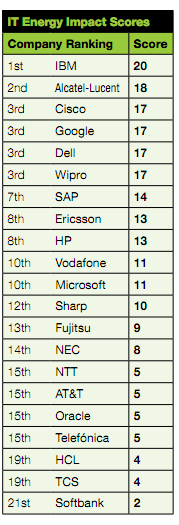
The IT Energy impact score has IBM in the lead.

NewImage

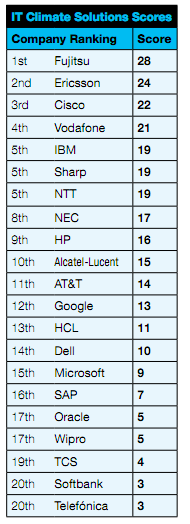
And Fujitsu leading the IT Climate Soltuitons.

NewImage

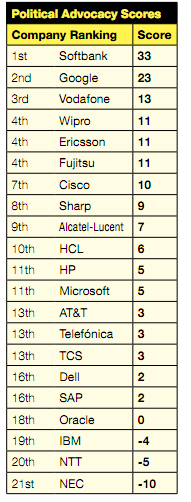
And Political Advocacy has Softbank with high score.

NewImage

Wikipedia going dark forces people to change, like look at alternatives

GigaOm has a post on Wikipedia going dark for 24 hrs to protest anti-piracy bills.

Has Wikipedia broken faith with users by going dark?

Among the websites and services that went dark on Wednesday to protest the anti-piracy bills that are currently making their way through Congress, one of the more controversial is Wikipedia. A number of critics — including some regular contributors to the “open source” encyclopedia — say the site shouldn’t be taking an advocacy position on such an issue, since it is supposed to represent a neutral point of view. But if anything, it could be argued that the internal process that led to that decision is actually a great illustration of how Wikipedia functions.


Going dark for 24 hrs reminds me of when the green energy efforts asks people to go dark, no electricity for an hour, forcing people to look for alternatives that don't use energy.  If you are researching a topic like I was 5 minutes ago, and you hit a dark wikipedia page.

NewImage

How many people will choose to contact their representatives vs. pick another source for information?

The blackout has woken up critics.

Among those criticizing the encyclopedia for its day-long blackout (which the Wall Street Journal said will affect more than 10 million users) was tech blogger Paul Carr, writing for the new site PandoDaily. In his post, Carr argued that Twitter CEO Dick Costolo was right when he said blacking out a global business to protest a U.S. law is “foolish,” and that Wikipedia was making a grave mistake by taking such a position, especially since the site just spent months trying to raise money from users to pay its bills:

[T]o shutter Wikipedia — a crowd-funded international encyclopedia — in protest of a single national issue is even worse. It’s idiotic, it’s selfish and it sets a horrible, horrible precedent.

Obama's Leaner Military equals investments for intelligence-gathering and cyberwarfare, therefore more data centers

NYTimes reports on President Obama's leaner military.  The part that caught my attention is what the future is.

Mr. Obama, who spoke surrounded by a tableau of the Joint Chiefs of Staff in dress uniforms and with chests full of medals, underscored the national security successes of his administration — the ending of the Iraq war, the killing of Osama bin Laden and the ouster of Col. Muammar el-Qaddafi of Libya — before declaring that the United States would downsize to a smaller ground force, get rid of “outdated cold war-era systems” and step up investments in intelligence-gathering and cyberwarfare.

Pentagon officials also chimed in.

Pentagon officials made it clear that the department’s priorities in coming years would be financing for defense and offense in cyberspace, for Special Operations forces and for the broad area of intelligence, surveillance and reconnaissance.

Reuters reports in more detail on the Defense technology investment.

Cyberwarfare and unmanned drones would continue to grow in priority, as would countering attempts by China and Iran to block U.S. power projection capabilities in areas like the South China Sea and the Strait of Hormuz.

Here is the Defense Strategic Guidance.

NewImage

There may be 1200 data centers being shut down, but the new data centers will be way more fun to work on than the 1200 that were shut down.

Thinking about Data Center business in China, consider the lessons of Soccer

There are a bunch of friends I have discussed the challenges of conducting data center business in China.  The Economist has a great article on Why China fails at Football (Soccer).

Why China fails at football

Little red card

The telling reasons why, at least in football, China is unlikely to rule the world in the near future


  • The Buddha tells the people he can fulfil only one of their wishes. Someone asks: “Could you lower the price of property in China so that people can afford it?” Seeing the Buddha frown in silence, the person makes another wish: “Could you make the Chinese football team qualify for a World Cup?” After a long sigh, the Buddha says: “Let’s talk about property prices.”

What is the challenge of doing business in China?  Understanding how money influences the system.

Qingdao’s owner Du Yunqi was irate—at his team’s utter incompetence. As he would later admit to investigators, he had just lost a bet that there would be a total of four goals scored in the game. His humiliated assistant coach said on national television, “Afterward the boss was angry and scolded me, saying I bungled things and couldn’t even fix a match.”

If you think data centers are private business, you can't see the connections to the government.

All this hints at something rather unique and powerful about the place of football in Chinese society. It is, like all organised sport in China, ultimately the domain of the government;

What outsiders call corruption is simply the way the Chinese system works.

A recent crackdown on football corruption offers little solace; it simply mirrors the pyrrhic campaigns against official corruption elsewhere in China. A mid-level functionary in China’s state security apparatus puts it candidly: “You know all those problems with society that you like to blame on China’s political system? Well it really is like that with football.”

Data Centers are a priority for the Chinese government.  Soccer is as well.

So whatever ails Chinese football, it is not a lack of passion from the country’s leaders. If anything, the opposite may be the problem. China’s Party-controlled, top-down approach to sport has yielded some magnificent results in individual sports, helping China win more Olympic gold medals in Beijing in 2008 than any other country. But this “Soviet model” has proven catastrophically unsuitable for assembling a team of 11 football players, much less a nation of them.

It would be interesting to survey the additional budget required to support keeping "favors."

Investors would contrive to fix games as favours to the local officials who nominally controlled the clubs (these types of matches are called “favour”, “relationship” or “tacit” matches, and are not viewed negatively by many within the game). Gambling syndicates, including the triads, began exerting influence over investors, referees, coaches and players. A spoils system evolved, and everyone took their cuts.

WSJ blogs about the soccer corruption trials.

Bribery:


China’s long-awaited trial into alleged bribery by the former head referee of the country’s soccer association has begun. The body pledged to fight corruption. More here and here. (China Daily, Xinhua, Xinhua, AFP)

A FIFA anti-bribery panel may be further expanded, its head said. Ted Howard isreported to be the new general secretary of the Caribbean, North American and Central American soccer confederation after Chuck Blazer left. More on a meeting by the FIFA Executive Committee in Tokyo is available here,hereherehereherehere and here. (Bloomberg, Inside World Football, Guardian, Daily Telegraph, AP, BBC, MidEast Soccer, Reuters, NZ News)

Tuna Industry attacks Greenpeace, lessons for the data center industry?

WSJ has an article and video on Greenpeace vs. the Tuna industry where part of the accusation is Greenpeace is focused on fund raising.  It would be interesting to know how much money Greenpeace has collected due to the uncoal Facebook data center campaign. The Tuna Industry must be pretty fed up to go to the media with their story.

The WSJ articles is here.

Unfortunately, this attack on canned tuna isn't about science. It's about fund raising, and Greenpeace has discovered a recipe for success: Target something that's easily recognizable (like tuna), make some scary claims in the media, parade around in funny costumes—and start raking in the donations. It's a recipe that Greenpeace has perfected over the past two decades.

Here is the video Greenpeace has put on line.

87,675

Uploaded by  on Aug 14, 2011

Each year the canned tuna industry kills thousands of sharks, rays, turtles and seabirds. Now that's a dirty little secret. Greenpeace is launching a new campaign to get the canned tuna industry to clean up its act and end its destructive ways. To kick things off we've teamed up with Pulitzer Prize winning cartoonist Mark Fiore on this video. Help expose the the tuna industry's dirty little secret by sharing this video with everyone you know.

Learn more at www.greenpeace.org

  • likes, 114 dislikes


Note how much dislikes (114) vs. likes (259).