There was all kinds of news when some of the first announcements were made that the federal gov't would reduce the number of its data centers. Virtualization vendors and consultants were excited. Data center companies joined in.
What I think almost everyone misses is this not a technology issue. Data Centers are socialist programs that keep lots of people employed who get paid really well, and can cripple an organization. When United Airlines cut over to the Continental reservation system there were all kinds of problems. People have little incentive to make things work smoothly when they are eliminating their jobs.
The GAO has their press release. The GAO recommends to solve the problem to get everyone to count things the same way with a standardized cost model.
What GAO Recommends
OMB’s Federal Chief Information Officer should ensure that agencies use a standardized cost model to improve consolidation planning, and the 5 selected agencies should implement recognized best practices when establishing schedules and cost estimates for their consolidation efforts. OMB and 3 agencies agreed with, and 2 did not agree or disagree with, GAO’s recommendations.
This situation will go on for years and years as people have little incentive to get ride of their job.
Monty Python has a skit on a failed execution. You could probably write a skit about the people who are asked to shut down their data center.
If you want some night time reading you can read the 124 page GAO report. http://www.gao.gov/assets/600/592696.pdf
HONG KONG — The Shanghai Stock Exchange produced an unlikely, almost ghostly result on the 23rd anniversary of the military crackdown in Tiananmen Square, an odd echo of a tragedy thatChina’s leaders have tried desperately to erase from their country’s consciousness.
The index fell 64.89 points on Monday, a figure that looks like June 4, 1989. In yet another unusual development, the index opened on Monday at 2346.98 — a figure that looks like the date of the crackdown written backward, followed by the 23rd anniversary.
Hopefully, most of you realize how silly this is to think that there is a meaning in the numbers 89/6/4 = 89 June 4. We have all read silly things like this being read into things. Which reminds me of my Cargo Cult Science post.
What is real though is the activity of China's censors.
Chinese censors, showing characteristic heavy-handedness, especially on anniversaries of Tiananmen Square, began blocking searches for “stock market,” “Shanghai stock” and “Shanghai stock market” and started deleting large numbers of microblog postings about the numerical fluke.
This got me thinking what happens when China's censors delete and block content.
The Chinese have great pride in figuring out how to be smarter than the next guy, including countries, races, as well as individuals. What comes to mind is with tthe billion plus people in China, there must be thousands and thousands of people who are trying to figure out how to be smarter than the censors. Why? It is like a game to show how smart you are.
To be a green data center you need a sustainable solution that reduces your environmental impact. This is complicated in itself figuring out the power grid, local weather conditions, and designing an efficient solution. What few talk about is the #1 thing that will cause the top guys to go from one state to another though are the taxes.
Mike Manos's posts on his observation on the pay to play game to get data centers to be in a state can backfire.
The Pay to Play that I am referring to is an emerging set of regulations and litigation techniques that require companies to pay tax bills upfront (without any kind of recourse or mediation) which then forces companies to litigate to try and recover those taxes if unfair. Increasingly I am seeing this in states where the budgets are challenged and governments are looking for additional funds and are targeting Internet based products and services.
If the state your data center is in not financially healthy then you could be in for a few surprises.
It does beg the question as to whether or not you have checked into the financial health of the States you may be hosting your data and services in. Have you looked at the risk that this may pose to your business? It may be something to take a look at!
A customer who filed a complaint against AT&T after having his wireless data speeds throttled has come out the victor.
One of the points made is ATT is looking to appeal
The victory could be short-lived for Spaccarelli, the AP said. AT&T spokesman Marty Richter told the outlet the company was "evaluating" the possibility of an appeal.
Some have said ATT has a case because no where in the contract does it say it cannot throttle the unlimited data plan.
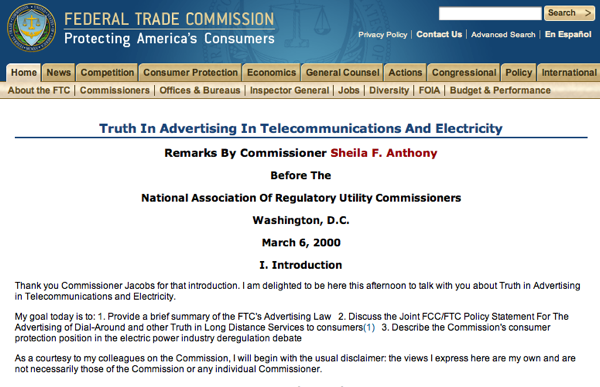
But, maybe the FCC and FTC can come to the rescue of consumers. How? Remember those overhyped long distance plans, that had restrictions in contracts that were not mentioned in the ads? The FTC and FCC did something about that and created the "Truth in Advertising in Telecommunications and Electricity" dated Mar 2000.
Here are some parts that should get you and ATT thinking. Maybe the rest of the mobile carriers and even Comcast's Internet throttling over 250 GB should consider this as well.
The FTC's of truth-in-advertising law that has been developed through Section 5 of the FTC Act, which prohibits "unfair or deceptive acts or practices," provides helpful guidance to long distance carriers.
...
A. General Concepts of Advertising Law
Today, I will describe how the concepts of advertising law apply to the advertising of telecommunications services and electricity. In general, Commission law requires that advertising be truthful, fair, and substantiated.
Each of these concepts is detailed in formal policy statements adopted by the Commission or addressed by statute. A deceptive act is one that contains a misrepresentation or omission that is likely to mislead and be detrimental to consumers who are acting reasonably under the circumstances.(2) An unfair act or practice is one which causes or is likely to cause substantial consumer injury, not reasonably avoidable by consumers themselves, and not outweighed by countervailing benefits.(3) Although the Commission challenges conduct that is unfair, the majority of our actions in the advertising area target deceptive ads.
ATT claimed unlimited data plan.
In all advertising cases, the Commission must determine exactly what claims are made, and whether there is substantiation to support those claims. We look at both express and implied claims. Express claims are claims that unequivocally state the representations. For example, an ad which says: "long distance services to 100 countries" makes an express claim. Implied claims are anything else and range on a continuum from language that is virtually express to language that literally says one thing but strongly suggests something else. For example, an ad which says: " 7 cents a minute" may make an implied claim that there is no minimum charge for each call. In determining the claims that an ad conveys, the Commission examines "the entire mosaic, rather than each tile separately."(5)
Advertisers must make truthful claims and substantiate all objective claims. These rules of the road, of course, apply both to advertisers using traditional media and those who market their products and services on the Internet, telephone, e-mail or through any other media.
Was throttling omitted from ads and should have been disclosed in advertisement?
B. Deception by Omission
Ads can be deceptive because of what they do not say. Let me give you a few examples. If an ad omits material information, an ad can be deceptive even if everything else in the ad is truthful. This is called deception by omission. An ad will be deceptive if it fails to disclose qualifying information that, in light of the representations made, would be necessary to prevent consumers from being misled. We determine whether material information has been omitted by examining a typical buyer's expectation and understanding of the advertiser's claims.
In the Dial Around context, if an ad represents that all calls are 10 cents a minute, but fails to disclose that all calls are subject to a 50 cent minimum charge, the ad would likely be deceptive. A reasonable consumer would likely conclude that a one minute call would be 10 cents, not 50 cents. The same would be true if an ad made specific per minute price claims but failed to disclose that there was a mandatory monthly fee.
C. Material Limitations on Service should be disclosed
Advertisers for Dial-Around and other long distance services must take special care to make certain that material limitations on services are disclosed in the ads. Given the importance of price information, any significant conditions or limitations on the availability of the advertised rates should also be disclosed clearly and conspicuously. I will talk more in a moment about what makes a disclosure clear and conspicuous. But, clear and conspicuous disclosures are important in advertising law generally, and they have special meaning in the Dial-Around context because ads are the primary source of price information for consumers.
Let me give you some examples of situations where disclosures should be used to avoid deception. If an ad features the phrase "10 cents a minute" and that rate is available only during certain times of the day, the failure to clearly and conspicuously disclose the restriction would be deceptive. Likewise, if there are significant geographic restrictions, that fact should also be disclosed. Additionally, terms such as "Basic Rate" should be used only if the meaning of that term is clear to consumers.
An ad cannot refer to a toll-free number or a website to make disclosures that should be made in an ad. While advertisers are encouraged to use customer service numbers and websites to offer consumers more information, these sources cannot cure misleading claims in the ad itself.
When you signed up for ATT's unlimited data plan did you feel like you knew 1.5 - 2GB was the cut off?
In simple terms, disclosures should be presented so that consumers actually see them and understand them. That means disclosures should be clear, prominent, and in close proximity to the claim being modified. There should be no distracting visual or audio elements surrounding the disclosures. Also, legalistic disclosures or those buried in fine print will not be effective. The FTC has a lot of experience with disclosures in a variety of contexts. We enforce certain statutes and regulations that are very specific as to how and when disclosures should be made.
You would think that some of the same people who worked on this FCC/FTC truth in advertising act are still around and they are watching ATT. Remember those old Bell System commercials?

Quisque iaculis facilisis lacinia. Mauris euismod pellentesque tellus sit amet mollis.