If you want to learn more about Windows Azure, check out this video. It has over 20,000 views, and is highly rated due to the lack of marketing overhead.
Your Custom Text Here
If you want to learn more about Windows Azure, check out this video. It has over 20,000 views, and is highly rated due to the lack of marketing overhead.
If you are looking for a tool to monitor virtualization sprawl with a vendor neutral tool. Cirba is a company you should take a look at.
Monitoring virtualization sprawl is a key feature to look for as virtualization increases the probability of uncontrolled VM growth.
Placing New Workloads to Avoid Resprawl & Excess Capacity
Even a virtualized data center is at high risk of having unnecessary excess hardware. CiRBA audits new applications in staging environments and finds the best place for those applications within existing infrastructure. As part of an overall application deployment process these steps ensure that new hardware is purchased only when all other options are exhausted.
Advanced workload analysis provides utilization
trending so that workloads can be proactively
placed to suit predicted changes
This product is one to compare when thinking of VMware’s Virtual Data Center OS as it is vendor neutral, and we have all learned how important it is to be able to move to another vendor’s technology.
CiRBA’s Placement Intelligence Technology
CiRBA’s software enables IT organizations to operate the most cost effective virtualized data center possible. Only CiRBA’s Placement Intelligence Technology™continually captures and analyzes technical, business, and resource constraints to safely guide workloads to the right physical or virtual infrastructure.
Also on the partner page, found IBM uses this tool.

IBM is a worldwide leader in providing end-to-end server consolidation services. IBM Global Technology Services has standardized world wide on CiRBA for all server consolidation and virtualization services. For more information, visit www.ibm.com
And has a range of other technology partners.
Technology Partners


Cisco brings up an interesting topic on how to accelerate Virtual Machines.
TechWiseTV
Accelerating Virtual Machines
Thursday, October 23, 2008, 10-11 a.m. Pacific Time
Of all of the recent technology trends in the world of enterprise IT, virtualization may be the most profound. Almost every organization is implementing virtualization. However, most have not moved beyond the server consolidation stage. How can you take it to the logical next level, without creating serious management, control, and security issues?
This TechWiseTV episode reveals the expertise and the latest solutions that will enable you to virtualize your entire network infrastructure. Learn how Cisco is delivering the capability to provision and manage services with virtual machine–level granularity. See how these new solutions provide for quality of service, storage management, and security capabilities at the hypervisor layer. Watch TechWiseTV and see the newest virtualization technologies and services, including:
This makes sense as a step after server consolidation for many, even though ideally people would think about these issues before starting a virtualization project.
Virtualization assessment, planning, and design services, available jointly from Cisco and VMware, to help you define the next steps in your virtualization strategy
Found out an old friend, from Apple days is at a VC firm, and he liked my focus on Green Data Center. Curious I went through the VC’s portfolio of companies, and I found a couple of Virtualization ones.
The one that jumped out though was Virtera, because they had this simple diagram to illustrate what their solution does.
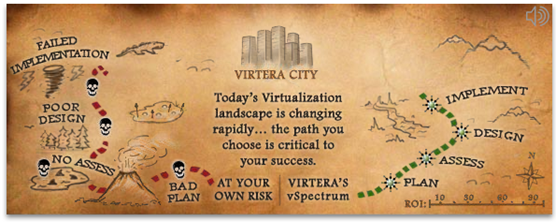
Green IT is one Solution.
Solutions / Green IT & Consolidation
According to Gartner analysts, by the end of 2008 half of the world’s datacenters won’t have enough energy capacity to meet the power and cooling requirements of the latest high-density computing equipment, such as blade servers. Gartner also estimates that over the next five years most enterprise data centers will spend as much on energy as they do on hardware infrastructure. Energy bills, which traditionally have accounted for less than 10% of an overall IT budget, soon could account for more than half. The need for Green IT has never been greater.
The VIRTERA Approach
Green IT starts with producing environmentally friendly products and adopting options such as virtualization, power management, and proper recycling habits within IT. VIRTERA can take you all the way with our Green IT virtual infrastructure solutions. The VIRTERA approach ensures that your Green IT solution is customized to your organization and delivers strong ROI by:
- Determining your server consolidation ratio.
- Testing your infrastructure to measure the minimum and maximum workloads of all of your servers and infrastructure components.
- Ensuring that we don’t overtax a server.
- Building in controls to ensure that application SLAs are met.
- Making adjustments for unexpected spikes after deployment for the best server balance.
Data Center Optimization is another.
Solutions / Data Center Optimization
Ever increasing IT labor costs are now the single largest expense in the data center, at times representing up to 70% of an IT operations budget. What’s more, the challenge to keep up with increasing power and cooling costs – now eight times greater than 10 years ago – and increasing security and compliance demands have drained IT resources and the required funding needed for new projects. The simple answer to these complexities is VIRTERA.
The VIRTERA Approach
VIRTERA’s Data Center Optimization solution gives you the ability to dynamically and transparently allocate IT infrastructure resources based on business needs. We can help you achieve simplicity, agility and efficiency in the data center as well as take a service management approach to your business. As such you'll have improved visibility into business operation and be able to control risks, manage compliance and leverage automation.
In this way, VIRTERA can help you solve the following challenges as part of the transformation to an optimized data center:
- Vendor selection – Our agnostic approach means no vendor lock-in or proprietary vendor solution is due.
- Organizational challenges - Understand the benefits of shared IT resources as opposed to the culture of “owning” a server.
- Cost allocation – Have the ability to measure usage of virtual or physical assets and “charge back” the costs.
I am most curious about their system for Cost Allocation. I highlighted this above.
This gives me a good excuse to have more discussions with my friend as we haven’t talked for years back when he was Cisco’s CIO.
I hope to get more details from Virtera on how they calculate cost allocations, and how it compares to solutions like VMware’s.
EWeek has an interview with Paul Martitz where he says the Virtual Data Center OS is the #1 priority for VMware.
Why is VMware focusing so heavily on the cloud, as opposed to updating what it already has or some products that could come out in six months?
Key point to correct there—the cloud is not our only focus.
The three key initiatives are, No. 1, the virtual data center operating system, No. 2, vCloud, No. 3, vClient.
So our key initiative really is the virtual data center operating system, not the cloud. There’s a cloud dimension to it, but our focus is really on how we allow our customers to build upon the technology we already have to strengthen their use of virtualization, to achieve much more fundamentally efficient and flexible usage of their computing infrastructure.
We believe that, in doing so, it will open up opportunities for them to federate with the external cloud, but it starts, first and foremost, with the virtual data center operating system.
VMware’s path to cloud computing is through its virtual data center OS.
On one side you said you have the cloud, and you have the sort of very dynamic data center. What’s the vision that VMware has about pulling all of these different things together?
First and foremost, we believe our customers need to have a way whereby they can essentially start using their internal resources as a giant computer and, in doing so, get maximum efficiency and flexibility out of it.
Now, they can’t afford to rewrite all of their applications to do that, and the only strategy, really, to reach for that state is through increased use of virtualization. As we do that, though, we have to make sure that that strategy is open to all of the other partners who play in the data center—and, hence, the need for a virtual data center operating system.
It’s that layer of software that allows our customers to start treating all of their internal resources as a giant pool that they can provision loads onto. It addresses both existing approaches to writing applications, like Windows and Linux, as well as future ways of writing applications. And it provides a way whereby specialized infrastructure vendors—whether they be storage or networking—can plug into that environment.


