Moving to a new Cloud Hosted environment for GreenM3, SquareSpace

It's been over 4 years as a happy user of TypePad for hosting www.greenm3.com, but I have new ideas for the blog and a new platform makes things much easier.

In the process of moving I will be making other changes to the blog, and with any move there will be transition issues. 

Please be patient over the next few days.

I will be moving to http://www.squarespace.com/ for hosting.  The url for the Green Data Center Blog wil stay www.greenm3.com. 

Read more

Signs of success as a platform, targeted for cyberattacks

CNN has an article referencing a McAfee report that iPhone, Facebook and Foursquare are 2011’s cyberattack targets.

2011 cyberattack targets: iPhone, Facebook, Foursquare

John D. Sutter

By John D. Sutter, CNN

December 29, 2010 10:25 a.m. EST | Filed under: Web

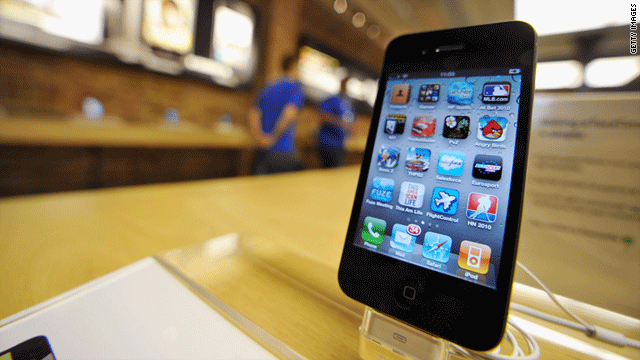
Apple products, including the iPhone, will be among the hot targets of cyberattacks in 2011, McAfee says.

Apple products, including the iPhone, will be among the hot targets of cyberattacks in 2011, McAfee says.

(CNN) -- Spamming e-mail is so last year.

Malicious coders and all-out cybercrooks will target newer and hipper forms of digital communication in 2011, according to a report released Wednesday by McAfee, the computer security company.

Noting a "significant decrease" in the total volume of spam messages sent to e-mail, the company's annual "Threat Predictions" report says attacks on instant messaging services, Facebook, Foursquare, URL shorteners, smartphones like the iPhone and even long-protected Apple operating systems will increase in the coming year.

The changes are driven by how people use tech, the report says. As e-mail starts to die, so do e-mail-targeted scams.

Google, Microsoft, and other who are used to be targets will watch as others respond and staff up.  Do you remember how much panic there was for MyDoom.  Here is a wikipedia entry on computer viruses and worms http://en.wikipedia.org/wiki/Timeline_of_computer_viruses_and_worms

Read more

Do you have an Elephant and Pig in your data center? Hadoop momentum continues

I am sure most of your have heard of Hadoop.

I've started studying Hadoop and its adoption in data centers.  Google started the effort with its MapReduce and Google File System.

Apache Hadoop is a software framework that supports data-intensive distributed applications under a free license.[1] It enables applications to work with thousands of nodes and petabytes of data. Hadoop was inspired by Google's MapReduce and Google File System (GFS) papers.

Why should you care about Hadoop? Look at who the users are - Amazon Web Services, Adobe, AOL, Baidu, eBay, Facebook, Google, Hulu, IBM, LinkedIn, Quantcast, Rackspace, Twitter, and Yahoo.

Yahoo! is proud of being the largest Hadoop user.  Here is their 2009 #'s 25,000 nodes.

image

And, 2010 38,000 servers for 170 PB of storage

image

Apache Pig is a platform for analyzing the large data set.

Pig

Apache Pig is a platform for analyzing large data sets that consists of a high-level language for expressing data analysis programs, coupled with infrastructure for evaluating these programs. The salient property of Pig programs is that their structure is amenable to substantial parallelization, which in turns enables them to handle very large data sets.

At the present time, Pig's infrastructure layer consists of a compiler that produces sequences of Map-Reduce programs, for which large-scale parallel implementations already exist (e.g., the Hadoop subproject). Pig's language layer currently consists of a textual language called Pig Latin, which has the following key properties:

Read more

Schneider Electric's Media Event, a great time to learn, network, and test new image gear

I just spent a day at Schneider Electric's media event in Chicago. Reflecting on what I got out of the event I'll just dump a stream of what comes to mind.

I was looking forward to connecting with Kevin Heslin with Mission Critical Magazine and Rich Miller with DataCenteKnowledge as any significant data center event has both of them there.  Between the three of us creating content on  data centers, Kevin made the point how much content would be loss if for some reason something happened to all three of us at the event.  I don't put myself in the same category as Kevin and Rich who are professional media people, but I do get media status with my blogging so I enjoy the benefits of seeing how things are presented to the media.

As part of getting ready for Schneider's event, Data Center Dynamics, and AFCOM Data Center World (where by the way I'll see Rich and Kevin again), I decided to upgrade my media capabilities.  I am a Canon user which can be just as religious an issue vs. Nikon.  After much thought I decided to get a Canon 7D.

EOS 7D

EOS Digital SLR Cameras

EOS 7D

Maximum resolution for any application.

The EOS 7D features a Canon-designed 18.0 Megapixel APS-C size CMOS sensor that captures such a high level of resolution it's easy to crop images for enlargement without concern of losing detail. A major factor in reducing noise, the CMOS sensor assures that images shot at highest sensitivity will be remarkably smooth. Dual DIGIC 4 Image Processors ensure that images are captured, processed and saved with remarkable speed. The EOS 7D's ability to capture and process data of images shot at 18.0 Megapixels at 8 fps, as well as Face Detection Live Mode, Full HD video recording, Auto Lighting Optimizer and Lens Peripheral optimization are all possible thanks to the Dual DIGIC 4 Image Processors.

One of the features I was playing with is to tether the Canon 7D to my laptop to allow quick transfer of images to my PC which I actually got a bunch of comments from other media people asking about my setup at the event.  My Lenovo X200 Tablet worked well capturing images and video while tethering transferring images in seconds. 

I couldn't find an exact video of what I was doing on YouTube, but here is a Canon 5D Mark II connected to a Mac.  This worked extremely well and I am looking forward to try the setup at other events to enable live blogging with better quality images and video.

What did I get out of the event for content?  I met Kevin Brown and his presentation on Infrastruxure. 

APC by Schneider Electric unveiled the next generation InfraStruxure architecture, a high performance, scalable and adaptable data center architecture. InfraStruxure integrates power, cooling, racks, security and management in a modular form factor and is a building block of Schneider Electric’s comprehensive energy management architecture portfolio, EcoStruxure.  This new generation of InfraStruxure delivers a 25%  increase in power and cooling capacity and a 15% smaller footprint, all while reducing cost by 15%.   Holland Computing Center at the  University of Nebraska-Lincoln, uses InfraStruxure to run high performance computing for cutting-edge research, including a 21 TFlop supercomputer, shared memory processing, grid computing and development of hadoop-on-demand and other custom implementations.

image

And spent a bunch of time with software his software subject matter expert Jon Gould diving into details of their modeling and simulation.

APC also introduced new features to the overall InfraStruxure management software portfolio, to better enable IT managers to change the way they monitor, operate, manage and maintain their data centers through the integration of new virtualization capabilities and upgraded energy efficiency and operations software. Enhanced capabilities include:

  • The new Data Center Lab application within InfraStruxure Capacity - a data center project management tool that enables the design of new data center build-outs or data center upgrades.
  • InfraStruxure Capacity’s updated Impact Analysis application - provides an instant overview of data center physical infrastructure operations including UPS, power distribution and cooling independent of the types and brands of equipment present in the data center.
  • InfraStuxure Efficiency 1.1 -  IT managers can quickly and easily report on monthly energy consumption of their data center subsystems including CO2 emissions, PUE (Power Usage Effectiveness) and DCIE (Data Center Infrastructure Efficiency). 
  • InfraStruxure Capacity Network Management Tool - provides insight into equipment dependencies including mapping and documenting fiber and copper networks from servers, via patch panels, to switches or routers allowing IT managers to document connectivity, manage their network structure and plan and control network usage.

image

Saw Rick McKay's BMS solution for data center facility operations.

I'll write a blog entry about Aaron Davis's presentation.

Overall I have a much better understanding of the Schneider Electric's portfolio, and met a lot of Schneider/APC people I am sure I will connect with again.

Read more

New Energy Resource Management tool coming to the enterprise market

When I was talking to a VC this week, we were discussing Hara.

image 

Another company he mentioned was C3.

image

There isn't much out there on C3, but there are job postings.

image

One of the things I've always thought as a weakness of Hara is what their SW does.  But, Hara does have a great VC investment and excellent marketing.  Which makes a lot of sense given most of the people who are buying environmental impact solutions aren't technical software people.

But, this leaves the opening for C3 to come in with a SW system for Energy Resource Management.  Being a technical guy, I like the C3 job posting list.  Compare this to Hara's current technical job posting.

image

So is Hara really just a reporting system?  Vs. C3 is trying to complex energy resource modeling.

Ideas move quickly, and the folks at Hara probably realize their weakness and are thinking of ways to compete vs. C3.

Compare the founder of C3 vs. Hara.  Siebel vs. SAP.

Hara founder.

Amit Chatterjee, CEO and Founder

Amit Chatterjee, Chief Executive Officer
Download image

Amit Chatterjee is CEO and Founder of Hara, the fastest growing provider of environmental and energy management solutions. Mr. Chatterjee has been at the forefront of shaping a new category of business software and has championed the notion of organizational metabolism. Under Chatterjee’s leadership Hara addresses an end-to-end environmental and energy business process from reporting to reduction across an organization and its value chain. Mr.Chatterjee is a thought-leader on green economy innovation, energy independence and entrepreneurship. He has participated in prominent conferences such as the United Nations Copenhagen Climate Change Conference, and has been a featured participant at Fortune Brainstorm Tech, Aspen Institute’s Clean Energy Economic Forum and the Corporate Leaders Group on Climate Change Conference. Mr. Chatterjee is a published author ofThe Post Carbon Economy and is on the board of the Corporate Responsibility Officers Association. Prior to founding Hara he led SAP’s fast-growing Governance, Risk and Compliance unit. Mr. Chatterjee developed his strategic and leadership experience while at McKinsey & Co., working with clients such as SAP, Cisco and Oracle. Mr. Chatterjee has B.A. degrees in Political Science and Chemistry from UC Berkeley, with graduate studies at Stanford University.

C3 founder.

Siebel_100px

Thomas M. Siebel

Founder and Chairman

Mr. Siebel is the Chairman of First Virtual Group, a diversified holding company with interests in investment management, commercial real estate, agribusiness, and philanthropy. Mr. Siebel was the founder, chairman, and chief executive officer of Siebel Systems. From 1984 through 1990, he was an executive at Oracle Corporation. Mr. Siebel serves on the Board of Advisors of the Stanford University College of Engineering, the University of California, Berkeley College of Engineering, and the University of Illinois College of Engineering. He is the Founder and Chairman of the Meth Project and the Siebel Scholars Foundation. Mr. Siebel is a graduate of the University of Illinois at Urbana-Champaign, where he received a BA in history, an MBA, and a MS in computer science.

Hara has the market now for environmental monitoring software, but long term I would place bets on C3 for a green data center software solution.

The CEO of C3 is a mechanical engineer.

Abbo_100px

Edward Abbo

Mr. Abbo is Chief Executive Officer of C3. He was formerly Senior Vice President at Oracle Corporation responsible for Oracle’s application and SaaS products including CRM and ERP & Supply Chain products. Prior to joining Oracle in 2006, he was Senior Vice President of Technology and Chief Technology Officer for Siebel Systems. During his twelve-year tenure at the company, he was a member of the Siebel executive management team, Founder’s Circle of first employees, and led Engineering, Industry Products, and Sales Consulting organizations. Prior to Siebel Systems, he worked in a variety of sales and consulting roles at Oracle Corporation.

Mr. Abbo earned a M.S. degree in Mechanical Engineering from the Massachusetts Institute of Technology and a B.S. degree in Mechanical & Aerospace Engineering from Princeton University.

There are companies like Sentilla for data center energy, but there is no reason why a well designed solution shouldn't work across the enterprise.

Read more