One Way to Build Real-Time Energy Controls for the Data Center, Inventory all your assets with an IP address

DCIM is a hot topic and a lot of what people are trying to do is get control over their data center assets.  One of my data center friends heard that the current count is up to 59 companies provide some form of DCIM solution.

The people who have been the early adopters of DCIM have learned that no one tool does it all, and they need to put together multiple products to solve their DCIM problem.  What is lacking is an architecture for the DCIM that meets the needs of their enterprise.

What is an architecture?  Merriam-Webster definition.  #1-4 is what most people think about.  I am referring to #5 for computer systems.

Definition of ARCHITECTURE

1
: the art or science of building; specifically : the art or practice of designing and building structures and especially habitable ones
2
a : formation or construction resulting from or as if from a conscious act <the architecture of the garden>b : a unifying or coherent form or structure <the novel lacks architecture>
3
: architectural product or work
4
: a method or style of building
5
: the manner in which the components of a computer or computer system are organized and integrated

Great architecture solves problems

So what problem are you trying to solve?

The problem is most don't even know what problems they have that need to be solved.  For example, what knobs and dials exist in the data center to control the energy consumption in the data center?  Who gets to turn the knobs and dials?

NewImageNewImage

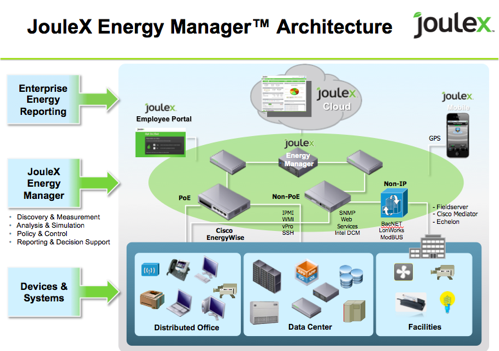
If you think you want to control the energy consumption of your IT assets you need to know all your assets and be able to talk to them, to control them.  One approach is JouleX's latest product.

Other highlights of JEM’s expanded capabilities include:

  • New device control features allowing for integrated power capping, central processing unit (CPU) performance leveling (for Windows, VMware, Linux), and support for VMware vCenter, and Distributed Power Management (DPM).
  • More granular control using power, temperature and utilization metrics to migrate virtual machines and optimize server performance and energy consumption using VMware vMotion.
  • Detailed analytics and reporting for sustainable procurement (analysis of device models for energy efficiency, for device replacement planning, and for measuring energy and carbon savings from virtualization projects)
  • Virtualization and utilization reporting to identify under- and over-utilized devices. This identifies candidates for upgrading, retiring, and virtualizing.
  • Additional device support for rack and floor power distribution units (PDUs) as well as computer room air conditioning (CRAC) and uninterruptable power supply (UPSs).
  • NewImage

JouleX CEO Tom Noonan explains the latest version.

“We continue to accelerate our technology development in terms of creating actionable energy intelligence for our customers to make quicker decisions, optimize their existing infrastructure, and reduce their operating expenses,” said Tom Noonan, president and CEO at JouleX.

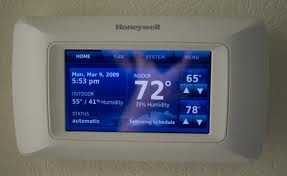
But, I think of it as Real-time Energy Control system.  Your energy thermostat for the data center.

One approach is JouleX and there are many others.  The hardest question that almost no one asks is what is the architecture of your DCIM solution?  What problems are you trying to solve?

We have a long ways to go in DCIM.


Software in Data Centers is Eating the World

Mark Andreesen of Netscape fame has an essay in the WSJ.

Why Software Is Eating The World

This week, Hewlett-Packard (where I am on the board) announced that it is exploring jettisoning its struggling PC business in favor of investing more heavily in software, where it sees better potential for growth. Meanwhile, Google plans to buy up the cellphone handset maker Motorola Mobility. Both moves surprised the tech world. But both moves are also in line with a trend I've observed, one that makes me optimistic about the future growth of the American and world economies, despite the recent turmoil in the stock market.

In short, software is eating the world.

Mark argues that software is dominating industries

The best new movie production company in many decades, Pixar, was a software company. Disney—Disney!—had to buy Pixar, a software company, to remain relevant in animated movies.

...

Photography, of course, was eaten by software long ago. It's virtually impossible to buy a mobile phone that doesn't include a software-powered camera, and photos are uploaded automatically to the Internet for permanent archiving and global sharing. Companies like Shutterfly, Snapfish and Flickr have stepped into Kodak's place.

Today's largest direct marketing platform is a software company—Google. Now it's been joined by Groupon, Living Social, Foursquare and others, which are using software to eat the retail marketing industry. Groupon generated over $700 million in revenue in 2010, after being in business for only two years.

Today's fastest growing telecom company is Skype, a software company that was just bought by Microsoft for $8.5 billion. CenturyLink, the third largest telecom company in the U.S., with a $20 billion market cap, had 15 million access lines at the end of June 30—declining at an annual rate of about 7%. Excluding the revenue from its Qwest acquisition, CenturyLink's revenue from these legacy services declined by more than 11%. Meanwhile, the two biggest telecom companies, AT&T and Verizon, have survived by transforming themselves into software companies, partnering with Apple and other smartphone makers.

All of this software goes into data centers, and to grow faster they need to be greener data centers using less energy and reducing the environmental impact.

Three Tips for a Smarter City project, IBM's Justin Cook shares insights working on Portland modeling project

I got a chance to talk to IBM's Justin Cook, Program Director, System Dynamics for Smarter Cities about IBM's press release for the Smarter Cities Portland project. 

IBM and City of Portland Collaborate to Build a Smarter City

Portland, Oregon, USA - 09 Aug 2011: To better understand the dynamic behavior of cities, the City of Portland and IBM (NYSE: IBM) have collaborated to develop an interactive model of the relationships that exist among the city's core systems, including the economy, housing, education, public safety, transportation, healthcare/wellness, government services and utilities. The resulting computer simulation allowed Portland's leaders to see how city systems work together, and in turn identify opportunities to become a smarter city. The model was built to support the development of metrics for the Portland Plan, the City's roadmap for the next 25 years.

I've got friends in Portland, so I appreciate the unique environment Portland has.  Here is what IBM discusses as when and why Portland was chose for the Smarter City project.

IBM approached the City of Portland in late 2009, attracted by the City's reputation for pioneering efforts in long-range urban planning. To kick off the project, in April of 2010 IBM facilitated sessions with over 75 Portland-area subject matter experts in a wide variety of fields to learn about system interconnection points in Portland. Later, with help from researchers at Portland State University and systems software company Forio Business Simulations, the City and IBM collected approximately 10 years of historical data from across the city to support the model. The year-long project resulted in a computer model of Portland as an interconnected system that provides planners at the Portland Bureau of Planning and Sustainability with an interactive visual model that allows them to navigate and test changes in the City's systems.

In talking to Justin, I asked him what Tips he had for implementing this complex project.  Here are three tips Justin shared with me.

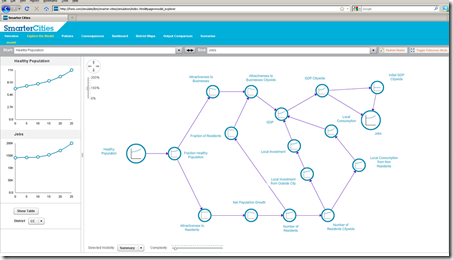
  1. Discuss the relationships of the groups to understand their perspectives and views.  This data will help you understand the semantics of information that helps you build a model.   There were 75 subject matter experts and multiple organizations involved in discussing initiatives for Portland's Plan.  Below is a view of one dashboard showing various metrics that get you thinking beyond an individual department's view.image
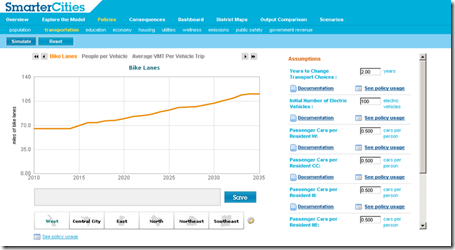
  2. Assumptions are openly documented to let others know inputs into the models.  Below is an example of bike lanes.image
  3. Trade-off between transparency and complexity where a simpler approach is easier to understand, therefore appears more transparent.  Justin shared that IBM's system dynamics team had 7,000 questions identified in a smarter city modeling project.

IBM is working with other cities to apply the lessons learned in Portland.

This collaboration with the City of Portland has also proven valuable for IBM.  IBM is applying its experience and modeling capabilities developed in this collaboration with the City of Portland to create offerings that will help other cities leverage systems dynamics modeling capabilities to enhance their city strategic planning efforts. Based upon IBM's experience in working with and conducting assessments of cities around the world, they've found that strategic planning in many cities is still being done in stovepipes without a holistic view of impacts/consequences across systems. By leveraging systems dynamics modeling techniques, IBM will be able to help other cities plan "smarter".

In closing Justin and I discussed the potential for projects that affect multiple city metrics and multiple city organizations to see in the model how ideas like more walking & biking lanes can address obesity, getting people out of cars which then reduces the carbon footprint of the city.  Bet you didn't think that addressing obesity could fit in a carbon reduction strategy.  IBM and Portland see the relationships in this and many other areas.

How valuable is the IBM Smarter City model?  We'll see some of the first results from Portland.

Tricks of the Trade,"Turning Numbers into Knowledge", info for the new wave of Data Analysts

I just received from amazon.com Jonathan Koomey's Turning Numbers into Knowledge book, and one of the things that caught my eye is the Foreword where

There is nothing else like this book out there.
Nobody who deals with problems where numbers matter—and everybody in today’s world really needs to—should be without it.
John P. Holdren*
Woods Hole, MA, October 2007

And Professor Holdren explains the "Tricks of the Trade" course he taught at UC Berkeley.

Berkeley’s guardians of academic respectability eventually made me change what they regarded as too frivolous a title for the course to “Professional Methods for Interdisciplinary Careers”, but the focus remained the same for the 15+ years that I taught it. It covered ways of thinking through complex problems; how to find and manage information; how to function in a committee; how to identify and avoid common pitfalls in the interpretation of data; how to present results clearly in words, graphs, and tables; how to manage one’s time; and even how to avoid jet lag.

Many students over the years suggested that I should write a book teaching the “Tricks of the Trade”. Notwithstanding my advice to others about time management, however, I never found the time to write it.

With the 2001 publication of the first edition of Jonathan Koomey’s remarkable book, Turning Numbers into Knowledge, I realized that I no longer needed to try. Dr. Koomey, who had taken my course in the 1980s as a Berkeley graduate student, had plenty of ideas of his own about the need and how to fill it. And the book that he wrote surpassed what I would have done, if I had found the time, in every important respect

WSJ has a post on how there is a new wave of Business Schools planning to educate students in data analysis.

Business Schools Plan Leap Into Data

By MELISSA KORN And SHARA TIBKEN

Faced with an increasing stream of data from the Web and other electronic sources, many companies are seeking managers who can make sense of the numbers through the growing practice of data analytics, also known as business intelligence. Finding qualified candidates has proven difficult, but business schools hope to fill the talent gap.

This fall several schools, including Fordham University's Graduate School of Business and Indiana University's Kelley School of Business, are unveiling analytics electives, certificates and degree programs; other courses and programs were launched in the previous school year.

Some of the students who are thinking of getting into Data Analytics should consider Jonathan Koomey's book, Turning Numbers into Knowledge.

Turning Numbers into Knowledge: Mastering the Art of Problem Solving