CloudPhysics uses a modeling, simulation, data approach to Operate Virtualized Infrastructure

GigaOm's Barb Darrow reports on CloudPhysics.

Exclusive: CloudPhysics seeks to nip VMware deployment issues in the bud


1 HOUR AGO

No Comments

John Blumenthal
SUMMARY:

CloudPhysics says its Knowledge Base Advisor about VMware deployments is just first step in it becoming the New Relic of VMware operations.

...

“We continuously analyze your operational data and relate it to a massive index of knowledge base articles and other unstructured data we manage.  We call this a ‘relevance matching engine’ for finding the exact vendor issue alerts personalized for specific components and configurations in your environment,” he said.

CloudPhysics has focused on managing VMs, but many of the ideas are ones to consider in the Physical data center.  This page is one I liked.

NewImage

 It will be interesting to see how CloudPhysics develops as they identify more areas of inefficiencies.

We think datacenters of today are woefully inefficient, both in terms of machine and human cost. Often, issues are discover when it is too late, requiring emergency fire drills to resolve. We understand these issues, and the dynamic nature of your virtualized environment. You demand deeper visibility into your datacenter, and we provide that by tapping into what we call ‘collective intelligence.’

Do you have a bug from hell running in your data center?

Before working in data centers I worked on operating systems at Apple and Microsoft.  Creating software and working on data centers are kind of a yin and yang - soft and hard, white and black, etc.

In Chinese philosophy, the concept of yin-yang (simplified Chinese阴阳traditional Chinese陰陽pinyinyīnyáng), which is often called "yin and yang", is used to describe how seemingly opposite or contrary forces are interconnected and interdependent in the natural world; and, how they give rise to each other as they interrelate to one another. Many natural dualities (such as male and female, light and dark, high and low, hot and cold, water and fire, life and death, and so on) are thought of as physical manifestations of the yin-yang concept.

Never thought about it until now that the hard part of IT is it is yin and yang.  Software and hardware.  bits and physical buildings.  web services and real physical infrastructure.  a SW engineer and a mechanical engineer.

Getting everything to work in a data center just right can be frustrating as things sometimes don't work exactly the way they are supposed.  In all that physical infrastructure there are software are bugs from hell.  Bugs that are so nasty and nerve wracking it will make you want to pull your hair out.  Some of these nastiest bugs exist at the transition from light and dark like yin and yang.  Here is a description of bugs from hell.

BugFromHell is any bug where several hours or more of time is spent by a veteran developer attempting to track-down (and fix) the cause of a software bug. By definition, any bug that takes this long to find is almost always the result of a side-effect of the problematic code (otherwise, the problem would be readily visible via typical debug tools--e.g., stack trace, stepping through code in debug mode, etc). A BugFromHell is very elusive and is typically cannot be isolated or consistently reproduced.

  • Hours? Nah, a true BFH is one that takes weeks to find. (Especially in embedded systems work, when "it's a hardware problem" is always a possibility).

The effects of a BugFromHell typically appear anywhere except near the problematic code. Such a bug will write to random part of memory, flip bits that aren't detected for a long period of running time, or appear to happen randomly without appearing to have been triggered by anything; or, worse, appear to be affected by the act of observing it (a HeisenBug).

In the example that the author uses you can see many of these bugs from hell exist at the interface between software and hardware.

Examples:

  • overwriting part of the stack frame
  • writing to a memory location that has been moved or deleted (and is now occupied by a different object)
  • using an uninitialized variable that ultimately leads to writing to a random memory location
  • an unforeseen interaction between two threads or processes that only has a very small chance of occurring
  • thread interaction that won't happen running on a single CPU box, but which manifests on multiple CPUs
  • assumptions made by developers of one webbrowser that aren't made by any other. (You'll always have a <title> tag when setting the charset.)
  • Hardware drivers that aren't sufficiently paranoid / robust.
  • JMPing into an unprotected NULL, or into some other executable gibberish.
  • returning from a function with an unbalanced stack (primarily when embedding assembly code, for embedded systems).

Bugs from hell are running in every data center and are so frustrating.  

Why did I write this post, because my SW dev lead has been in three weeks of bug from hell working full time to fix.  Ouch three weeks of unexpected productivity sapped by a bug so nasty it was elusive yet extremely damaging.

Watch out DCIM and other Industrial data systems vendors, IBM will be showing up with MessageSight Appliance in the future

On Tuesday I had a chance to sit in a discussion with IBM's Michael Curry.  

NewImage

Michael has his own blog here.

By way of background, I work for IBM, live in Massachusetts, and have about 20 years of experience in all aspects of software. However, the postings on this site are my own and don’t necessarily represent IBM’s positions, strategies or opinions. At this point in time, I’m most interested in topics like mobile,  Cloud APIs & API management, SOA, security, big data analytics,  and data protection, so I’ll likely be talking about some of those. However, as I said, my interests have a tendency to shift…

One of the questions from the other media and analyst is what Michael is excited about.  And, Michael discussed MessageSight which is in beta and ships by end of May.

Michael is a reader of this blog and is quite technical.   

One of the questions I asked is whether MessageSight appliance is designed for a fail-over and/or mesh environment.  Yes it is.  One of the examples could be a regional approach to collect transportation data.  In the local area you could have two appliance set up as fail over, then have these nodes are networked in a mesh environment to share data with other MessageSight servers.  With a goal of 99.999% availability this would make sense.

When i was out in the exhibit hall areas I had a chance to chat with a technical person.  Hint: when you walk around with a Press Badge, you have to wait to talk to the people who are approved to talk to the press.  The funny thing is I was on the other side of this when I worked for Microsoft and you needed to have press training.  There were a few people I geeked out with and discussed hardware and software systems, then at the end they realized my badge said press and they were really nervous.  I told them don't worry, I don't write about things that aren't public disclosures.  Back to the public disclosure by an approved person.

One of the things I learned from a press trained technical person is even though MQTT is emphasized MessageSight appliance works with Java Message Service (JMS) and other messaging protocols.  Great, MessagSight appliance is messaging protocol agnostic.  IBM likes MQTT, but it will work with many other protocols.

I asked Michael if MessageSight has been targeted for use cases like Oil and Gas.  Yes.  Working Modbus and SCADA and other protocols is also part of what MessageSight appliance does.  Telecom and Transportation are also interesting. 

On Feb 22, 2010, IBM announced the Johnson Controls partnership.  I remember that one as I was there and had a chance to talk to the Johnson Control guys.  It would make sense that Johnson Controls is teaming up with IBM to allow MessageSight to work with their systems for the Smarter Buildings initiative.

IBM and Johnson Controls Join Forces to Make Buildings Smarter

Combined Offering to Enhance Energy and Operational Efficiencies

LAS VEGAS, - 22 Feb 2010: IBM (NYSE: IBM) and Johnson Controls (NYSE: JCI), today announced a new relationship to create a new era of smarter buildings.  Together, the companies will team to provide a Smart Building Solution that can improve operations and reduce energy and water consumption in buildings worldwide.


Next, has IBM looked at the DCIM market?  It has been mentioned, but not a targeted scenario in the short term.  Which may be a sigh of relief for the DCIM vendors.

One of the scenarios IBM is targeting is M2M, Machine to Machine (M2M) system.

My simple definition is M2M is the set of systems, networks, processes and data that connects machines, being technology in the field, with machines that are computers, primarily for the purpose of asset management and physical security. 

This definition seems workable but let’s explore it a bit further.  The first machine is the technology in the field, being the terminal or the endpoint of the network, and the second machine is the computer, typically located in the data centre.  The machine in the field has a routable IP address and collects data which is sent over a communications network to the computer for processing.  For example the computer correlates the sensor data with other data, it ingests, stores and analyses the live video, and it stores the smart meter data to track usage and generate a bill.

Now, if you an industrial control system vendor you need to think whether IBM's MessageSight appliance is a competitor or how you are going to work with it.  Johnson Controls is partnering with IBM.

Think about these statements in the press release.

“When we launched our Smarter Planet strategy nearly five years ago, our strategic belief was that the world was going to be profoundly changed as it became more instrumented, interconnected and intelligent. IBM MessageSight is a major technological step forward in continuing that strategy,” said Marie Wieck, general manager, WebSphere, IBM. “Until now, no technology has been able to handle this volume of messages and devices. What's even more exciting is that this only scratches the surface of what's to come as we continue down this path of a Smarter Planet.”  

...

The ability of IBM MessageSight to handle and route tremendous volumes of messages makes it ideal for use by governments and organizations looking to connect and infuse intelligence into cities and across industries such as automotive, healthcare and finance. 

...

“To realize the vision of a Smarter Planet, we must first enable the universe of instrumented sensors, devices and machines to communicate more efficiently while sharing, managing and integrating large volumes of data at a rate much faster than ever before,” said Bob S. Johnson, director of development for Sprint’s Velocity Program. “We have been testing IBM MessageSight for some initial projects and are excited about the capabilities that it could help us deliver to the vehicle and beyond.” 

There is no reason why IBM's MessageSight would be the repository of operation data in a data center or other industrial systems.

Get Insight on Devops, Download 2013 survey of 4,000 IT professionals

I was chatting with Luke Kanies, CEO of Puppetlabs a few months ago and he said his company had a DevOps survey it was working on and it is now available for download here.

DevOps Adoption is Accelerating, Don't Get Left Behind

We surveyed over 4000 IT Operations and Development professionals and found that DevOps adoption is accelerating across organizations of all sizes. Organizations that have implemented DevOps practices are up to five times more likely to be high-performing than those that have not, and the more mature the DevOps implementation, the better their performance.

Download the 2013 State of DevOps Report to learn more about:

  • How DevOps enables high performance
  • How to achieve high performance
  • How to remove barriers to DevOps adoption
  • How to stay ahead of the curve as demand for DevOps skills grows

Spread the Word

Know anyone who needs a dose of DevOps? Please share!

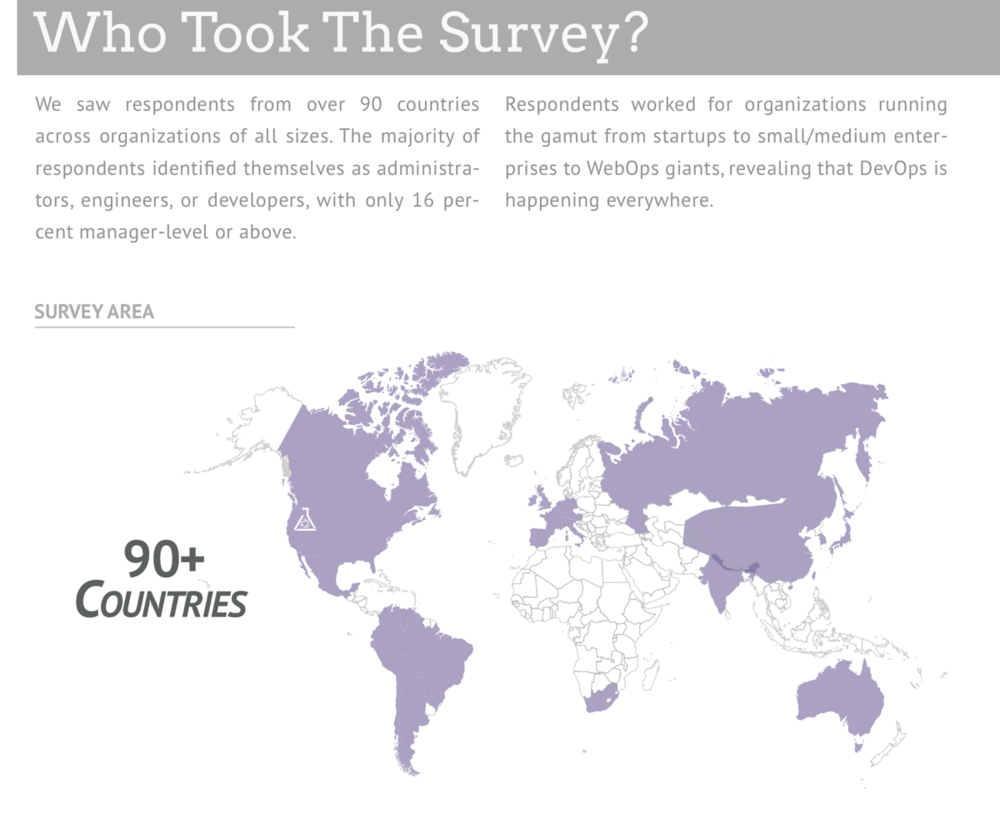
The survey was quite broad in 90 countries

NewImage

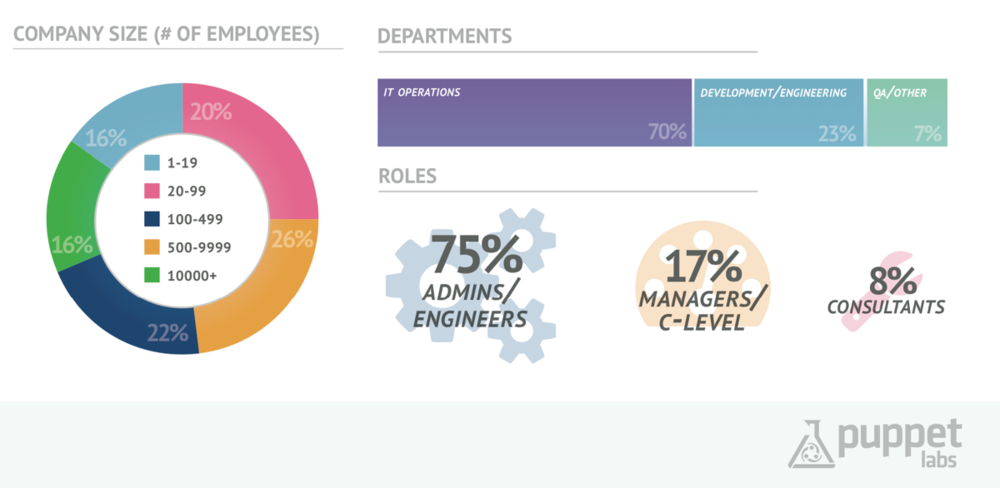
Mostly with IT operations.

NewImage