We've reached the limit of General Purpose Operating System

Linux is much more popular on Servers than Desktops.  Windows dominates the desktop and laptop OS as the market declines.  Android and iOS are the dominant mobile OS on tablets and phones.  The Internet of Things will have OSs in all the different devices from a wide range of suppliers.  It may have been a dream of OS focused executives to dominate with an OS across devices, but with device counts now reaching billions the General Purpose Operating System that created the opportunities for DOS, Windows, and Linux needed by customers has reached its limits.

The problem is the larger the market share the harder it is to develop and test new OS releases which slows down the overall hardware development.  No one will accept an OS that slows hardware development.

It was not too long ago when users would talk about running a version of Windows or Mac OS.  Smartphones and Tablets are with people more and people talk about the device brands more the OS brands.  The developer audience will talk about a version of the OS, but end users less and less.

Being an old OS guy working on Mac OS and Windows OS (I stopped working on desktop OS with Windows XP and moved to Windows Server 2003, then stopped completely) looking at OS development is still interesting, but I don't want to work on them full time any more.  Which in some ways gives a perspective to watch from afar.

The OS is simply part of the overall solution and not as important as it was.  The user interface is what people interact with not the low level OS which is hidden much to the frustration of those who want to create a general purpose operating system across all devices.  Linux on the server appeals to those who don't' want to be bothered with a user interface.  The servers is where there is still the battle for general purpose OS between Windows and Linux but there are much less people working on server OS than mobile OSs.

Steve Jobs never wrote code, who cares? his code would have probably sucked

Some things that get written up are random things that aren't an issue.  For example?  Steve Jobs didn't write code covered in Business Insider.

Steve Jobs Never Wrote Computer Code For Apple

Publicly answering an email over at his site, Apple co-founder Steve Wozniak goes into a few details on Steve Jobs's technical background.

"Steve didn't ever code," writes Wozniak. "He wasn't an engineer and he didn't do any original design, but he was technical enough to alter and change and add to other designs."

Why does the visionary CEO need to write code? To inspire the coders to write better code?  

Introvert-Friendly Career - Computer Programmer

Spending time alone with a computer could be a dream come true for any introverted techie. For them, life as a computer programmer might sound like a dream that could also pay the rent.

"From my understanding, computer programmers work by themselves, in the world of ideas," Anthony says. "That's more on the introverted side because introverts are more comfortable alone and like working on their own."


Apple products work because there is a huge amount of effort to hide the technical issues and just make things work.  Who cares if the code is beautiful if it doesn't solve an end user problem.

BTW the article got the introverted and extroverted pictures switched.  Here is the extrovert post.

Extrovert-Friendly Career - Computer Support Specialist

If you're a computer geek - sorry, computer aficionado - who isn't afraid of terms like face time and small talk, you might be hard-wired for a computer support specialist career.

"I think as a computer support specialist you have to feel comfortable interacting with people, unlike a computer programmer where you'll be working alone for long periods," Anthony says. "You'll want to make sure people are at ease so you can get information about their computer problems and then be effective in solving them."

Insight into Google Data Center Operations, Site Reliability Presentation at PuppetConf

I was at PuppetConf 2013 in SF for the first time and had a great time.  After the opening Keynote by Luke Kaines, was a presentation by Google Site Reliability Engineer, Gordon Rowell.

Google’s Corporate Engineering SRE team provides infrastructure services used by many of Google’s desktops, laptops and servers. This talk gives an overview of the design philosophy, challenges, technologies and some interesting failures seen while implementing infrastructure at scale.
Speakers

Gordon Rowell

Site Reliability Manager, Google
Gordon Rowell is a site reliability manager at Google, Sydney. His team focuses on delivering services to Googlers around the world. They have migrated major internal services to run on Google technology and are currently focused on removing dependencies on the corporate network. | He enjoys the challenges of building robust systems that scale and has a particular passion for configuration management. 

The presentation is here.

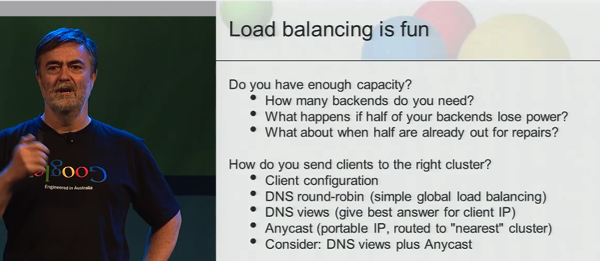
Key takeaways I saw are in these slides.

NewImage

NewImage

NewImage

NewImage

Here is someone who could design a kick ass DCIM system - Pat Helland Software Architect

One of my software buddies sent me a video link pumped that the presentation discussed the power of immutable distributed systems.  When I saw the presentation I saw it was by ex-Microsoft Software Architect Pat Helland.  In 2010, Pat moved to the Bing team to work on back end infrastructure to support the search environment.  

Last Fall, I switch to work on Bing Infrastructure and have been very, very busy (and having a wonderful time).  The projects I’m working on include COSMOS and Autopilot.  COSMOS is a petabyte store (working towards being an exabyte store) which runs over tens of thousands of inexpensive computers.  In addition to reliable storage, COSMOS supports Dryad based computation with application development in SCOPE which is a SQL-like language.  Some public papers include: SCOPE and COSMOS, and Partitioning and Parallel Plans in SCOPE and COSMOS.  The Autopilot team in OSD (Online Services Division which includes Bing) makes hardware selections for our ever-increasing bunch of servers, networking, systems support, automatic deployment and load balancing.  See  Autopilot.  I have been having a blast working with the team in Bellevue and a team in Beijing with lots of talented people.

FYI, Pat now works as a software architect at Salesforce and this video got me to reconnect to Pat through LinkedIn.

Pat is a guy who could definitely design a DCIM system.  Below is the presentation my developer friend got pumped about. I watched it too and agree Pat describes the ideas it takes to build a system for a complex data environments.

Warning this video can be hard to watch if you don't already think about software designs and believe immutability changes everything.  Other great points are "normalization is for sissies" and "accountants don't have erasers."

Immutability Changes Everything - Pat Helland, RICON2012 from Basho Technologies on Vimeo.

I hadn't chatted with Pat for probably 5 years to discuss data centers.  He was just getting started studying data centers, and he gave a presentation on green data centers in 2008.

Green Computing through Sharing
Reducing both Cost AND Carbon

Data centers consumed 1.5% of the total electricity in the US in 2006 and are on track to double as a percentage every five years. It is about 2% of the US total in 2008. Western Europe’s use is increasing at a slightly faster rate (from a slightly lower base percentage). The consumption of electicity within data centers is of significant financial and environmental importance.

Where the heck is all this power going? Why is the electrical load increasing so much? What can be done about it?

This talk will examine both traditional and emerging data center designs. We will start by examining how a data center is laid out, constructed, and managed. We will show two emerging trends: the change to designing data centers for the optimization of power and the emergence of new economies of scale in data centers which is contributing to the drive towards cloud computing. Microsoft is actively moving to compete in the space of cloud computing as we are seeing at the PDC (Professional Developers Conference) a few weeks before TechEd EMEA Developer.

Next, we will examine the sources of waste in the system today and examine why so many of our resources are underutilized. Because we are reluctant to share computing resources, they are left idle much of the time. Why is this currently the dominant choice? What can be done in the design of applications, systems, and data centers to make them more green (both carbon and cash)? What can developers do to make a difference?

It was a pleasure chatting with Pat 5 years ago, and I look forward to connecting with him again, and discuss how immutability changes everything.  :-)

Another IT Automation Tool gets funded - AnsibleWorks

3 weeks ago I was talking to an IT Operations friend and we were chatting about IT Automation Tools.  He said he used Ansible.  Why didn't he use PuppetLabs or Chef?  He runs servers in a remote secure environment and using SSH with no agents would work to drive automation.  Wandering around OSCON I talked to a few Ansibleworks staff and now GigaOm's Barb Darrow reports on the company being funded. 

AnsibleWorks gets $6M to open source IT automation


7 HOURS AGO

No Comments

ansibleworks
SUMMARY:

Ansible performs both configuration and deployment management across platforms and now has funding to expand its already impressive toehold.

Here is the elevator pitch.

The company’s sales pitch is that devops and systems administrators want something more “holistic” than Opscode Chef or Puppet Labs’ Puppet (see disclosure) configuration management tools to do their jobs. AnsibleWorks says it focuses both on up-front configuration management and the actual deployment itself.

In the same way that the data center industry is a small world.  The IT automation operations is a small one too.

DeHaan, who also spent time at Puppet, started work on Ansible 18 months ago and the company claims to have garnered more than 300,000 users since then, including Aerospike, AppDynamics, Basho Technologies, Care.com and Gawker Media. The first commercial version of the enterprise product, AWX, came online last month and is available free for use on up to 10 nodes.